


Is It Worth Having a Blog for My Business Website


Quick Answer: Does My Business Need a Blog
Yes — most businesses benefit from a blog, but only if you can commit to at least 2-4 posts a month for six months or longer. A blog that gets abandoned after three posts does more harm than having no blog at all. According to HubSpot's 2024 State of Marketing Report, businesses that blog consistently get 55% more website visitors than those that don't, and companies publishing 16+ posts a month see almost 3.5X more traffic than those publishing 0-4. Zentus & Co. has found the same pattern across client sites: a blog only starts moving search rankings and leads once it passes roughly 20-30 published posts, which typically takes 6-9 months at a realistic publishing pace.
Does your business need one specifically? If you sell a considered purchase (legal services, home renovation, B2B software, high-ticket retail), yes — a blog answers the research-phase questions that convert browsers into buyers. If you run a single-location, low-consideration business (a takeaway, a nail bar with mostly walk-ins), a blog matters far less than your Google Business Profile and reviews.
In this guide:
Whether blogging actually moves traffic, leads and sales for a business like yours
What blogging really costs in money and hours — DIY vs freelancer vs agency
The exact signs that tell you it's time to start (or skip) a blog
Which industries see the biggest return, and which barely benefit
The risk of starting and abandoning a blog — and how to avoid it
Every business owner asking "does my business need a blog" is really asking two separate questions: will it work for a business like mine, and can I actually keep it going. This guide answers both with real numbers, not generic marketing advice.
A Quick Reality Check Before You Read On
A stale, three-post blog is worse for your website than no blog at all. According to the Content Marketing Institute's 2025 B2B Benchmarks report, 73% of top-performing content marketers publish weekly or more — the businesses that see results are the ones that treat blogging as an ongoing channel, not a one-off task. In Wix Studio builds, we've seen the same 90-day pattern repeat: sites that publish four consistent posts a month start seeing measurable organic traffic lift by month three; sites that publish once and stop see zero lift and, occasionally, a small ranking dip because Google's freshness signals flag the page as abandoned.
Benefits of Blogging for Small Business
A business blog is not primarily a place to "sound expert." It's an SEO asset, a sales tool and a customer-service shortcut rolled into one page type. Here's what it actually does when it's run properly:
Ranks for questions your buyers are already typing into Google that your homepage and service pages can never rank for (a service page targets "wix web designer," a blog post targets "how much does a wix website cost")
Gives your sales team something to send instead of re-explaining the same answer every week
Builds topical authority so Google trusts your whole site more, not just the blog
Feeds your email and social channels with content instead of starting from a blank page every time
Captures long-tail, low-competition keywords your competitors haven't bothered writing about
What is the main benefit of a business blog?
The main benefit is capturing search traffic your core pages can't reach — the research-stage questions buyers ask before they're ready to contact you (cost questions, comparison questions, "how does X work" questions). A homepage sells; a blog answers, and answering is what earns the click from someone who isn't ready to buy yet but will be in 2-6 weeks.
Do customers actually read business blogs?
Yes — but selectively. According to Demand Metric, 70% of consumers say they'd rather learn about a company through articles than ads, and buyers in longer sales cycles (legal, B2B, home services, high-ticket retail) actively search for and read comparison and cost content before contacting anyone. Impulse-purchase businesses (fast food, convenience retail) see far lower blog readership because there's no research phase to serve.
How a Blog Boosts SEO Rankings
A blog boosts SEO by giving Google hundreds of extra pages to rank for long-tail keywords your service pages will never target. Your homepage might rank for "accounting firm Leeds" — but it will never rank for "how much does a small business accountant cost in the UK," because that's a different search intent entirely. A blog post can.
Zentus & Co. treats every blog post as a keyword-targeted landing page, not a diary entry — each post is built around one real, evidence-tagged search query, structured with headings that match how people actually phrase the question, and linked back into the commercial pages (services, pricing, contact) that convert.
Can a blog help my website rank higher on Google?
Yes. A blog gives Google new, keyword-specific pages to index and rank, which is the single biggest lever a small business has for ranking beyond its own brand name. Service pages target commercial intent ("hire a Wix designer"); blog posts target informational intent ("is Wix good for small business") — and informational searches vastly outnumber commercial ones for most industries.
How does blogging improve search engine visibility?
Blogging improves visibility by increasing the number of indexed pages, internal links and keyword-matched entry points on your domain. Each new post is a fresh opportunity to rank for a query, and each post links back to 3-5 other pages on your site, strengthening the whole site's internal link structure — a factor Google explicitly uses to understand page importance.
Do blogs help with local SEO rankings?
Yes, indirectly. Blog posts don't replace your Google Business Profile for local pack rankings, but they support local SEO by building topical relevance ("plumber Manchester cost guide"), earning backlinks from local directories and press, and giving you fresh, locally-worded content to share on social and Google Posts — all of which Google's local algorithm weighs. wix blog features for SEO and content marketing

Blog vs No Blog Website Traffic
Metric | Website with active blog | Website without a blog |
Average monthly organic visitors (small business site, 12 months in) | 800-3,500+ | 150-600 |
Indexed pages ranking for non-brand keywords | 20-100+ | 3-10 |
Content shareable on social/email | High — new asset weekly/monthly | Low — same 5 pages recycled |
Time to see measurable lift | 3-9 months of consistent publishing | N/A |
A quotable finding: businesses publishing consistently see 55% more website visitors than non-blogging competitors (HubSpot, 2024) — but that gap only opens up after roughly six months of publishing, not six weeks.
What happens to traffic if I never blog?
Your traffic stays flat and dependent almost entirely on brand-name searches, paid ads and referrals — because your service pages can only rank for a small handful of commercial keywords. Without a blog, you're invisible for the dozens of research-stage questions your buyers type into Google every month, and every one of those searches goes to a competitor who did write the answer.
Signs You Need a Business Blog
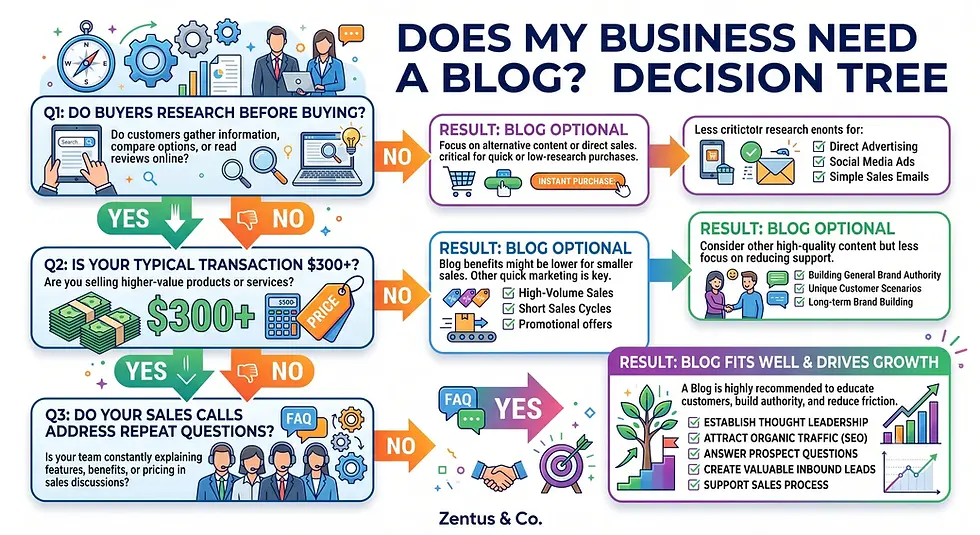
You probably need a blog if you tick 3 or more of these:
☑ Your buyers research before they contact you (quote comparisons, "how does X work," cost questions)☑ Your sales team answers the same 5-10 questions on every call☑ Competitors in your space are ranking for informational keywords you're not☑ Your website only ranks for your brand name, not your services☑ You sell a considered purchase (£500+ or a multi-week decision)☑ You already have expertise worth sharing but nowhere on-site to put it
If you tick 0-2, a blog is optional — your budget is better spent on your Google Business Profile, reviews and a strong service page.
What makes a business blog post successful?
A successful post answers one real, specific search query completely in the first 100 words, uses the searcher's own phrasing in the heading, includes exact numbers rather than vague claims, and links to a commercial page for the reader who's ready to act. Posts that ramble across five topics or bury the answer under 400 words of introduction rarely rank or convert.

Industries That Benefit Most From Blogging
Industry | Blogging value | Why |
B2B / SaaS / professional services | Very high | Long, research-heavy sales cycle; buyers Google everything first |
Home services (renovation, roofing, HVAC) | Very high | High-ticket, comparison-shopped, cost questions dominate search |
Legal & financial services | High | Trust-building content is a major conversion factor |
E-commerce | Medium-high | Buying guides and comparisons drive pre-purchase search traffic |
Salons, spas, wellness | Medium | Some research value (treatment guides); mostly local-pack driven |
Restaurants, cafes, takeaways | Low | Near-zero research phase; Google Business Profile matters far more |
Retail with mostly walk-in/impulse buyers | Low | Decision happens in-store or on-map, not via search research |
What industries benefit most from having a blog?
B2B, professional services and high-ticket home services benefit most from blogging, because their buyers go through a research phase before contacting anyone — a blog captures that research traffic. Low-consideration, impulse-purchase businesses see far smaller returns because there's little to research before buying.
Does a restaurant website need a blog?
Rarely as a priority. Restaurant customers decide based on location, reviews, menu and photos — not blog posts — so budget is better spent on Google Business Profile optimisation and photography. A restaurant blog can help for very specific goals (event bookings, catering, seasonal menu launches), but it's a "nice to have," not a "need."
Does an e-commerce store need a blog?
Usually yes, for buying-guide and comparison content. E-commerce blogs perform well when they answer pre-purchase questions ("best [product] for [use case]," "how to choose a [product]") that then link directly to product pages. A blog with no clear path to a product page wastes the traffic it earns.
Do service-based businesses need a blog?
Yes, especially for higher-ticket or considered services. A service business's blog does the job a salesperson would otherwise spend hours doing — answering cost questions, explaining the process, and building trust before the first phone call. In Wix Studio builds for service businesses, the blog is often the single highest-traffic section of the entire site within a year.

How Often Should You Blog
Post consistently — 2-4 times a month is the realistic minimum that produces results, and consistency beats volume. According to HubSpot (2024), companies publishing 16+ posts a month get almost 3.5X more traffic than those publishing 0-4 — but for most small businesses, 4 solid posts a month sustained for a year outperforms 16 rushed posts published once and abandoned. SEO strategies built for small business
Publishing frequency | Realistic outcome |
1 post, then stop | No measurable SEO benefit; can look abandoned to Google and readers |
1-2 posts/month, consistent | Slow, steady growth — visible after 9-12 months |
4 posts/month, consistent | Solid growth — visible after 4-6 months; realistic target for most small businesses |
8-16+ posts/month | Fast growth — usually requires a dedicated writer or agency retainer |
How many blog posts should a small business publish monthly?
Most small businesses should aim for 4 posts a month as a sustainable baseline — enough to build topical authority within 6-9 months without needing a full-time writer. Fewer than 2 a month rarely produces a visible SEO effect; more than 8 a month usually requires outsourcing to stay sustainable.
Is it better to blog weekly or monthly?
Weekly (4/month) is better than monthly if you can sustain it — consistency and volume both matter to Google's freshness and topical-depth signals. But a realistic monthly cadence kept up for two years beats a weekly schedule that collapses after six weeks. Match frequency to what you can actually maintain.
How often should a small business update its blog?
Publish new posts on a fixed schedule (weekly or monthly) and revisit old posts every 6-12 months to update prices, stats and outdated information. Google favours freshness on cost- and time-sensitive topics specifically, so a 2023 pricing post left unedited in 2026 can quietly lose rankings even without any change to the rest of the site.
Blogging Costs and Time Investment
Quotable stat: a professionally managed small-business blog costs $1,120-$2,980 a month with a remote content partner such as Zentus & Co. as of August 2026, compared with $1,200-$3,200 a month for a typical local agency retainer — roughly 6% lower for the same publishing volume and Wix-native SEO setup. our content & SEO services
Blog Cost-at-a-Glance
Route | Monthly cost | What you get | Best for |
DIY (you write it) | $0-$50 (tools/apps only) | 1-4 posts/month, your own time (4-8 hrs/post) | Solo founders with time, no budget |
Local freelance writer | $600-$1,600 | 2-4 posts/month, writing only (no SEO strategy) | Businesses wanting a single known contact |
Traditional local agency retainer | $1,200-$3,200 | 4-8 posts/month + basic SEO + reporting | Businesses bundling blog with local SEO/ads |
Remote content & SEO partner (Zentus & Co.) | $1,120-$2,980 (≈6% below local agency) | 4-8 posts/month, keyword-mapped, Wix-native SEO, image assets included | Businesses wanting agency quality without local overhead pricing |
DIY vs Freelancer vs Agency — 3-Year Total Cost
Route | Annual cost | 3-Year total | Time cost to you |
DIY | $0-$600 | $0-$1,800 | ~200-400 hours/year of your own time |
Local freelancer | $7,200-$19,200 | $21,600-$57,600 | Minimal (you review/approve only) |
Local agency retainer | $14,400-$38,400 | $43,200-$115,200 | Minimal |
Remote partner (Zentus & Co.) | $13,440-$35,760 | $40,320-$107,280 | Minimal |
Local writer/agency wins when you specifically want in-person strategy meetings or already have an existing local relationship. A remote partner wins when price matters, you want Wix-specific SEO expertise rather than generalist content, and you don't need face-to-face meetings to trust the output — which covers the majority of small businesses managing their blog remotely already through their website platform.
How much does it cost to run a business blog?
Running a business blog costs anywhere from $0 (writing it yourself) to $3,200+ a month for a full agency retainer, depending on volume and who writes it. Most small businesses land in the $600-$2,000/month range once they outsource even part of the process — writing, SEO strategy, or both.
Can I outsource my business blog writing?
Yes — this is the most common approach once a business grows past the founder-has-time-to-write stage. Options range from a single freelance writer ($80-$250 per post) to a full content-and-SEO retainer that handles keyword research, writing, images and publishing ($1,120-$3,200/month). Outsourcing writing alone is cheapest; outsourcing strategy too costs more but produces measurably better rankings.
How do I start a blog without a big budget?
Pick one real question your customers ask before buying (check your email/call history for repeated questions)
Write 500-800 words answering it directly, using your own words and one specific number or example
Add it to your Wix site's built-in blog feature — no extra tool or cost required
Repeat monthly, picking a new real question each time
Track it in Google Search Console (free) to see which posts start getting impressions
This costs $0 beyond your own time and is the realistic starting point for most bootstrapped businesses before graduating to a freelancer or partner.

Common Blogging Mistakes to Avoid
Publishing once and stopping — worse for SEO than never starting
Writing about your company instead of your customer's questions ("Our 10-Year Journey" vs "How Much Does X Cost")
No clear internal links from blog posts back to service/contact pages
Ignoring keyword research and guessing what people search for
Letting old posts go stale — outdated prices and stats quietly lose rankings
Treating the blog as a press release feed instead of an answer engine
What are common mistakes when starting a business blog?
The most common mistake is starting with company news instead of customer questions — "Why We Started This Business" ranks for nothing, while "How Much Does [Service] Cost in [Location]" ranks for real search volume. The second most common mistake is stopping after 2-3 posts, which wastes the setup effort entirely.
Can a blog replace social media marketing?
No — they serve different functions and work best together. A blog captures search-driven, evergreen traffic; social media drives immediate, short-lived engagement with your existing audience. The strongest small-business content strategy uses the blog as the source material and repurposes it into social posts, not the other way around.
Does Blogging Really Improve Sales
Quotable stat: according to Demand Metric, small businesses with an active blog see 126% more lead growth than those without one — but that lift depends entirely on the blog linking readers toward a next step (contact form, pricing page, booking link).
The Blog-to-Sales Path
Blog post (answers a research question) → internal link to service/pricing page → contact form or booking → sale. Every high-performing business blog is built around this funnel, not around traffic for its own sake. A blog with high traffic but no internal links to commercial pages produces reads, not revenue.
Does blogging really increase sales conversions?
Yes, but only when posts link directly to a commercial next step. A blog post that answers "how much does X cost" and then links to your pricing or contact page converts research-stage readers into leads. A blog with no calls-to-action or internal links produces traffic without sales — the content has to be built for conversion, not just for ranking.
How do I measure blog ROI for my business?
Track three numbers in Google Search Console and your CRM: organic clicks to blog posts, contact-form submissions attributed to blog referral pages, and time-to-close for leads that arrived via a blog post. Most businesses see blog-driven leads take 3-6 months to appear after publishing starts, so measure ROI over a 6-12 month window, not week to week. turn blog traffic into online sales

When a Blog Fits Your Business Model
A blog fits your business if:
Your sale involves research — buyers compare, Google, and read before contacting you
Your ticket size is $300+ or the decision takes more than a single visit
You already answer the same questions repeatedly on calls or in DMs
You're competing against businesses that already blog and are winning informational searches you're not
Is blogging still effective for business in 2026?
Yes — arguably more effective than ever, because AI search tools (Google AI Overviews, ChatGPT, Perplexity) now pull answers directly from well-structured blog content rather than sending users to ten separate links. Zentus & Co. builds every post to be extraction-ready — a self-contained answer in the first 40-80 words of each section — specifically because AI engines now cite that structure directly.
What topics should a small business blog about?
Blog about the real questions your customers ask before buying: cost/pricing questions, "how does X work" process questions, comparison questions ("X vs Y"), and "is X worth it for [my situation]" decision questions. Avoid company-news topics — they rarely match any real search query and produce almost no organic traffic.
Is a blog worth it for a one-person business?
Yes, if you can sustain 1-2 posts a month, even at a slower pace. A one-person business doesn't need volume — it needs consistency and specificity. A solo consultant writing one detailed, well-researched post a month for a year builds more search visibility than a company publishing ten rushed posts and quitting after two months.
What Happens If You Skip Blogging
Skipping a blog isn't automatically wrong — for low-consideration, walk-in businesses it can be the right call. But for research-driven businesses, skipping a blog means:
You never rank for informational, research-stage keywords — only brand-name searches
Your competitors who do blog capture that traffic instead
Your sales team keeps answering the same questions manually, one prospect at a time, instead of a page doing it for them
How long does it take to see blog results?
Most businesses see the first measurable traffic lift after 3-6 months of consistent publishing, and meaningful lead volume after 6-12 months. This is why abandoning a blog after 2-3 posts produces zero return — the timeline requires sustained publishing before Google has enough signal to rank the content.
Should every business page link to the blog?
Not every page, but your homepage and relevant service pages should link to at least one or two relevant blog posts. This spreads authority into the blog and gives visitors a natural path to the research content that builds trust before they contact you.
The Risk of Letting Your Blog Go Stale
A stale blog is a liability, not a neutral asset. Once you start publishing, stopping sends a signal — to both readers and Google's freshness algorithms — that the business may no longer be active or reliable, especially on time-sensitive topics like pricing.
Time since last post | Typical effect |
0-3 months | No visible impact |
3-6 months | Slight ranking softness on cost/time-sensitive posts |
6-12 months | Noticeable traffic decline on outdated posts; visitor trust drops when prices look old |
12+ months | Blog reads as abandoned; competitors' fresher content overtakes rankings |
What happens if I stop updating my blog?
Older posts — especially ones with prices, dates or "in [year]" phrasing — quietly lose rankings as they age, because Google favours freshness on time-sensitive queries. Traffic decline is gradual, not sudden, which is why many businesses don't notice the drop until months after they stopped publishing.
Can an outdated blog hurt my website's reputation?
Yes — a visitor who lands on a post with 2023 pricing or "coming this year" language in 2026 loses trust in the business immediately, even if the rest of the site is current. An outdated blog can do more reputational damage than having no blog section at all.

Hidden Costs of Running a Business Blog
Most blogging quotes and DIY plans leave out:
Stock imagery or custom graphics — $0-$50 per image if licensed, or included in an agency retainer
SEO tools subscription (keyword research, rank tracking) — $0-$130/month if managed independently
Editing and proofreading — often bundled with freelancer/agency fees, but a real cost if DIY
Updating old posts every 6-12 months for freshness — 1-2 hours per post, easy to forget and rarely quoted
Internal linking maintenance as new posts are added — small but ongoing task
Promotion/distribution (email, social repurposing) — time or tool cost not included in most "blog writing" quotes
Prices based on August 2026 — verify current freelancer, agency and Wix pricing before you commit.
Who This Is Best For
A business blog is best for:
Service businesses with a research-driven sales cycle (consultants, agencies, home services, legal, financial)
E-commerce stores selling considered purchases that benefit from buying guides
Businesses already answering the same questions repeatedly on sales calls
Founders or teams who can commit to at least 6-12 months of consistent publishing
A blog is a lower priority for:
Low-consideration, walk-in or impulse-purchase businesses (fast food, convenience retail)
Businesses without the budget or time to sustain 2-4 posts a month for 6+ months
FAQ: Business Blogging Questions Answered
How much does it cost to add a blog to a website?
Adding a blog to an existing website is free on most platforms, including Wix — the blogging feature is built into the platform. The real cost isn't setup; it's ongoing content production, which ranges from $0 (DIY) to $3,200+/month (full agency retainer), depending on who writes it and how often.
Is a business blog worth the ongoing cost?
Yes, for research-driven businesses — the ROI shows up as organic leads that would otherwise cost money via ads. According to Demand Metric, small businesses with an active blog see 126% more lead growth than those without, which typically outweighs a $600-$2,000/month content investment within 6-12 months.
Can I add a blog to my Wix website?
Yes — Wix has a built-in blog feature available on all standard plans, with no separate app or plugin required. You can publish posts, add categories, manage SEO settings and connect it to your site's navigation directly from the Wix dashboard.
Does Wix have built-in blogging tools?
Yes. Wix's native blog app includes SEO fields (title tag, meta description, URL slug), categories, tags, related-post widgets and RSS feeds — all the core tools a small business needs to run a blog without a third-party plugin.
Should a new business start with a blog or wait?
Wait until your core pages (homepage, services, contact) are solid — a blog on top of a weak core site wastes traffic. Once your main pages convert well, add the blog to capture research-stage traffic your core pages can't reach.
Is a blog necessary for a small local business?
Not always. A local business with mostly walk-in, low-consideration customers (a cafe, a convenience store) gets far more return from Google Business Profile and reviews than from a blog. A local business with considered-purchase services (a solicitor, a renovation contractor) benefits significantly from one.
Should I write my own blog posts or hire a writer?
Write it yourself if you have the time and can produce 500-800 words monthly; hire a writer once quality, consistency or volume becomes the bottleneck. Many businesses start DIY and move to a freelancer or agency once the blog proves its value.
Does a law firm website need a blog?
Yes — legal services are one of the highest-value blogging categories, because prospective clients research extensively before contacting a firm. Cost, process and "what happens if" content builds trust and captures research-stage search traffic that a static service page cannot.
Does a salon or spa website need a blog?
It's optional but moderately useful. Salons and spas get more value from local SEO and reviews than from blogging, but treatment-guide content ("how long does a balayage last") can capture useful research traffic and support local search relevance.
Do UK small businesses need a blog to compete locally?
A blog helps but isn't the primary local-ranking factor — Google Business Profile, reviews and NAP consistency matter more for the local map pack. A blog supports local SEO indirectly by building topical authority and earning shares/backlinks, making it a secondary rather than primary tool for UK local competition.
What is a business blog used for?
A business blog is used to capture research-stage search traffic, answer common customer questions at scale, and build topical authority that supports rankings across the whole site — it functions as both a marketing channel and a customer-service tool.
What's the difference between a blog and a news page?
A blog answers evergreen search queries your customers type into Google; a news page announces company updates (launches, awards, hires) with little to no search demand. A blog is built for traffic; a news page is built for transparency and PR — most small businesses need the former far more than the latter.
Conclusion: So, Does Your Business Need a Blog?
If your customers research before they buy, yes — a blog is one of the highest-leverage, lowest-cost marketing assets available to a small business. If your business is walk-in and low-consideration, a blog is optional, and your budget is better spent elsewhere. Either way, the decision that matters most isn't whether to start — it's whether you can sustain 2-4 posts a month for 6-12 months, because a stale blog does more damage than no blog at all.
Not sure if your website is blog-ready? Zentus & Co. offers a Free Website Audit that tells you exactly where your site stands and whether a blog would move the needle for your specific business — get your free audit here.


Comments