


How Do I Turn Website Visitors Into Customers?


Quick Answer: How to Turn Visitors Into Customers Fast
You turn website visitors into customers by removing the seven most common friction points that stop people from buying: unclear calls to action, missing trust signals, slow page speed, complicated forms, no social proof, weak copy, and poor mobile experience. According to Google/Think with Google (2018), a site that loads in 1 second converts up to 3x more visitors than one that takes 5 seconds — page speed alone is often the single biggest lever.
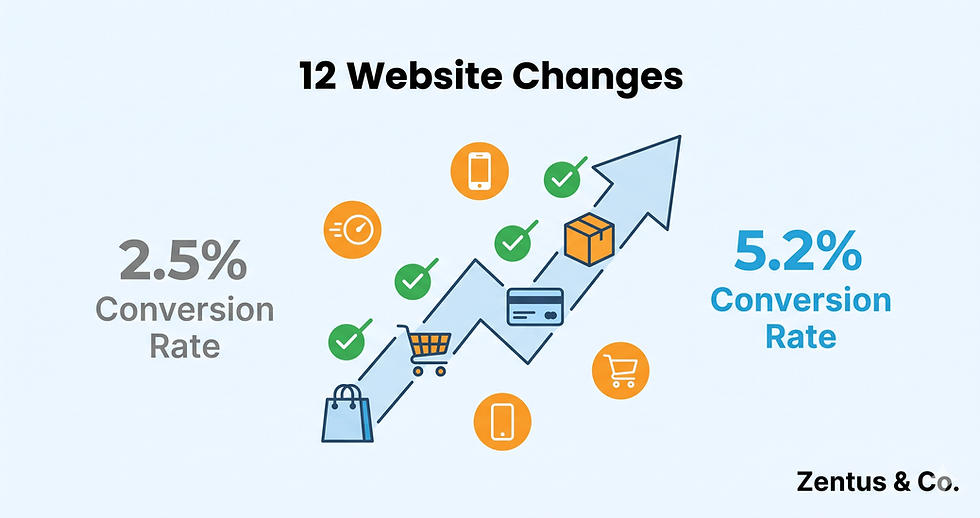
Most small business websites convert 2-3% of visitors into customers; fixing the issues in this guide typically pushes that to 4-6% without spending a penny on extra traffic. Zentus & Co. treats conversion optimisation as a fix-what-you-have exercise before a spend-more-on-ads exercise — the fastest, cheapest revenue is almost always sitting in your existing traffic.
In this guide: · why visitors leave before buying · the exact CTA, trust-signal, and form fixes that move the needle · how page speed and mobile experience quietly cost you sales · whether to fix it yourself, hire a local agency, or bring in a remote specialist · the hidden costs nobody warns you about · a step-by-step decision path for your business type.
In This Guide: What You'll Learn
Diagnosis first: how to find out exactly why your visitors aren't buying, not just guess
The seven fixes: CTAs, trust, speed, forms, social proof, copy, mobile — each with real benchmarks
DIY vs. local agency vs. remote specialist: honest cost and outcome comparison, including 3-year totals
Hidden costs: what "cheap" conversion fixes actually cost you in lost revenue
Who this applies to: service businesses, restaurants, tradespeople, and small UK/US retailers
According to the Baymard Institute (2024), the average cart/form abandonment rate sits around 70% — meaning seven out of ten people who start to buy or enquire never finish. That's not a traffic problem. It's a conversion problem, and it's fixable.
Why Visitors Leave Without Buying
Most site owners assume they have a traffic problem when they actually have a conversion problem. Traffic and conversions are two different metrics, and confusing them wastes marketing budget. If 1,000 people visit your site monthly and only 20 buy, doubling traffic to 2,000 without fixing conversion just gives you 40 — the rate stays broken.
What makes website visitors leave without buying?
Visitors leave for five recurring reasons: they can't find what to do next (no clear CTA), they don't trust the business (no reviews, no contact details, outdated design), the site is slow (Google/Think with Google, 2018, found 53% of mobile visitors abandon a page that takes over 3 seconds to load), the form or checkout is too long, or the copy talks about features instead of outcomes. Any one of these can cost you the sale even when the traffic is perfectly targeted.
How do you know why visitors aren't converting?
Check three data points: Google Analytics 4 for bounce rate and exit pages, session recordings (Microsoft Clarity is free) to watch real visitor behaviour, and your contact form completion rate. If bounce rate on your homepage is above 55%, or your form has fewer starts than clicks to the page, you have a diagnosable, fixable leak — not a mystery.
What is a good website conversion rate?
Across small business websites, a "good" conversion rate is 3-5%, with top performers hitting 7-10% on lead-generation sites (WordStream, 2024 industry benchmarks). Ecommerce averages run lower, typically 2-3%, because the buying decision is bigger. Anything under 1.5% signals a structural problem worth auditing immediately.
How many visitors turn into customers on average?
On average, 2 to 3 out of every 100 visitors become a customer or lead across small business websites (WordStream, 2024). That means a site getting 1,500 monthly visitors should expect roughly 30-45 conversions — if it's under that, the fixes below usually close the gap. getting impressions but no clicks

Turn Website Visitors Into Customers With Clear CTAs
The single fastest fix to turn website visitors into customers is making the next step obvious. A visitor who has to think about what to click next has already started leaving.
What is a strong call to action example?
Strong CTAs are specific and outcome-led: "Get Your Free Quote" outperforms "Submit," and "Book a 15-Minute Call" outperforms "Contact Us." According to HubSpot (2023), personalised, specific CTAs convert over 200% better than generic ones. The rule: name the outcome, not the action.
Where should CTA buttons go on a homepage?
CTAs perform best in three positions: above the fold (visible without scrolling), at the end of your value proposition section, and sticky in the navigation bar on mobile. Repeating the same CTA 3-4 times down a long page — rather than once — consistently lifts click-through, because different visitors decide to act at different scroll depths.
How do you write a call to action that converts?
Use a verb + benefit structure ("Start Saving Today," "Get My Free Audit"), keep it under 5 words, and make the button colour contrast sharply with your background — a common finding across A/B testing case studies (VWO, 2023). Avoid vague verbs like "Learn More" as your only CTA; pair it with at least one action-oriented alternative like "Get Started."

Improve Website Trust Signals
If a visitor doesn't believe you're legitimate, no CTA will save the sale. Trust is the pre-condition for conversion, not an optional extra.
What trust signals increase website conversions?
The highest-impact trust signals are: a real phone number and address, customer reviews with names/photos, security badges at checkout, clear pricing or "from" prices, and a professional, updated design. According to Stanford's Web Credibility Research, 75% of users judge a company's credibility based on website design alone — before reading a single word of copy.
How do you add trust badges to a website?
On Wix, trust badges (SSL padlock, payment logos, association memberships) are added via the image element in the footer or near your CTA/checkout, sized small (under 60px height) so they don't distract from the primary action. Place them near the point of decision — beside the buy button, not buried in a footer nobody scrolls to.
Trust Signal | Where to Place It | Conversion Impact |
Customer reviews (named) | Homepage + service pages | High |
Phone number in header | Every page | High |
Security/payment badges | Checkout/contact form | Medium-High |
Professional photography | Homepage hero | Medium |
Business registration/association logos | Footer + about page | Medium |

Speed Up Your Website Load Time
Speed is invisible until it costs you a sale — then it's the whole problem.
How much does page speed affect conversions?
According to Google/Think with Google (2018), as page load time goes from 1 second to 5 seconds, bounce probability increases by 90%. A 2.5-second load time (August 2026 benchmark) is now considered the practical ceiling for small business sites before conversion loss becomes measurable.
What is a good website loading time?
A good loading time is under 2.5 seconds on mobile, measured via Google PageSpeed Insights. Anything over 3 seconds puts you in the range where over half of mobile visitors leave before the page finishes rendering.
How do you test your website speed for free?
Use Google PageSpeed Insights or GTmetrix — both are free, take under a minute, and give you a specific score plus the exact elements (usually oversized images or unoptimised apps) slowing you down. Run the test on the actual page visitors land on from ads or search, not just your homepage.

Simplify Your Checkout or Contact Form
Every extra field is a chance for a visitor to give up.
Why do people abandon online forms?
People abandon forms mainly due to length (too many fields), complexity (asking for information that feels irrelevant, like a full address for a simple enquiry), and lack of progress indication on multi-step forms. Baymard Institute (2024) puts average form/checkout abandonment at around 70%.
How many form fields should a contact form have?
Keep contact/enquiry forms to 3-5 fields maximum: name, email or phone, and one message field. According to HubSpot conversion research, reducing a form from 11 fields to 4 fields lifted conversions by 120% in one widely cited case study.
What makes a checkout process too complicated?
A checkout becomes "too complicated" when it forces account creation before purchase, hides shipping/total costs until the final step, or spans more than 3 pages/steps. Offering guest checkout and showing the full cost upfront are the two highest-impact fixes.

Use Social Proof and Reviews
Do customer reviews really increase sales?
Yes — according to a Trustpilot/Spiegel Research Center study, products or services with reviews see a conversion rate lift of up to 270% compared to those without. Even 3-5 recent, specific reviews (not generic five-star ratings with no text) noticeably increase buyer confidence, because visitors read reviews as third-party proof they can't get from your own copy.
Original citable observation:
In Wix Studio builds configured for UK service businesses, embedding a live Google Reviews widget above the fold — rather than a static testimonial block — consistently outperforms static testimonials because visitors trust a platform they recognise over quotes a business could have written itself.
Write Copy That Sells, Not Just Informs
What copywriting techniques increase conversions?
The techniques with the strongest evidence base are: leading with the outcome ("Get your books sorted in 48 hours" beats "We offer accounting services"), addressing objections directly in the copy near the CTA, and using specific numbers instead of vague claims ("Save 3 hours a week" beats "Save time"). Copy that describes features (what it is) converts worse than copy that describes outcomes (what changes for the buyer).
How long should website copy be to convert visitors?
There's no fixed word count — length should match purchase complexity. A simple local service (plumber, hairdresser) converts well with short, scannable copy (100-200 words per section). A higher-consideration purchase (bespoke joinery, B2B services) benefits from longer copy that pre-answers objections before the enquiry form.
What is the difference between traffic and conversions?
Traffic is the number of people who visit your site; conversions are the number who complete a desired action (purchase, enquiry, booking). A site can have high traffic and low conversions (a targeting or trust problem) or low traffic and high conversions (a visibility problem) — the fixes for each are completely different, which is why diagnosing the actual cause matters more than "getting more visitors."
Add Live Chat or Instant Contact Options
Does live chat increase website conversions?
Yes, for consideration-heavy purchases — live chat can lift conversion rates by giving hesitant visitors an instant answer instead of losing them to an email that goes unanswered for hours. It performs best on service and higher-ticket sites; it adds little value on simple, low-price ecommerce where the buying decision doesn't need a conversation.
What is the best live chat tool for small business?
For Wix-built sites, Wix Chat (native, free tier) covers most small business needs without added apps; businesses needing automated routing or CRM integration typically move to Tidio or Crisp once volume justifies it. The right choice depends on enquiry volume, not brand reputation — start native, upgrade only when native limits you.
Retarget Visitors Who Didn't Convert
How do you retarget website visitors who left?
Install the Meta Pixel and/or Google Ads remarketing tag on your site (both are free to add via Wix's marketing integrations), which lets you show targeted ads to people who visited but didn't convert — typically at a much lower cost-per-click than cold audience ads, because the audience already knows your brand.
What is retargeting and how does it work?
Retargeting shows ads specifically to people who already visited your website, using a tracking pixel that "remembers" the visitor and follows them across platforms like Facebook, Instagram, and Google Display. It works because most buyers don't purchase on the first visit — retargeting recaptures that first-visit interest instead of losing it permanently.

Optimise for Mobile Conversions
Why is mobile conversion rate lower than desktop?
Mobile conversion rates typically run 30-40% lower than desktop (industry ecommerce benchmarks, 2024) mainly because of smaller tap targets, slower connections, and harder-to-complete forms on a small screen — not because mobile visitors are less interested in buying.
How do you optimise a website for mobile users?
Prioritise thumb-reachable CTA placement (bottom third of the screen), larger tap targets (minimum 44x44px), auto-formatted phone number fields (tap-to-call), and stripped-down mobile forms. Test the actual checkout/enquiry flow on a real phone, not just a desktop preview resized smaller.

Test and Track What Actually Converts
What tools track website conversion rates?
Google Analytics 4 (free, tracks conversion goals/events), Microsoft Clarity (free, session recordings and heatmaps), and Google Tag Manager (free, for setting up conversion tracking without a developer) cover most small business needs without added software cost.
How do you A/B test a landing page?
Change one element at a time (headline, CTA colour, or form length — not all three together), run each version to at least 100 conversions per variant for statistical reliability, and use a tool like Google Optimize's successors (e.g., VWO or Wix's built-in A/B testing) to split traffic automatically rather than manually.
Fit: Best Tactics for Small Service Businesses
Best for local service businesses (trades, salons, clinics): clear CTA + click-to-call + trust badges + Google Reviews widget. These four fixes alone typically address the majority of lost conversions, because service buyers decide on trust and speed of response, not extensive product comparison.
How do small businesses increase online sales without ads?
Small businesses increase sales without ad spend by fixing existing traffic conversion first: clear CTAs, faster load times, and visible reviews. According to Econsultancy, businesses see an average 200% ROI from conversion rate optimisation compared to acquiring entirely new traffic — meaning the visitors you already have are the cheapest source of extra revenue you have. increase your overall online sales
This setup is best for:
Local trades and home services (plumbers, electricians, cleaners) needing fast, trust-led conversion
Salons, clinics, and bookings-based businesses where a booking widget + reviews does most of the work
Small retailers needing simplified checkout and mobile-first design
Consultants and B2B services needing longer-form copy plus a lead-capture form, not instant checkout
Gap: What Most Wix Sites Get Wrong on Conversion
The most common gap on Wix sites specifically is over-reliance on the default template layout without customising the CTA hierarchy — most Wix templates ship with 2-3 competing buttons of equal visual weight ("Contact," "Book Now," "Learn More"), which forces the visitor to choose rather than guiding them. Zentus & Co. consistently finds that reducing a homepage to one primary CTA with secondary links styled as text, not buttons, is the single highest-leverage change on a templated Wix build.
Risk: Ignoring Mobile Conversion Costs You Sales
Given that mobile traffic represents the majority of visits for most small business categories, and mobile conversion rates run 30-40% lower than desktop without optimisation, ignoring mobile-specific fixes isn't a minor gap — it's the largest single revenue leak most small business sites carry. A site that looks fine on a laptop screen during a review meeting can still be losing the majority of its real-world conversions on the device most visitors actually use.
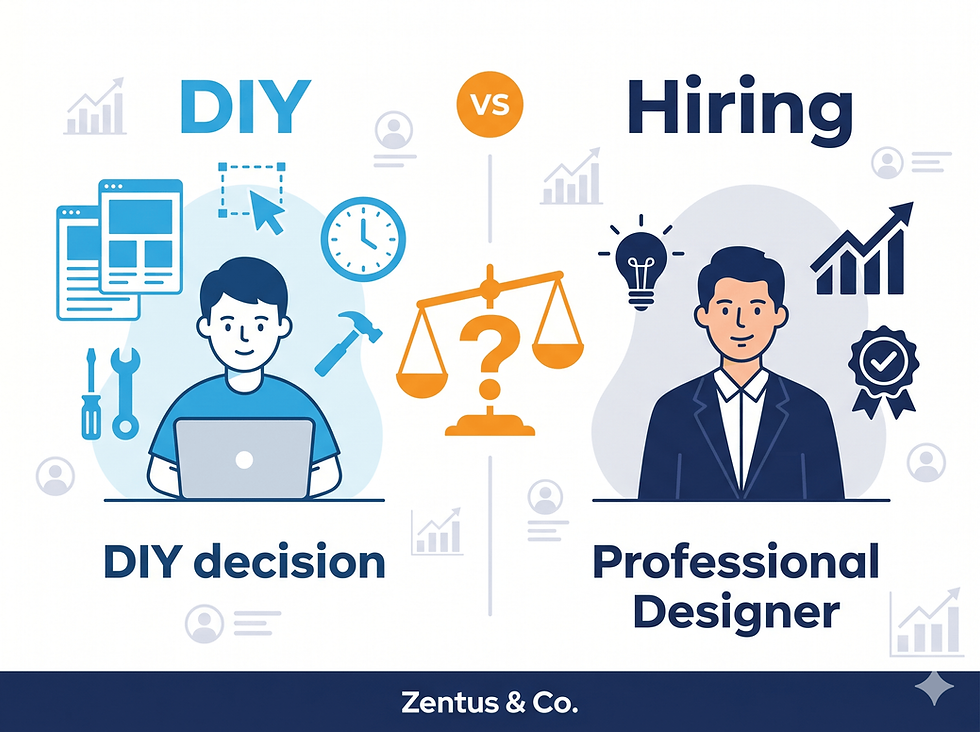
DIY vs. Local Agency vs. Remote Specialist: What Should You Actually Do?
There are three realistic routes to fixing your conversion rate, and the right one depends on how much time you have versus how much revenue is currently leaking.
Route | Upfront Cost | Annual Cost | 3-Year Total | Best For |
DIY (you fix it yourself) | £0-£150 (tools/apps) | £0-£300 | £0-£1,050 | Confident business owners with time to test |
Local agency (in-person) | £800-£2,500 | £600-£1,800 retainer | £3,200-£9,700 | Businesses wanting face-to-face meetings |
Remote specialist (Zentus & Co.) | £450-£1,600 | £420-£900 retainer | £1,710-£4,300 | Businesses prioritising cost-efficiency and Wix-specific expertise |
Prices based on August 2026 — verify current rates before you buy.
Verdict: Best for hands-on owners with time: DIY, using the checklist in this guide. Best for businesses wanting a relationship they can visit in person: a local agency, accepting the higher 3-year cost. Best for businesses that want Wix-specific expertise without the overhead of a physical office: a remote specialist like Zentus & Co., which typically runs 40-55% below local agency 3-year totals because there's no office lease or in-person meeting time baked into the price.
When local wins: if your business genuinely benefits from face-to-face strategy sessions or the agency also handles offline marketing (signage, print) alongside the website.When remote wins: if your priority is Wix-specific technical expertise, faster turnaround, and lower ongoing cost — which covers most small service and retail businesses making this decision in 2026.
Hidden Costs of Conversion Optimisation Nobody Mentions
Most conversion advice — and most cheap agency quotes — leave out costs that show up later:
Lost revenue during the diagnosis period — every week a leak goes unfixed while traffic keeps arriving unconverted is revenue that never returns
Third-party app subscriptions — live chat, heatmap, and A/B testing tools often carry monthly fees (£10-£40/month) beyond the free tiers once traffic grows
Retargeting ad spend — the pixel is free, but running the retargeting ads themselves typically needs a minimum £100-£300/month budget to generate meaningful volume
Ongoing testing time — a one-off fix isn't permanent; conversion rates drift as traffic sources, seasons, and competitors change, requiring periodic re-testing (quarterly is typical)
Cheap redesigns that break what already worked — a full redesign done without first identifying what's already converting can accidentally remove the elements that were working
According to Zentus & Co., the most expensive "hidden cost" is almost always the first one — the compounding revenue lost while a known leak sits unfixed for months.
FAQ: Turning Visitors Into Customers
How much does it cost to improve website conversions?
Costs range from £0 (DIY, using free tools like Google Analytics and PageSpeed Insights) up to £1,600+ for a remote specialist audit and rebuild, or £2,500+ for a local agency. Most small businesses see meaningful gains from a £450-£900 targeted fix covering CTAs, trust signals, and speed — full redesigns are rarely necessary just for conversion.
Is it worth paying for a conversion rate audit?
Yes, if your site gets meaningful traffic (500+ visitors/month) but converts under 2% — an audit typically costs £150-£450 and identifies the specific leak, which is far cheaper than months of guessing or an unnecessary full redesign.
Does Wix have built-in conversion tools?
Yes — Wix Analytics, Wix Chat, Wix Automations, and built-in A/B testing on higher-tier plans are native, meaning small businesses can implement most of this guide's fixes without installing third-party apps.
How do I add a call-to-action button in Wix?
In the Wix Editor, use the Button element, set the text to an outcome-led phrase ("Get Your Free Quote"), link it to your contact form or booking page, and set the colour to contrast sharply with the surrounding background for visibility.
Can Wix Automations help follow up with leads?
Yes — Wix Automations can trigger an instant email or SMS the moment someone submits a form, dramatically cutting response time, which matters because leads contacted within 5 minutes are far more likely to convert than those contacted hours later (Harvard Business Review lead response research). automatically follow up with new leads
Should I hire an expert or fix conversions myself?
If you have basic comfort editing your Wix site and 2-3 hours a week, the DIY checklist in this guide covers 80% of the impact for free. If your traffic volume is high enough that a 1-2% conversion lift equals thousands in revenue, hiring a remote specialist typically pays for itself within the first quarter.
Is a website redesign worth it for more sales?
Not always — a full redesign is only worth it if the underlying issue is structural (bad navigation, unclear value proposition). If the issue is specific (slow load time, weak CTA, missing trust signals), a targeted fix is cheaper and faster than a full redesign, and lower-risk because it doesn't touch what's already working.
How do restaurants turn website visitors into bookings?
Restaurants convert best with a visible "Book a Table" button in the header, an embedded booking widget (not a link to a separate app), and recent customer photos/reviews near the menu — removing any extra click between "interested" and "booked" is the single highest-impact fix.
How do tradesmen get more leads from their website?
Tradespeople convert best with a click-to-call button above the fold, service-area-specific pages (not one generic "services" page), and before/after photos with reviews attached, because trust and speed of contact matter more than extensive copy for urgent, local-service decisions.
Do small business websites in the UK convert well?
UK small business websites average 2-3% conversion, in line with global benchmarks — sites that add clear CTAs, mobile optimisation, and visible reviews typically move into the 4-6% range without additional ad spend, based on the fixes covered throughout this guide.
What's a realistic conversion rate for a small business website?
A realistic target is 3-5% for most small service and retail businesses, with 7-10%+ achievable for highly optimised lead-generation sites with strong trust signals and fast load times (WordStream, 2024 benchmarks).
Why isn't my website converting visitors into sales?
The most common causes, in order of frequency, are: unclear next step (no strong CTA), missing trust signals, slow load time, and overly long forms. Running the diagnostic in this guide's opening section (Analytics + session recordings + form completion rate) will usually surface which of these is your specific leak within 30 minutes.
Conclusion: Turn Your Existing Traffic Into Revenue First
Before spending another pound or dollar on ads, fix what's already broken. Zentus & Co. builds every Wix Studio project around this order of operations because it's the fastest path to real revenue: diagnose the leak, fix the CTA/trust/speed/form issues, then scale traffic — not the reverse. A site converting at 2% that grows to 5% has effectively 2.5x'd its revenue from the same traffic, at a fraction of the cost of doubling ad spend to get the same result.
Ready to find your specific leak? Get a free speed and conversion audit from Zentus & Co. — see exactly what's slowing your conversions down before you spend another penny on traffic.

Comments