


Wix vs Etsy for Makers: The Real Fee Math


Wix vs Etsy: Quick Fee-Stacking Verdict
Most makers think Etsy "takes 6.5%." It doesn't stop there. Etsy stacks a listing fee, a transaction fee, a payment processing fee, and — for most active sellers — a mandatory offsite ads fee on top. Once you add those together, a single sale can lose 15–22% of its value before you've paid for materials.
Etsy's real per-sale cost is 10–22%, not 6.5%, once offsite ads apply
An owned Wix store's real per-sale cost is roughly 3%, just payment processing
Etsy still wins on discovery — it has built-in buyer traffic a new store doesn't
Wix wins on ownership — your customer data, your email list, your SEO
The smartest setup for most makers in 2026 is running both, deliberately, not by accident
The rest of this guide breaks down exactly where Etsy's fees stack, why your own store struggles to outrank Etsy listings in Google, and how to build the SEO independence and customer ownership that a marketplace will never give you.
Introduction
Most wix vs etsy for makers comparisons treat Etsy's fee as a flat percentage and move on. That's the myth. Etsy doesn't charge one fee — it charges four, and they compound on top of each other on every single order. A maker selling ceramic mugs at $28 each might assume they're losing under $2 per sale to Etsy. In reality, once the transaction fee, payment processing, and offsite ads surcharge are stacked together, the real number is often closer to $5–$6 — and that's before Etsy decides your listing needs to compete against thousands of near-identical ones.
This post adds up the true per-sale cost, explains why Etsy's own domain authority outranks your independent store even when your product is better, and shows the realistic path to owning your customer relationship without abandoning the discovery traffic Etsy still provides.

What Etsy Actually Takes Per Sale (Listing + Transaction + Processing + Offsite Ads)
Etsy's fee structure is built from four separate charges, and understanding each one is the first step to seeing your real margin. None of these fees are optional once you're an active seller — only the offsite ads fee has a partial opt-out, and only for sellers under a revenue threshold.
Etsy's Listing, Transaction and Payment Processing Fees Explained
Etsy charges $0.20 per listing, which renews automatically every four months or immediately when the item sells. On top of that sits a 6.5% transaction fee on the total sale price, including shipping — not just the item price. Then Etsy applies a payment processing fee, typically around 3% plus a small fixed fee (this varies slightly by country), deducted from the same order. Stacked together, these three alone already put you at roughly 10% of the order value before you've paid for materials or your own time.
When the Offsite Ads Surcharge Applies to Your Sale
The offsite ads fee applies automatically if a buyer clicks through from one of Etsy's external ad placements, and it is mandatory at 12% for any seller who has made $10,000 or more in Etsy sales in the past 12 months — you cannot opt out at that point. Sellers under that threshold can opt out, but the default is 15% if they don't. This single fee is the one most makers underestimate, because it isn't visible until the sale attribution happens.
Comparison: Where Etsy's fees stack up
Fee type | Rate (checked august 2026) | Applies to |
Listing fee | $0.20 per listing | Every listing, every 4 months or on sale |
Transaction fee | 6.5% | Item price + shipping |
Payment processing | ~3% + small fixed fee | Every order |
Offsite Ads (mandatory tier) | 12% | Sellers with $10k+ trailing 12-month sales |
Offsite Ads (opt-in tier) | 15% | Sellers under $10k who don't opt out |
Etsy Plus (optional) | ~$10/month | Extra tools, listing credits |
Prices checked for august 2026. Always verify current Wix and tool pricing before you buy — platform pricing can change.

Customer Ownership: Whose Buyer Is It on Etsy
On Etsy, the buyer belongs to the platform first and to you second. This single fact shapes everything about long-term marketing for handmade sellers, and it's the reason repeat-customer marketing is so restricted on marketplaces.
Who Legally Owns the Buyer Relationship on a Marketplace
Etsy owns the primary relationship with every buyer who purchases through the platform. You can see the buyer's name and shipping address for fulfilment, but you do not automatically get their email address for marketing, and Etsy's terms restrict using order information to build an outside mailing list without the buyer's separate opt-in. Your shop is a tenant on Etsy's domain — the buyer's loyalty is to "Etsy shopping," not necessarily to your brand.
Contacting Buyers Off-Platform: What Etsy Allows
Etsy allows direct messaging through its own Messages system, but actively discourages sellers from pushing buyers to external sites, social media, or email lists within that messaging thread — doing so aggressively can trigger policy warnings. You can legitimately invite buyers to follow your owned channels (a business card insert, a thank-you note with your own site URL, a QR code) as long as you're not violating Etsy's off-platform solicitation rules inside the messaging system itself.
SEO Dependence: Why Etsy Outranks Your Own Store
This is the gap most Etsy-vs-own-site comparisons skip entirely. It isn't just about fees — it's about who owns the search visibility for your product category.
Why Etsy Listings Beat Independent Stores in Google Rankings
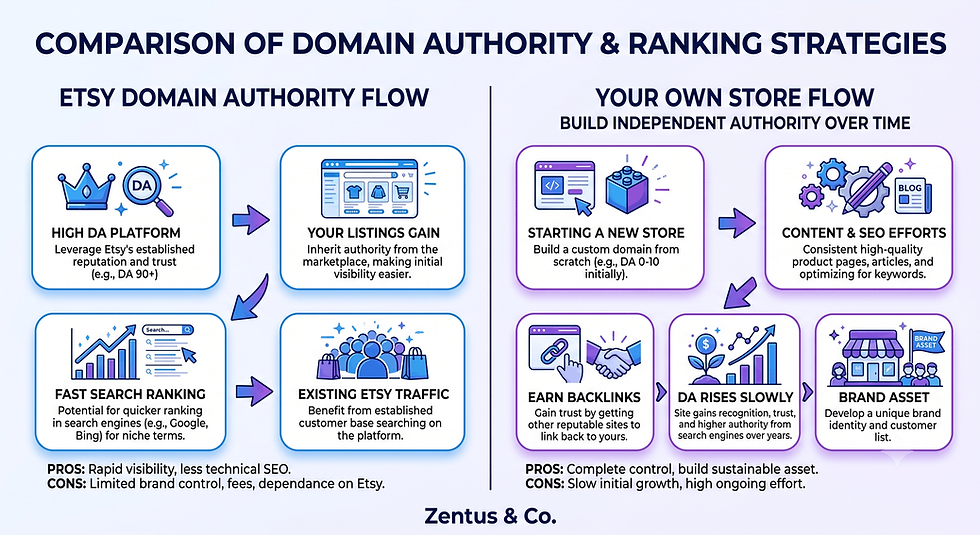
Etsy outranks most individual maker stores because it has decades of accumulated domain authority, millions of indexed product pages, and a search engine's trust that the domain reliably serves relevant shopping results. When someone searches "handmade walnut cutting board," Google frequently shows Etsy listings on page one because Etsy's domain has earned that trust at scale — your three-month-old Wix store has not, yet. This is structural SEO for small business, not a fault in your product photography.
Building Independent SEO Signals Away From Marketplace Pages
You build independent SEO by targeting long-tail, buyer-intent phrases Etsy's generic listing titles don't optimise for — think "handmade oak cutting board with juice groove UK" rather than "cutting board." Publish supporting content (care guides, gift guides, behind-the-scenes process pages), collect genuine reviews on your own domain, and build backlinks from craft directories, local press, and maker communities. This won't outrank Etsy overnight, but it compounds — Etsy's authority doesn't transfer to your product-specific long-tail phrases the way many sellers assume.
The Owned Wix Store Alternative: Your SEO, Your Customer
An owned store isn't a replacement for Etsy's reach — it's a different asset class entirely, one where the value compounds to you instead of to a marketplace.
What an Owned Wix Store Adds That a Marketplace Can't
A Wix store gives you the buyer's email address by default, complete control over the checkout branding, and full ownership of every review, photo, and page you publish for SEO. In a Wix Studio build, the setup detail that changes the outcome is connecting Wix Automations to trigger a welcome email and a post-purchase review request the moment an order lands — something Etsy simply won't let you automate on its own buyers.
Matching (and Beating) Etsy's Checkout Experience on Wix
Wix Stores supports guest checkout, Apple Pay, Google Pay, saved cards, multiple currencies, and abandoned cart recovery — all features Etsy buyers already expect. The practical issue is trust signals: a brand-new domain needs visible reviews, secure checkout badges, and clear shipping/returns policy pages to match the instant trust a buyer already has in Etsy's checkout, which most makers underestimate when they first launch independently.
Print on Demand and Production Partners on Wix
Many handmade sellers aren't hand-making every unit — they're running print-on-demand or working with production partners, and this changes the platform comparison.
Running Print-on-Demand Products Through a Wix Store
Wix can run a full print-on-demand catalogue through connected apps that sync designs, handle fulfilment, and auto-update stock — no manual order forwarding required. Orders placed on your Wix store push directly to the production partner, who ships to the customer under your branding, the same fulfilment model available on Etsy but without the marketplace's transaction cut on top of production costs.
POD Integrations That Connect Cleanly With Wix
Printful and Printify are the two integrations most makers use with Wix Stores, both syncing order status, tracking numbers, and product mockups automatically. The platform behaviour that surprises many business owners is that POD margins are usually tighter than handmade margins, which makes Etsy's fee stack proportionally more damaging — a $6 fee bite on a $12-margin POD product is a much bigger deal than the same fee on a $40-margin handmade item.
Running Both: Etsy for Discovery, Wix for Loyal Buyers
The realistic strategy for most makers in 2026 isn't "leave Etsy" — it's using each platform for what it's actually good at.
Using Etsy as a Discovery Channel, Not Your Only Channel
Etsy remains the strongest place to be found by new buyers who aren't already searching for your brand by name, because its internal search and personalised recommendations put your product in front of intent-driven shoppers you couldn't otherwise reach. Treat Etsy as top-of-funnel discovery and your Wix store as the place where repeat buyers, wholesale enquiries, and custom orders land without the fee stack.
Keeping Repeat Buyers Off the Marketplace Fee Meter
Every repeat customer who reorders through Etsy pays the transaction fee stack again — every single time. Insert a card in every shipped order inviting the buyer to your owned site for a discount on their next order, and that repeat purchase moves entirely off the fee meter. Over a 12-month period, a maker with even a modest repeat-purchase rate can save hundreds of dollars simply by giving loyal buyers a reason to reorder direct.
How to Move Buyers From Etsy to Your Own Store
Migration only works with a deliberate, non-aggressive plan — buyers won't switch platforms just because you ask once.
The Practical Steps for Migrating Etsy Buyers to Your Site
Start with a packaging insert offering a first-order discount code redeemable only on your own site, paired with a QR code that lands directly on that product's page. Follow with a thank-you email through Etsy's allowed messaging (without violating solicitation rules) inviting the buyer to join your mailing list for restocks and new drops. This two-touch approach converts a meaningful share of repeat buyers within the first year without breaching marketplace policy.
Incentives That Actually Move Etsy Buyers to Follow You
The incentive that performs best is a tangible discount plus early access — "10% off and first access to new drops" outperforms generic "shop our website" messaging by a wide margin, because it gives the buyer a concrete reason to act now rather than bookmark for later. Loyalty perks like a small free add-on for direct orders also work well for handmade sellers where margin allows.

Pricing and Margin: Real Per-Sale Cost Compared
Here's the number that actually matters — not the headline fee percentage, but what lands in your account after every deduction.
Per-Sale Margin: Etsy Fees vs an Owned Wix Store
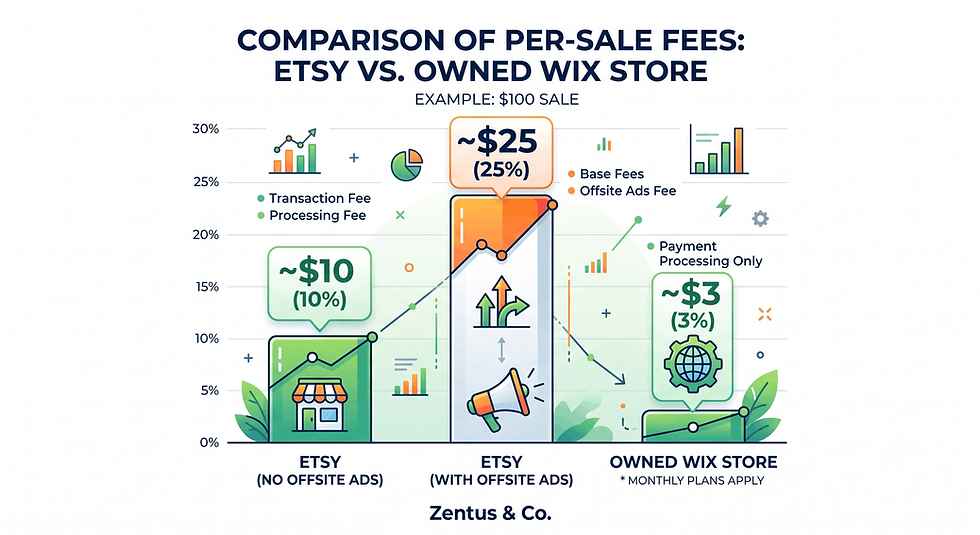
On a $56 order (a $50 item plus $6 shipping), Etsy's listing, transaction, and payment processing fees together take roughly $5.77, or about 10.3%. If the sale is attributed to offsite ads at the mandatory 12% tier, add another $6.72, pushing total fees to roughly $12.49, or 22.3% of the order. On the same $56 order through an owned Wix store, payment processing alone runs about $1.92, or 3.4% — no listing fee, no transaction cut, no ads surcharge unless you choose to run your own paid ads.
Per-sale cost comparison ($56 order)
Cost component | Etsy (no offsite ads) | Etsy (with offsite ads) | Owned Wix store |
Listing fee | $0.20 | $0.20 | — |
Transaction fee (6.5%) | $3.64 | $3.64 | — |
Payment processing | $1.93 | $1.93 | $1.92 |
Offsite ads (12–15%) | — | $6.72–$8.40 | — |
Total fees | ~$5.77 (10.3%) | ~$12.49 (22.3%) | ~$1.92 (3.4%) |
The Sales Volume Where Owning Your Store Wins
The break-even point arrives faster than most makers expect: once you're consistently selling 15–20 units a month, the monthly Wix plan cost is usually already covered by the fee savings on just a handful of those orders, with every sale beyond that pure margin gain compared to Etsy. Below that volume, Etsy's discovery traffic is often still worth the higher per-sale cost while you build your own audience.
What an Owned Wix Store Costs a Maker in 2026
This is the number every maker actually needs before deciding whether to build independently.
The Wix Plan a Maker Business Actually Needs in 2026
Most handmade sellers need Wix's entry ecommerce tier at minimum, moving up once they add discount codes, subscriptions, or abandoned cart recovery. Compare it against Etsy's optional Etsy Plus subscription, which adds shop customisation credits and advertising credits but doesn't touch the core fee stack.
Wix plan pricing for a maker store (checked august 2026)
Plan | Price (approx., monthly billing) | What it unlocks | Best for |
Wix Light | $17/mo (~£13/mo) | Basic online store tools | Very early testing |
Wix Core | $29/mo (~£22/mo) | Full ecommerce, discounts, multi-currency | Most makers starting out |
Wix Business | $36/mo (~£27/mo) | Abandoned cart recovery, automations | Makers scaling repeat sales |
Wix Business Elite | $159/mo (~£129/mo) | Advanced/multi-location tools | High-volume or multi-brand sellers |
Etsy Plus (optional add-on) | ~$10/mo | Shop customisation, ad credits | Existing Etsy sellers wanting extra tools |
Prices checked for august 2026. Always verify current Wix and tool pricing before you buy — platform pricing can change.
Etsy Fees vs Wix Costs at Higher Sales Volumes
At $3,000 in monthly sales, Etsy's fee stack (without offsite ads) costs roughly $310, and closer to $670 if offsite ads apply — compared to a flat Wix Core plan cost of around $29 plus roughly $87 in payment processing, a total near $116. The gap widens every month you scale, which is why high-volume Etsy sellers are the group most likely to benefit from building an owned store in parallel. See Wix Payments fees and payouts for how processing rates apply once you're taking payments directly.
For the underlying build, most makers work with a standard Wix Studio services setup rather than a custom-coded store, keeping ongoing costs predictable — full packages are outlined on the website design pricing page.
When Owning Your Store and Your SEO Beats Etsy's Reach
Not every maker should leave Etsy, and not every maker should stay. The decision comes down to where you are in your growth curve.
The Type of Maker Who Should Own Their Store
Makers with a repeat-purchase product (consumables, subscriptions, seasonal restocks), an existing social following, or wholesale ambitions benefit most from an owned store, because the customer-ownership and SEO investment compounds over multiple purchases rather than a single transaction. A clean Wix Studio setup usually separates the "new customer acquisition" job from the "repeat customer retention" job — Etsy handles the first job better; your own store handles the second job better.
When Etsy's Built-In Reach Still Wins
A brand-new maker with no existing audience, low search volume for their product category, or a one-off gift-style product often does better staying on Etsy exclusively while building initial sales velocity and reviews. Building an independent SEO presence from zero takes months; Etsy's marketplace search delivers buyer intent from day one, which matters more than fee savings when you have no traffic of your own yet.
The Fee-Stacking and SEO-Dependence Trap Most Makers Fall Into
The two mistakes above are connected — makers who don't see the fee stack also tend not to notice how dependent they've become on Etsy's search engine instead of Google's.
Why Fee Stacking Catches Makers by Surprise
Most sellers calculate their margin using only the 6.5% transaction fee because that's the number Etsy displays most prominently in seller education material, and payment processing and offsite ads feel like separate, smaller line items rather than part of the same total. By the time a maker adds up a full month of payouts against gross sales, the real fee percentage is often double what they budgeted for.
The Real Cost of Staying SEO-Dependent on Etsy
The cost isn't just fees — it's that every hour spent optimising an Etsy listing builds Etsy's authority, not yours, and that investment disappears the moment you close your shop or get suspended. A maker who's spent three years building five-star reviews on Etsy has zero of that trust transferred if they ever need to rebuild on their own domain, which is the real argument for starting SEO independence early rather than waiting until Etsy fees become unbearable.
Fee, SEO and Customer-Migration Checks Before You Leave or Split From Etsy
Before shifting strategy in either direction, run through these checks to avoid an expensive mistake.
What to Audit Before You Leave Etsy
Check your trailing 12-month sales total against the $10,000 offsite ads threshold, because crossing it locks you into the mandatory 12% fee with no opt-out — this changes your break-even math for going independent. Also audit how much of your traffic comes from Etsy search versus your own social channels; if it's almost entirely Etsy search, leaving abruptly will cause a sales cliff you're not ready for.
What Breaks When You Split Traffic Across Two Stores
The most common failure is inventory desync — selling the same one-of-a-kind item on both platforms without a shared stock feed, resulting in a cancelled order and a damaged review. Set a strict rule for one-of-a-kind items (list on one platform only) and use inventory sync apps for made-to-order or production-run items that can genuinely be sold in both places simultaneously.
Checklist before running Etsy and Wix together:
✅ Trailing 12-month Etsy sales checked against the $10k offsite ads threshold
✅ One-of-a-kind items restricted to a single platform
✅ Made-to-order/POD items connected to a shared inventory feed
✅ Packaging insert with your own site URL and discount code printed
✅ Welcome email automation live on your Wix store for new signups
✅ Reviews and policies published on your own domain, not just Etsy
For a full platform comparison beyond Etsy, see Wix Studio for small business and Wix vs Shopify if you're also evaluating ecommerce platforms outside the marketplace model.

Frequently Asked Questions About Wix vs Etsy for Makers
How much does Etsy actually take per sale?
Etsy typically takes 10–12% of an order once the listing fee, 6.5% transaction fee, and payment processing are combined, rising to 20–22% if the sale is attributed to the mandatory offsite ads surcharge. Most sellers underestimate this because Etsy's fee education highlights the 6.5% figure most prominently, without stacking in the other three charges that hit every single order.
What are Etsy listing, transaction and offsite ad fees?
The listing fee is $0.20 per item, renewing every four months or on sale; the transaction fee is 6.5% of the item price plus shipping; and the offsite ads fee is 12% (mandatory over $10,000 trailing sales) or 15% (opt-in tier). Together with payment processing, these four fees make up Etsy's complete cost stack for sellers in 2026.
Should a maker use Etsy and a Wix store together?
Yes, for most makers this hybrid model works best — Etsy for new buyer discovery and a Wix store for repeat buyers, wholesale, and custom orders where you keep the full margin. Running both avoids the sales cliff of leaving Etsy cold turkey while still building an owned audience and SEO presence over time.
Who owns the customer on Etsy?
Etsy owns the primary buyer relationship — you get shipping details for fulfilment but not automatic marketing rights to the buyer's email address. This is the core reason makers who want to build a repeat-customer business eventually need an owned store, since Etsy's terms limit how freely you can market to marketplace buyers directly.
How do I move buyers from Etsy to my own site?
The most effective method is a packaging insert with a first-order discount code and QR code linking to your Wix store, followed by a thank-you message inviting buyers to join your mailing list for restocks. This two-touch approach respects Etsy's policies while still giving loyal buyers a clear, low-friction reason to reorder direct.
Is an owned Wix store cheaper than Etsy?
Per sale, yes — an owned Wix store typically costs around 3% in payment processing compared to Etsy's 10–22% stacked fees, though you also pay a fixed monthly plan fee Etsy doesn't charge. The break-even point for most makers arrives around 15–20 sales per month, after which the owned store's savings clearly outweigh the plan cost.
Can Wix handle print on demand?
Yes, Wix Stores connects with Printful and Printify, syncing designs, order fulfilment, and stock updates automatically without manual order forwarding. Orders route directly to the production partner under your branding, giving makers the same POD workflow available on Etsy but without the marketplace transaction cut on top of production costs.
Why does Etsy rank above my own store?
Etsy outranks most independent maker stores in Google because of its decades of accumulated domain authority and millions of indexed listings that Google already trusts for shopping intent. A new Wix store hasn't earned that trust yet, which is why independent SEO needs to target specific long-tail phrases rather than compete head-on for broad category terms.
How do I build SEO independence from Etsy?
Start by targeting specific, long-tail buyer phrases your Etsy listing titles don't cover, publishing supporting content like care guides and gift guides, and collecting genuine reviews directly on your own domain. This SEO independence compounds slowly, but it's the only way to stop every search ranking you build from benefiting Etsy's domain instead of yours.
Which Wix plan do I need for a maker store?
Most makers starting out need Wix's Core ecommerce plan, which unlocks discount codes and multi-currency selling, moving up to the Business plan once abandoned cart recovery and automations become worth the extra cost. Very early testing can start on the Light plan, but most sellers outgrow it within a few months.
Can I run Etsy and a Wix store at the same time?
Yes, and for most makers this is the recommended approach rather than an either/or decision — Etsy handles discovery traffic while your Wix store captures repeat business at a much lower fee. The main operational risk is inventory desync on one-of-a-kind items, so restrict unique pieces to a single platform and sync stock feeds for made-to-order items.
When should I leave Etsy for my own store?
Consider leaving (or significantly scaling back Etsy) once your repeat-purchase rate is high enough that the fee savings clearly outweigh the discovery traffic you'd lose, typically once you're generating consistent sales from your own email list and social channels. Most makers shouldn't leave entirely — building the owned store alongside Etsy, then gradually shifting weight, is the lower-risk path.

Decision Recap
Etsy's real fee stack runs 10–22% per sale, not the 6.5% headline figure, once transaction, processing, and offsite ads are combined. An owned Wix store cuts that to roughly 3% but requires you to build the SEO and discovery traffic Etsy already provides. For most makers in 2026, the answer isn't "Wix or Etsy" — it's Etsy for discovery, Wix for ownership, with a deliberate migration plan moving repeat buyers off the fee meter over time. If you're ready to build the owned side of that strategy, book a free consultation to scope a Wix Studio store built for exactly this hybrid model.


Comments