


Wix vs Shopify in 2026 — Which Platform Costs Small Businesses Less?

Updated: Jun 22

If you're trying to decide between Wix vs Shopify for your small business, the feature comparison articles you've already read are probably not helping. Most were written before 2024, and none of them show you the actual cost math.
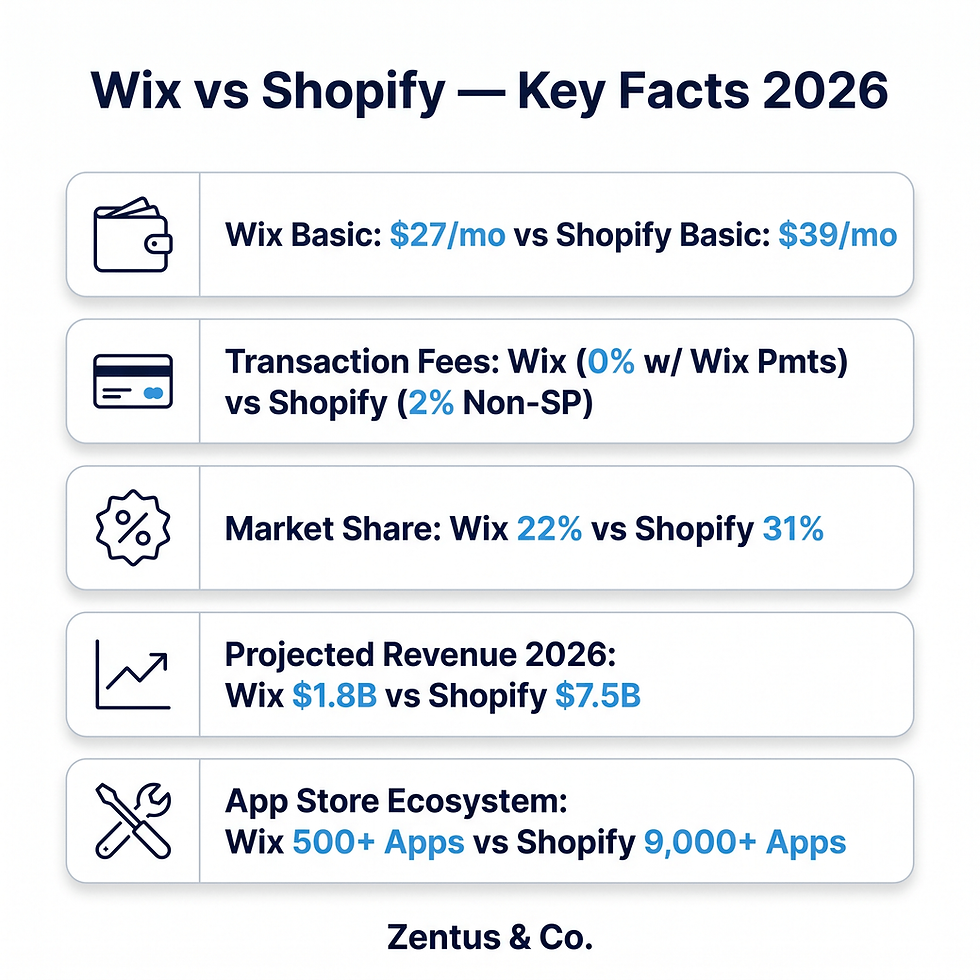
Here is the honest situation: Shopify charges $39/month minimum, plus 2.9% + $0.30 per transaction if you use external payment processors — and that number climbs before you add any apps. Wix runs a full online store on its Business plan at $36/month with Wix Payments built in at 2.9% + $0.30 per transaction.
For a small business doing under $500,000 per year in revenue, those differences matter more than feature counts.
This post breaks down the 2026 pricing reality, the design gap, the SEO tools, and the exact revenue point at which switching from Wix to Shopify actually makes financial sense.
Bottom Line Box:
What You Need to Know Before Choosing
Wix Business plan costs $36/month (billed annually) vs Shopify Basic at $39/month — but Shopify charges 0.5–2% extra on transactions if you don't use Shopify Payments
Wix Studio offers full design control without developers — drag-and-drop canvas with no code required
Shopify has a larger app ecosystem (8,000+ apps) but most useful apps add $10–$50/month each
For hybrid businesses (services + products + bookings), Wix handles all three natively — Shopify does not
Break-even analysis: At under 200 orders/month, Wix typically delivers lower total cost of ownership than Shopify Basic
Wix vs Shopify — Which Platform Wins for Small Business in 2026?
For most small businesses doing under $500,000/year in online revenue, Wix wins on total cost — and in many cases, it wins on design flexibility too. The landscape has shifted significantly since the last wave of comparison articles was published.
Wix Studio launched its fully redesigned e-commerce infrastructure in 2024, closing many of the functionality gaps that once made Shopify the obvious default. At the same time, Shopify increased pricing tiers and tightened its ecosystem in ways that squeeze small stores.
Before you decide, you should also read our three-way platform comparison- go deeper on scenarios where a third platform may be the better call.
Is Wix better than Shopify for small businesses in 2026?
Wix is better than Shopify for small businesses in 2026 when your priority is lower fixed overhead, design control, and mixed business models. Shopify remains superior for high-volume pure-product stores that need extensive third-party integrations and multi-channel selling infrastructure.
The key distinction is business type. A boutique selling 80–150 products, managing appointments, and running a blog is a Wix business. A dropshipping operation scaling to 10,000 SKUs with warehousing integrations is a Shopify business.
For the majority of independent retailers, coaches, local service businesses with product lines, and makers selling direct-to-consumer, Wix covers 90% of the functionality at a meaningfully lower price point.
Which platform has a faster setup time?
Wix sets up faster for non-technical owners. A fully functional Wix e-commerce store — with product listings, checkout, payment processing, and a connected domain — can be live in 2 to 4 days using Wix's AI site builder or a Studio template.
Shopify's setup is similarly quick at the basic level, but reaching a professional result typically requires theme customization, app installation, and additional configuration — adding 5 to 10 days for most independent store owners without developer help.
Speed of setup is relevant not just at launch. Ongoing edits — adding pages, changing layouts, updating product sections — are faster in Wix Studio's visual editor than in Shopify's Liquid-based theme system.
Wix E-Commerce vs Shopify — Transaction Fees and Pricing Reality
This is the section that changes most decisions. The real cost of Shopify is not the monthly plan — it is the compounding fees.
Cost Item | Wix Business | Shopify Basic | Shopify (Advanced) |
Monthly plan (annual billing) | $36/month | $39/month | $399/month |
Transaction fee (own payment gateway) | 0% (Wix Payments) | 2% extra | 0.5% extra |
Payment processing (Wix/Shopify Payments) | 2.9% + $0.30 | 2.9% + $0.30 | 2.4% + $0.30 |
Annual plan cost | $432/year | $468/year | $4,788/year |
Abandoned cart recovery | Included | Included | Included |
Custom domain | Included | $14/year extra | $14/year extra |
Email marketing (basic) | Included | App required ($20+/mo) | App required |
Estimated total (small store, 100 orders/mo) | ~$780/year | ~$960–$1,440/year | N/A |
Estimates based on 2026 published pricing. Actual costs vary by payment gateway, country, and app usage.
Our full website design pricing page covers what Zentus Agency charges for professional Wix Studio e-commerce builds on top of these platform costs.
What are Wix Payments transaction fees compared to Shopify?
Both Wix Payments and Shopify Payments charge 2.9% + $0.30 per transaction for standard card processing. At this level, the fees are identical.
The critical difference appears when you use a third-party payment processor. Shopify charges an additional 0.5% to 2% on every transaction processed outside Shopify Payments — a fee that does not exist on Wix. For stores using PayPal, Stripe, or regional payment providers, this surcharge adds up fast.
At 100 orders per month with an average order value of $80, that 2% Shopify surcharge costs $1,920/year extra — more than the annual plan cost itself. This is the number most comparison articles fail to mention.
Does Shopify's monthly cost outweigh its features for small stores?
For stores processing fewer than 200 orders per month, Shopify's cost often outweighs its features. The Shopify Basic plan lacks advanced reporting, has limited staff accounts, and requires paid apps for features Wix includes natively — like loyalty programmes, subscription products, and advanced shipping rules.
The commonly cited justification for Shopify — its app ecosystem — becomes a liability at small scale. Each app typically costs $10 to $50 per month. Three essential apps add $360 to $1,800 per year before any transaction fees.
Wix includes email marketing, basic automation, abandoned cart recovery, product reviews, and booking tools within the platform. For a small business, native tools beat a fragmented app stack every time.

Ease of Use — Wix Studio vs Shopify for Non-Technical Owners
Wix Studio is easier to use for non-technical owners — and by a wider margin than most comparison articles admit. Shopify's editor is improving but remains constrained by its theme architecture.
For more context on how Wix Studio compares to its own legacy version, read our Wix Studio vs standard Wix breakdown — the platform has changed substantially since 2022.
How steep is the Shopify learning curve for beginners?
Shopify's learning curve is moderate to steep for owners with no technical background. The storefront editor is relatively intuitive, but customising layouts beyond a theme's pre-built sections requires either Liquid code knowledge or a developer.
Shopify's admin panel — covering products, orders, shipping, taxes, apps, and analytics — has improved, but the number of settings panels and menus overwhelms many first-time users in the first two weeks.
Most small business owners who self-build on Shopify spend 20 to 40 hours learning the system before launching. Many report needing help from a Shopify developer within six months when customisation needs arise.
Can you edit a Wix site without touching code?
Yes — Wix Studio is entirely code-free for standard store management. Every layout element, product section, navigation menu, colour scheme, and page section is editable through visual drag-and-drop controls.
Working exclusively in Wix Studio, the most common mistake we see owners make is not using section-level layout controls — instead trying to move elements pixel by pixel. Once the section grid system is understood, editing speed is genuinely fast.
Adding new products, adjusting prices, creating discount codes, and managing orders all happen through a clean dashboard that most owners learn within 2 to 3 days. No app installation, no code, no developer dependency for standard changes.

Design Freedom — Can Wix Match Shopify's Customisation Options?
Wix Studio offers more native design freedom than Shopify for visual layout and page structure. Shopify's theming system is more rigid — designed for consistency across large catalogues, not creative flexibility.
For service businesses and brands where design identity is a competitive advantage, this matters significantly. Compare this with the Wix Studio vs WordPress analysis if you're also considering an open-source build.
Does Shopify offer more design templates than Wix Studio?
Shopify offers approximately 130+ themes in its theme store, with the majority of premium themes costing $180 to $350 each. Wix Studio offers 900+ templates across all business types, all included at no additional cost.
Shopify themes are purpose-built for commerce and tend to be cleaner at product catalogue display. Wix Studio templates cover a broader range — service businesses, portfolios, restaurants, events — making them more versatile for businesses that are not purely product-focused.
The practical design advantage of Wix Studio is not in template quantity but in post-template flexibility. Every element can be repositioned, resized, or replaced without touching a line of code. Shopify templates lock structural sections unless you edit the underlying Liquid files.
Can Wix Studio achieve a custom look without developers?
Yes — Wix Studio achieves genuinely custom design without developer involvement for the vast majority of small business needs. Responsive breakpoints, custom fonts, brand colour palettes, sticky headers, scroll animations, and complex grid layouts are all handled natively.
The platform behavior that surprises most clients is the separation between mobile and desktop layouts. In Wix Studio, you design desktop and mobile layouts independently — a detail that most drag-and-drop builders get wrong by auto-scaling desktop to mobile, which often breaks spacing and readability.
For stores needing advanced custom logic — conditional product rules, subscription models with complex tiers, or enterprise inventory systems — developer involvement may still be necessary on either platform. Wix Studio's ceiling is high for design; its ceiling for complex backend logic is lower than Shopify's.
SEO and Marketing Tools — Wix vs Shopify for Organic Growth
Wix and Shopify are broadly comparable in SEO capability for small stores, with each having distinct strengths. The 2022 narrative that "Shopify is better for SEO" is no longer accurate for most use cases.
Which platform has better built-in SEO tools?
Both platforms provide solid built-in SEO tools for small businesses, including editable title tags, meta descriptions, canonical URLs, structured data, and XML sitemaps. The gap has narrowed substantially.
Wix Studio added automatic image compression, improved Core Web Vitals performance on its hosting infrastructure (99.9% uptime on Google Cloud), and generates clean URL structures without the /collections/ and /products/ path duplications that historically hurt Shopify's crawl efficiency.
Shopify's SEO advantage remains at scale — its blog structure, collection pages, and filter-based URLs create more pages for Google to index across large product catalogues. For stores with fewer than 500 SKUs, this advantage is marginal.
One area where Wix currently leads: structured data schema generation is built into Wix Studio at the product level. Shopify requires third-party apps for rich schema beyond basic product markup.
Does Shopify or Wix offer superior email marketing?
Wix offers superior built-in email marketing for small stores. Wix Email Marketing is included with paid plans, supporting up to 200 emails/month on the free tier and substantially more on paid plans — with automation flows, abandoned cart sequences, and campaign analytics built in.
Shopify Email is also built-in and free up to 10,000 emails per month, which is competitive at volume. However, for automation depth — welcome sequences, segmentation triggers, re-engagement flows — both platforms' native tools are limited compared to dedicated tools like Klaviyo.
The difference at small-business scale: Wix's included email tools handle 80% of a small store's marketing needs without additional cost. Shopify's native tools are comparable, but the ecosystem pressure toward Klaviyo ($45/month minimum) is stronger in Shopify communities.

What Most Wix vs Shopify Guides Get Wrong
Every comparison article published before 2025 makes the same mistake: it compares platform feature lists without accounting for the actual cost structure small businesses face. This section covers the angles that none of the top comparison articles address properly.
The real cost gap is not the monthly plan — it is fee compounding
Most articles compare Wix Business ($36/month) to Shopify Basic ($39/month) and call it roughly equal. That comparison is misleading for three reasons.
First, Shopify's external gateway fee (0.5% to 2% per transaction) is not mentioned in the headline pricing. A store doing $150,000/year in revenue with a 2% external gateway surcharge pays $3,000/year in hidden fees — six times the monthly plan difference.
Second, Shopify's app dependency is structural, not optional. Features that Wix includes natively — product reviews, loyalty points, subscription billing, advanced shipping rules — cost $10 to $50 per month each on Shopify's app store. Three common apps add $360 to $1,800/year.
Third, Shopify's domain is not free. Wix includes a connected custom domain on paid plans. Shopify charges $14/year for a domain purchased through the platform.
Total annual cost difference for a store doing 100 orders/month at $80 average order value, using an external payment gateway:
Wix Business total cost: ~$780/year
Shopify Basic total cost: ~$2,160–$3,600/year (including apps and gateway surcharge)
That is a gap of $1,380 to $2,820 per year — which represents real margin at small-business scale.
The break-even revenue point most articles never name
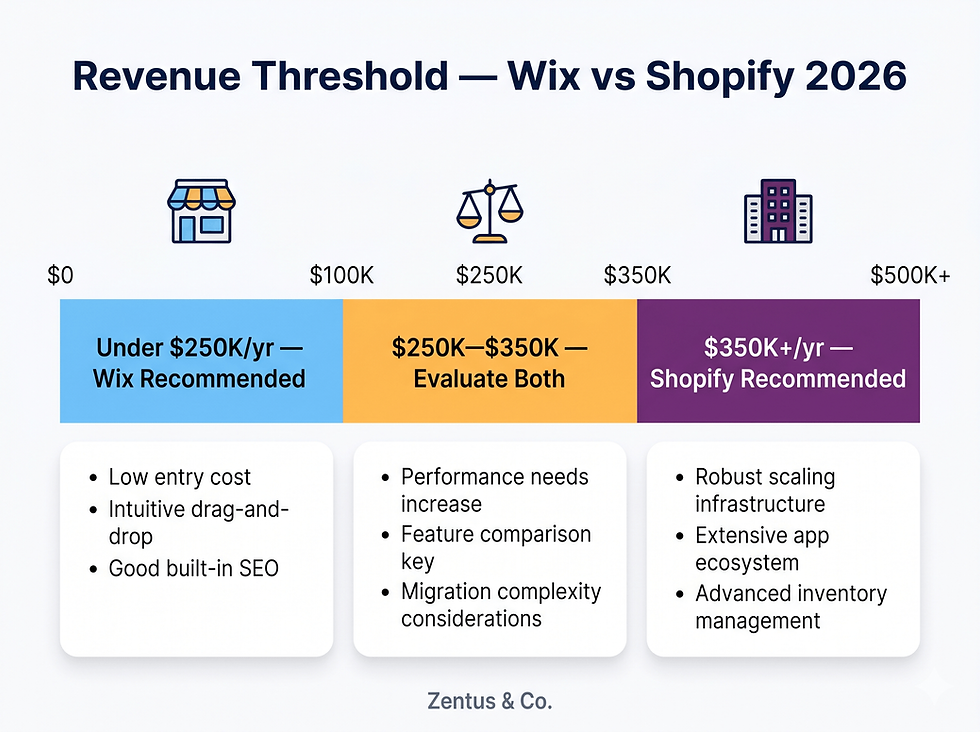
The revenue level at which Shopify's ecosystem benefits start to justify its higher cost is approximately $250,000 to $350,000 per year in product revenue — and only when you are using Shopify Payments natively (avoiding the external gateway surcharge) and genuinely need its advanced multi-channel features.
Below that threshold, the app costs, transaction fee structures, and lack of native hybrid-business tools make Wix the more financially rational platform for most independent store owners.
Above $500,000/year — especially for pure product businesses with large SKU catalogues, wholesale channels, and multi-currency markets — Shopify's infrastructure justifies its cost. This is the honest answer most comparison articles avoid because it requires taking a position.
Scalability — When Should You Move from Wix to Shopify?
Moving from Wix to Shopify makes sense at approximately $300,000 to $500,000 in annual product revenue — when your store needs inventory management integrations, multi-channel selling at scale, or fulfilment network connections that Wix does not natively support.
At what revenue level does Shopify become essential?
Shopify becomes the stronger platform above $300,000 in annual product revenue when any of the following are true: you are selling across Amazon, Instagram, TikTok Shop, and a web store simultaneously; you need warehouse management system integration; or you are managing 1,000+ active SKUs with variants.
Below that threshold, the operational features Shopify adds are largely available through Wix's native tools or simple integrations. Shopify's multi-channel infrastructure — built for volume — is underutilised by most stores in the $50,000 to $200,000 revenue band.
The most common configuration issue in small businesses switching to Shopify is paying for Advanced plan features they do not yet need, driven by comparison articles that assume all stores are scaling toward enterprise.
What are the migration costs from Wix to Shopify?
Migrating from Wix to Shopify typically costs $1,500 to $5,000 for professional assistance, depending on catalogue size, custom design requirements, and data migration complexity.
Product data (titles, descriptions, images, variants, pricing) migrates cleanly via CSV export/import. Customer order history, custom page designs, blog content, and third-party integrations require manual rebuilding.
The most commonly underestimated migration costs are: new Shopify theme purchase ($180–$350), app recreation ($50–$200/month ongoing), SEO redirect mapping ($500–$1,500), and two to four weeks of store downtime or reduced functionality during transition.
If migration is a future consideration, plan for a minimum three-month runway from decision to fully operational new store.
Wix vs Shopify for Service Businesses and Hybrid Models
Wix is significantly stronger than Shopify for hybrid business models — businesses that combine service bookings, physical products, digital downloads, memberships, and content in a single site.
This is the use case Shopify was never designed for, and where Wix's native toolset creates the clearest competitive advantage.
For more on how this applies to US-based stores specifically, our online store design for US businesses post covers the platform setup in detail.
Can Wix handle bookings and products on the same site?
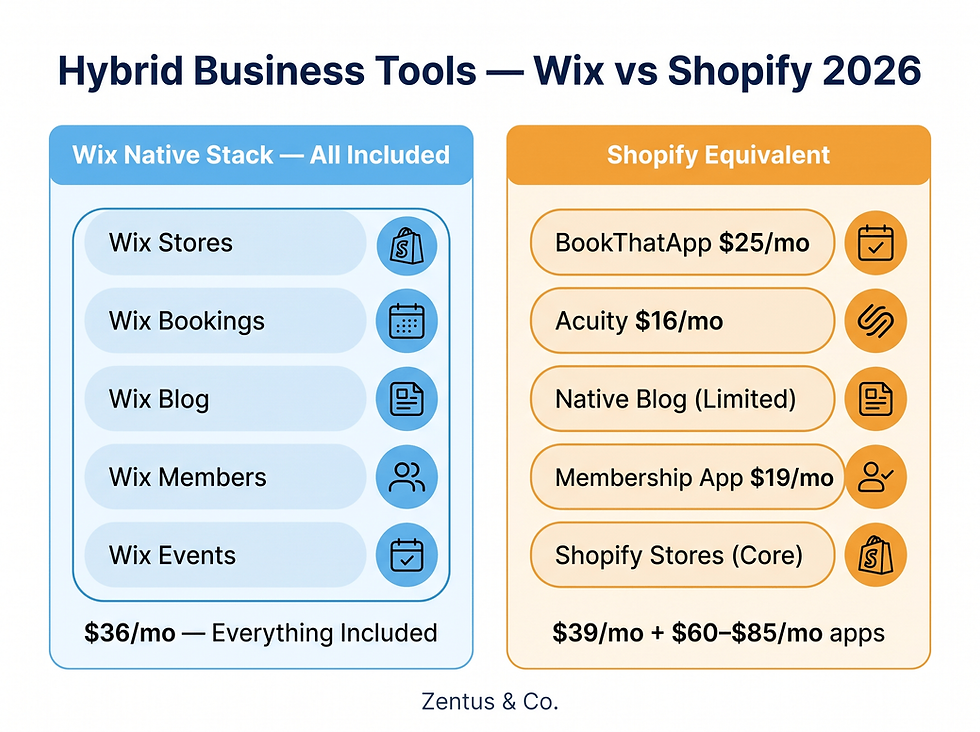
Yes — Wix handles bookings and products on the same site natively, without additional apps or custom integration. Wix Bookings, Wix Stores, Wix Blog, Wix Members, and Wix Events all operate within a single dashboard and present to visitors as a unified site.
The specific Wix Bookings setting that determines whether deposit collection works correctly is the "Payment Policy" toggle inside each service's booking settings — set this to "partial payment" with a percentage deposit before enabling the booking flow publicly. Most first-time users miss this and end up with full payment required at booking, which increases cart abandonment for service categories.
This native integration is why therapists, coaches, fitness studios, photographers, and local retailers with appointment-based consultations consistently choose Wix over Shopify for their primary business site.
Is Shopify limited to pure e-commerce?
Shopify is not limited to e-commerce, but its non-commerce tools are significantly weaker than its core product. Shopify offers a blog, basic page builder, and limited appointment booking through third-party apps.
Booking systems on Shopify (Acuity, Booksy, BookThatApp) require separate subscriptions at $15 to $50/month and do not integrate natively with the Shopify product checkout. This means bookings and product purchases require separate transactions — a friction point most service-product hybrid businesses cannot absorb.
For a business where 50% of revenue comes from appointments and 50% from product sales, the operational overhead of managing two separate checkout systems on Shopify is a genuine business problem — not a minor inconvenience.
Final Verdict — Who Should Choose Wix and Who Needs Shopify?
The honest answer: platform choice should be driven by your current revenue model, not your five-year ambition. Choose the platform that fits your business today — you can always migrate when the business outgrows it.
Our Wix Studio services page covers how we build and configure professional e-commerce sites on Wix Studio for small businesses in the USA, UK, and across Europe.
Who This Is Best For
Wix Is a Strong Fit For | Shopify Is a Better Fit For |
Stores doing under $250,000/year in revenue — lower total cost of ownership | Pure product businesses doing $300,000+/year who need multi-channel infrastructure |
Hybrid businesses combining services, bookings, digital products, and physical goods — all native | High-volume dropshipping or wholesale operations needing deep inventory integrations |
Businesses where design identity and brand differentiation are competitive advantages | Businesses already deeply integrated into the Shopify ecosystem (POS, Shopify Shipping, Shopify Markets) |
Non-technical owners who need to manage and update the site independently | Stores needing 1,000+ apps or complex conditional logic across product variants |
UK and US small businesses needing GDPR-compliant forms, local payment methods, and multilingual pages | Enterprise retailers requiring advanced B2B pricing, customer-tiered catalogues, and ERP integration |
Businesses using a third-party payment gateway — no extra transaction fees on Wix | Businesses where Shopify Payments is available and the 0% gateway fee justifies the ecosystem lock-in |
Should a UK startup choose Wix or Shopify in 2026?
A UK startup in 2026 should choose Wix if its annual revenue target is under £200,000 and its product catalogue is under 500 SKUs. Wix Payments is available in the UK, the platform is GDPR-compliant natively, and the Business plan at approximately £28/month (billed annually) offers strong value for early-stage stores.
UK startups choosing Shopify should be aware that Shopify Payments is available in the UK, which removes the external gateway surcharge — narrowing the cost gap. However, Shopify's app dependency and theme costs still add meaningful overhead before a startup reaches profitability.
For UK-based businesses with a mix of local service clients and online product sales, Wix is the clearer starting platform.
Is Shopify always the better choice for high-volume sellers?
No — Shopify is not automatically better for high-volume sellers. Volume alone is not the determining factor. The relevant factors are: catalogue complexity, multi-channel selling requirements, fulfilment integration needs, and whether the business is pure product or hybrid.
A high-volume seller doing £500,000/year through a single product niche with a small SKU count and a clean direct-to-consumer model may operate efficiently on Wix Business Elite ($159/month, billed annually) — particularly if custom design and blog-driven content marketing are core to the growth strategy.
Shopify becomes the rational default above £500,000/year only when the business genuinely needs its enterprise infrastructure — not because of cultural assumption that "Shopify is for serious sellers."

Frequently Asked Questions About Wix vs Shopify
Which is cheaper, Wix or Shopify, for a small online store?
Wix is cheaper than Shopify for most small online stores in 2026. The Wix Business plan costs $36/month (billed annually) with Wix Payments included at 0% additional transaction fee. Shopify Basic costs $39/month but adds 2% per transaction when using external payment gateways, plus app costs for features Wix includes natively. For a store doing 100 orders/month, total annual cost on Wix averages $780 vs $1,500–$3,600 on Shopify Basic.
Is Wix good for e-commerce in 2026?
Yes — Wix is genuinely capable for e-commerce in 2026, particularly for small businesses doing under $300,000/year in revenue. Wix Stores supports unlimited products, discount codes, abandoned cart recovery, product reviews, and multi-currency display. The platform runs on Google Cloud infrastructure with 99.9% uptime. Its main limitation is at enterprise scale — large SKU catalogues and complex multi-channel integrations are still better served by Shopify.
Can I switch from Wix to Shopify later?
Yes, you can migrate from Wix to Shopify, but expect the process to cost $1,500 to $5,000 and take four to eight weeks with professional help. Product data migrates via CSV, but custom page designs, blog content, SEO redirects, and third-party integrations require manual rebuilding. Plan for a minimum three-month runway from decision to fully operational new store. Build in 301 redirect mapping from day one to protect organic search rankings.
What is the main difference between Wix and Shopify?
The main difference between Wix and Shopify is their core architecture. Shopify is built exclusively for product commerce at scale, with deep inventory, multi-channel, and fulfilment infrastructure. Wix is built for all business types — including hybrid service-product-booking models — with commerce as one of several native capabilities. Shopify wins at pure e-commerce volume; Wix wins at design flexibility, cost efficiency, and business model versatility.
Does Shopify or Wix rank better on Google?
Neither platform has a systematic SEO advantage over the other for small businesses in 2026. Both generate clean sitemaps, editable meta data, structured data, and responsive mobile layouts. Wix Studio's Core Web Vitals performance has improved significantly on Google Cloud infrastructure. Rankings are determined by content quality, backlinks, and technical setup — not by platform choice at the small-business scale. The platform matters less than what you build on it.
Is Wix or Shopify better for beginners?
Wix is better for beginners due to its fully visual drag-and-drop editor, no-code customisation, and lower learning curve. First-time owners can manage products, layouts, pages, and marketing tools from a single dashboard without developer dependency. Shopify's storefront editor is intuitive, but layout customisation beyond pre-built sections requires Liquid code knowledge, which most beginners do not have. For a non-technical owner self-managing their store, Wix reduces ongoing operational friction.
Does Wix work for UK businesses in 2026?
Yes — Wix works well for UK businesses in 2026. Wix Payments is available and GDPR-compliant in the UK, supporting GBP transactions and UK VAT configuration natively. The platform supports multilingual content for businesses serving European markets alongside the UK. UK startups with under 500 products and mixed business models — particularly local retailers and service-product hybrids — consistently find Wix the more practical choice at launch stage.
Start Building the Right Store for Your Business
If you're still deciding between Wix and Shopify, the most useful next step is not reading more comparison articles — it is getting an honest assessment of your specific business model against what each platform actually delivers.
At Zentus Agency, we work remotely with small businesses across the USA, UK, Canada, and Europe to build and configure professional Wix Studio e-commerce stores. We help you avoid the cost traps, set up payments and tax correctly from day one, and build a store your customers actually trust.
No guesswork. No overselling.
No commitment required. We respond within 24 hours.


I can see why encouraging learning through local participation would invite discussion, since different people will bring different experiences to the same question. Taking part in a local activity can give a classroom topic a practical purpose. I would keep that thought nearby when looking for ideas about Jankowice community education. I do not have a settled view yet, but this seems like a good place to slow down and look more closely. How could a school invite families into a project without making participation difficult?
My first thought about writing clear and useful local advertisements is that the everyday experience deserves as much attention as the larger explanation. Specific descriptions can save both the reader and the advertiser a round of basic questions. This is why I would approach local classified advertisements with a specific question rather than a fixed expectation. A short discussion of an everyday example would make this easier for me to connect with, especially as someone still learning about the subject. Which details should always appear in a short local listing?
My first thought about learning languages through everyday situations is that the everyday experience deserves as much attention as the larger explanation. A familiar situation can give new words a purpose beyond memorisation. That is the kind of detail I would keep in mind while exploring practical language learning. I can imagine different answers depending on the situation, so I would want to understand the context before drawing conclusions. How would you practise vocabulary so that it becomes easier to use in conversation?
What interests me about telling meaningful stories with digital media is how a broad idea becomes part of an ordinary day. The order of images and words can change how an audience understands a story. For me, that is a useful way into the broader subject of digital storytelling techniques. I would probably come back to this question after trying to work through one concrete example rather than deciding immediately. How do you decide which details belong in a short digital story?
When it comes to using a tourist guide to plan a flexible trip, I would rather understand one useful detail properly than rush through a long list of ideas. A useful guide should help visitors understand distances and pacing as well as major attractions. That is the kind of detail I would keep in mind while exploring tourist itinerary planning. I would be interested in a simple example, because it is often the ordinary details that make an idea memorable. What would you check before turning a list of places into a day plan?