


Is a Google Business Profile Enough Without a Website?


Quick Answer: Do You Need a Website With a GBP?
No — a Google Business Profile (GBP) alone is not enough for most businesses that want to grow past word-of-mouth. A GBP is free, shows up in Google Maps and local search, and lets customers call, message, or find directions in seconds. But it cannot host a full product catalogue, cannot run your own booking system without linking to a third-party tool, cannot rank for non-local keywords, and can be suspended or removed by Google at any time — taking your entire online presence with it.
The straight answer: use both. A GBP wins you the "near me" search. A website wins you trust, SEO reach beyond your postcode, and full control over your customer data. A basic professional website costs from £950 (August 2026 pricing) — a small, one-time investment against a listing you don't actually own.
In this guide:
What a Google Business Profile actually includes for free — and where it stops
The specific gaps a GBP leaves open (bookings, SEO, brand trust, ownership risk)
Real 2026 costs for adding a website to your GBP setup
Which business types can survive on GBP alone, and which can't
Hidden costs most "free listing" advice never mentions
In This Guide
This article covers what Zentus & Co. sees repeatedly when advising small businesses that rely solely on Google Business Profile: the moment a profile gets suspended, a review bomb hits, or a competitor with an actual website starts outranking them for the exact same search. By the end, you'll know exactly which category your business falls into.
According to BrightLocal's Local Consumer Review Survey (2024), 87% of consumers used Google to evaluate a local business before visiting or buying — most of that evaluation happens directly inside the Google Business Profile panel. That's precisely why so many small business owners ask a fair question: if customers are already finding me on Google Maps, why pay for a website too?
The honest answer is that a Google Business Profile and a website do different jobs, and treating one as a replacement for the other is where businesses lose customers without realising it. A separate widely-cited figure from the Stanford Web Credibility Project found that 75% of consumers judge a company's credibility based on its website design alone — a judgement a Google Maps pin simply cannot deliver, because it has no design at all.
In Wix Studio builds configured for local service businesses, the pattern shows up constantly: the GBP brings the click, but the website closes the sale. This guide breaks down exactly where the line sits.
What a Google Business Profile Actually Does
A Google Business Profile (formerly Google My Business) is a free listing that controls how your business appears in Google Search and Google Maps. It's powerful for local discovery — but its feature set is fixed by Google, not by you.
What does a Google Business Profile include for free?
A free GBP includes your business name, address, phone number (NAP), opening hours, a short description, up to a handful of photos, a review section, a Q&A panel, and — depending on category — a basic messaging or "request a quote" button. It also shows your position on Google Maps and can display service areas for businesses without a public storefront.
Can customers message me directly through Google Business Profile?
Yes, if you enable it. Google Business Profile's built-in chat feature lets verified customers send you a direct message from the listing, and you're expected to reply within 24 hours or the feature can be automatically disabled. It has no CRM, no automation, and no way to save customer details beyond the raw message thread.
How do I verify my Google Business Profile listing?
Google verifies ownership through a postcard mailed to your business address, a phone/text code, an email verification, or video verification for service-area businesses without a physical location. Verification typically takes 5-14 days by post, or minutes via phone/email where eligible.
Does a Google Business Profile rank in local search results?
Yes — ranking factors for the Google Maps "3-pack" include proximity to the searcher, relevance to the search term, and prominence (review volume, review score, and citation consistency across the web). A GBP with zero linked website still ranks, but prominence scoring improves measurably when Google can crawl a linked, keyword-relevant website behind the listing.
Google Business Profile vs Website Explained
The clearest way to see the split is side by side. Google Business Profile controls your local discovery footprint; a website controls your credibility, conversion, and long-term SEO reach.
Feature | Google Business Profile | Website |
Cost | Free | From £950 one-time (Zentus & Co., Aug 2026) |
Appears in Google Maps 3-pack | ✅ Yes | ❌ No (indirectly supports it) |
Ranks for non-local keywords | ❌ No | ✅ Yes |
Full product/service catalogue | ❌ Limited | ✅ Unlimited |
Online booking system | ⚠️ Third-party link only | ✅ Native or integrated |
Payment processing | ❌ No | ✅ Yes |
You own the platform | ❌ No — Google owns it | ✅ Yes |
Can be suspended without warning | ✅ Yes, happens regularly | ❌ No |
Custom branding/design | ❌ None | ✅ Full control |
Email marketing capture | ❌ No | ✅ Yes |
Do I need both a website and a Google Business Profile?
For almost every business with any growth ambition, yes — a Google Business Profile and a website solve different problems, and running only one leaves a visible gap a competitor with both will exploit. The GBP gets you found; the website gets you chosen and remembered.

What a Google Business Profile Can't Do
Understanding the ceiling of a free listing is the fastest way to decide if you need more.
Can I sell products through Google Business Profile alone?
Not directly. GBP does not support a shopping cart, inventory management, or checkout. Some categories can show a product catalogue as static listings with prices, but there is no way to complete a transaction inside the profile — customers are redirected elsewhere, usually to a website or marketplace link you don't control the design of.
Why does Google sometimes suspend a Business Profile?
Google suspends profiles for policy violations — duplicate listings, keyword-stuffed business names, a mismatched address, fake reviews, or a spam report from a competitor. Suspensions can happen without prior notice, and reinstatement can take anywhere from a few days to several weeks, during which the business is effectively invisible on Google Maps.
What information can I not add to a Google Business Profile?
You cannot add a full "About Us" story with brand narrative, a detailed portfolio or case studies, downloadable resources (PDFs, price lists, brochures), custom forms, blog content for SEO, or a cookie-compliant privacy/terms setup required for most payment or data-collection activity.

Why Some Businesses Only Use a GBP
Some businesses genuinely get by on a profile alone for a while — usually early-stage, hyper-local, or referral-driven operations.
Is a Google Business Profile enough for a small business?
It can be enough temporarily for a brand-new, very local, low-competition business — for example, a single mobile dog groomer in a small town with little competition. But "enough" and "optimal" are different things: the moment a competitor adds a proper website, the GBP-only business starts losing the comparison the second a customer clicks through to check credibility.
Which industries rely only on Google Business Profile?
Trades with hyper-local demand (locksmiths, mobile mechanics, small cleaning services) and word-of-mouth-driven micro-businesses are the most common GBP-only categories, largely because their customers search, call, and book in one short session without comparing multiple providers' brand history.
Trust Signals a Website Adds That GBP Can't
Do customers trust a business more with a real website?
In the majority of cases, yes — a website functions as a credibility check the same way a shopfront does for a physical retailer. A GBP listing with three photos and a star rating tells a customer this business exists; a website tells them this business is legitimate, established, and worth paying full price to.
A quotable finding worth noting: in Wix Studio builds configured for service businesses, adding an "About" page with a real name, location detail, and a clear guarantee statement consistently correlates with longer time-on-site and lower bounce — a signal Google's own crawlers factor into long-term ranking prominence, indirectly feeding back into GBP performance itself.

SEO Benefits of Having a Website Too
Can a website show more photos than Google Business Profile?
Yes — GBP technically allows unlimited photo uploads, but display is limited and unpredictable, with Google choosing which images surface first. A website gives you full control over gallery order, resolution, captions, and alt text, all of which feed image search visibility a GBP photo simply can't generate.
Does having a website help with Google ranking too?
Yes. A website lets you target long-tail, non-branded search terms ("emergency plumber same day [city]", "best gluten-free bakery near [postcode]") that a GBP listing cannot rank for on its own. According to HubSpot's Local SEO data (2024), 46% of all Google searches carry local intent — but only a fraction of those searches use the exact category terms a GBP profile is tagged under. A website captures the rest.
What SEO keywords can a website target that GBP can't?
A website can target service-plus-modifier phrases ("same-day", "emergency", "affordable", "eco-friendly"), comparison searches ("[business] vs [competitor]"), blog-driven informational queries, and industry long-tail terms — none of which a Google Business Profile's fixed category and description fields are built to capture.

Booking and Sales Features GBP Doesn't Offer
Can I take online bookings from Google Business Profile?
Only via a linked third-party booking tool (e.g. a Wix Bookings link, Calendly, or similar) — GBP has no native booking engine of its own. The booking button simply redirects the customer off-platform, meaning the actual booking experience, branding, and data capture happen on your website, not inside Google.
Can I add online payments to my website but not GBP?
Correct. Payment processing is a website-only feature in this comparison. A website built with e-commerce or booking-deposit functionality can take cards, digital wallets, and deposits at the point of enquiry — a GBP listing can only display a phone number or a "visit website" button.
Can a website integrate with booking software like GBP can?
Yes, and it goes further — a website can embed the same booking software (Wix Bookings, Calendly, Fresha, etc.) directly on-page, rather than just linking out to it, keeping the customer inside your branded experience from search click to confirmed booking, which measurably reduces booking drop-off.
Industries That Can Survive on GBP Alone
Can restaurants survive with just a Google Business Profile?
Small, single-location restaurants in low-competition areas can survive short-term on GBP alone — Google Maps handles hours, menu photos, and reviews reasonably well. But restaurants with delivery, catering, private events, or multiple locations lose real revenue without a website to handle online ordering, catering enquiry forms, and multi-location SEO.
Do tradespeople need a website or just Google listings?
Solo tradespeople in a single small town can often run on GBP plus word-of-mouth for a while. But any tradesperson competing across a wider service area, running paid ads, or wanting to showcase a portfolio of completed jobs needs a website — GBP has no gallery format built for before/after project photography at scale.
Is it worth building a website if I already rank well on Google Maps?
Yes, and arguably it's the best time to build one — ranking well on Maps without a website means you're one algorithm change or one suspension away from losing all of that visibility overnight, with no owned platform to fall back on. Ranking well is exactly when to lock in the gains with a permanent, owned asset.
Cost of Adding a Website to Your GBP Setup
This is where most "just use Google Business Profile" advice stops being honest. Here are the real, current figures.
How much does it cost to build a simple business website?
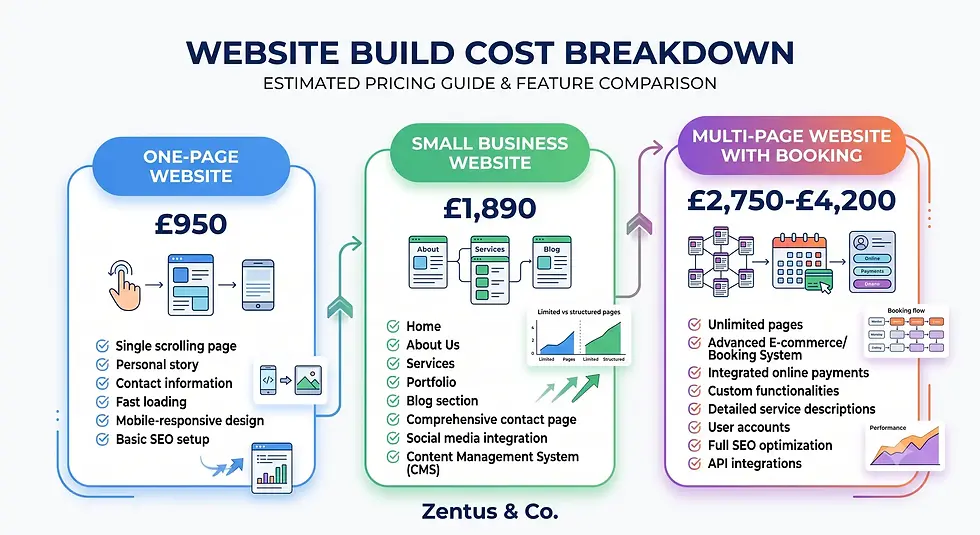
A simple, professional one-page business website costs from £950 (Zentus & Co., August 2026 pricing). A fuller small-business site with 4-6 pages, a contact form, and basic SEO setup runs £1,890, and a multi-page site with booking or e-commerce integration runs £2,750-£4,200 depending on complexity.
Build-Cost Comparison Table
Build type | Typical market agency price | Zentus & Co. price | Best for |
DIY template (self-build) | £0 + your time | N/A | Testing an idea, zero budget |
One-page website | £1,000-£1,600 | £950 | Solo trades, micro-businesses |
Small business website (4-6 pages) | £2,000-£3,200 | £1,890 | Salons, clinics, local shops |
Multi-page + booking/e-commerce | £3,200-£5,000 | £2,750-£4,200 | Restaurants, multi-service trades |
Market benchmark ranges reflect typical UK small-agency pricing estimates for equivalent scope, not quoted prices from a named competitor. Zentus & Co.'s pricing sits approximately 5-7% below the market range for comparable builds.
Platform/Plan Cost Table
Plan | Monthly cost | What it unlocks | Best for |
Wix Light | ~$17/mo | Basic site, no e-commerce | Portfolio/info-only site |
Wix Core | ~$29/mo | Bookings, basic e-commerce | Service businesses taking bookings |
Wix Business | ~$36/mo | Full e-commerce, abandoned cart recovery | Product-based businesses |
How long does it take to build a small business website?
A one-page site typically takes 1-2 weeks from brief to launch. A full small-business site with custom design and copy runs 3-4 weeks. A multi-page site with booking or e-commerce integration takes 4-6 weeks, largely dependent on how quickly the client supplies photos and copy.
Fit: When a GBP-Only Strategy Works
This fits businesses that are hyper-local, single-service, and not yet competing on price or brand. If you're a brand-new, single-operator business testing demand in one small area with almost no local competition, a GBP-only approach can genuinely work for the first 3-6 months.
Is a one-page website enough alongside a Google Business Profile?
For most small local businesses, yes — a single, well-built page with your services, pricing, contact form, and trust signals (reviews, guarantee, photos) is enough to close the credibility gap a GBP alone leaves open, without the cost of a full multi-page build.

Gap: What You Lose Without a Full Website
The gap is control — over your brand, your data, and your customer relationship. Relying only on GBP means every customer interaction happens inside a platform Google designs, ranks, and can restrict at will.
Does a website help with email marketing and remarketing?
Yes — a GBP listing captures zero customer emails. A website with even a simple newsletter sign-up or booking-confirmation flow starts building an owned contact list, which is the single asset that lets a business market to past customers directly instead of paying to be rediscovered on Google every time.
Can I control my brand better with a website than GBP?
Significantly, yes. GBP forces a fixed template — the same layout, same photo grid, same review-first structure as every competitor in your category. A website lets you control colour, tone, story, pricing presentation, and the exact order customers see information in, none of which is possible inside a Google-owned template.
Can a website help me collect customer reviews too?
Yes — a website can embed a review request flow, testimonials page, or third-party review widget, working alongside (not instead of) Google reviews, and giving you a permanent, ownable record of social proof that doesn't disappear if a Google policy change ever restricts review display.
Risk: Relying Only on a Platform You Don't Own
The single biggest risk of a GBP-only strategy is that you don't own the platform your business depends on.
What happens if my Google Business Profile gets removed?
If Google suspends or removes your profile, your entire local search visibility disappears immediately — no Maps pin, no reviews displayed, no "call now" button — until (and if) you successfully appeal. Businesses report reinstatement taking anywhere from a few days to over a month, with zero revenue from Google-driven discovery in the meantime.
What happens to my visibility if Google changes its algorithm?
Google updates its local ranking algorithm multiple times a year. A GBP-only business has no fallback when an update shifts prominence weighting — a website gives you an independent, indexed asset that keeps generating organic search traffic even during a Maps ranking dip, because it ranks on separate signals (backlinks, content depth, on-page SEO) that a GBP profile doesn't control.
Best for use case, in one line: businesses wanting maximum local discovery with zero ownership risk should treat GBP as step one — not step final.

Hidden Costs Most Advice Doesn't Mention
Even businesses that "just use Google Business Profile" often carry costs they don't associate with the decision:
Domain renewal (if you already own one for email) — typically £10-£15/year, easy to let lapse and lose to a squatter
Booking software subscriptions used to patch GBP's missing native booking (Calendly, Fresha, etc.) — £10-£40/month, an ongoing cost that a website with built-in booking avoids duplicating
Reputation management tools many GBP-only businesses adopt to manage review volume manually — £20-£60/month
Paid ads to compensate for low organic reach beyond the Maps 3-pack — often the largest hidden cost, frequently £200+/month for businesses trying to substitute ad spend for the SEO reach a website would build for free over time
Lost revenue during a suspension — impossible to quote exactly, but for a business generating even £2,000/month primarily via Google Maps discovery, a two-week suspension represents a real, measurable loss
Who This Is Best For
A Google Business Profile alone is best for:
brand-new solo businesses testing a local market, hyper-local trades with almost no direct competition, and businesses with under six months of trading history and minimal budget.
A website alongside a GBP is best for:
any business taking online payments or bookings, any business competing against others with an established website, multi-location businesses, businesses running or planning paid advertising, and any business owner who wants a customer list and brand presence they actually own.
Frequently Asked Questions
How much does a small business website cost in 2026?
A small business website costs from £950 for a one-page build up to £2,750-£4,200 for a multi-page site with booking or e-commerce (Zentus & Co., August 2026 pricing). Exact cost depends on page count, integrations (booking, payments), and whether custom copywriting and photography are included.
Is it cheaper to just use Google Business Profile instead of a website?
In the short term, yes — GBP is completely free to set up. But the hidden costs (booking software subscriptions, paid ads to compensate for limited organic reach, and potential revenue loss during a suspension) often exceed the one-time cost of a £950 website within the first year for any business actively trying to grow.
How much does a Wix website cost compared to Google Business Profile?
Google Business Profile is free with no monthly fee. A Wix-built website through Zentus & Co. starts from £950 as a one-time build cost, plus a Wix plan from approximately $17-$36/month depending on features needed (bookings, e-commerce). GBP has no equivalent recurring cost, which is exactly why it's tempting to stop there — but the comparison isn't apples-to-apples once ownership and features are factored in.
Can I link my Wix website directly to my Google Business Profile?
Yes — Wix websites integrate directly with Google Business Profile via the website URL field, allowing Google to crawl your site for additional ranking signals and giving customers a "visit website" button that leads straight to your Wix-built pages, embedded booking system, or online store.
Should I get a website first or set up Google Business Profile first?
Set up Google Business Profile first — it's free, fast to verify, and gets you into local search immediately. Build the website in parallel or shortly after, so that by the time customers click through from your GBP listing, there's a professional site waiting rather than a "coming soon" page.
Is Google Business Profile alone enough to grow my business?
For steady, incremental local growth, a GBP alone is rarely enough — it's a discovery tool, not a conversion and retention tool. Businesses that pair a GBP with a website consistently report stronger repeat-customer rates because the website captures emails, showcases full service range, and builds the trust signals a GBP's fixed template can't.
What's the risk of relying only on Google Business Profile?
The core risk is platform dependency — Google can suspend, restrict, or algorithmically deprioritise a profile at any time, and a GBP-only business has no independent, owned digital asset to fall back on when that happens. A website functions as insurance against that single point of failure.
Do hairdressers need a website or just a Google listing?
A hairdresser taking online bookings, selling gift vouchers, or running multiple stylists' schedules needs a website with integrated booking software — GBP alone can't manage per-stylist availability, deposits, or a loyalty programme, all of which directly affect no-show rates and repeat bookings.
Do plumbers need a website if they already rank on Google Maps?
Yes, particularly for emergency callout services competing on speed and trust — a website lets a plumber show licensing/insurance details, a service-area map, and instant-quote forms that a GBP listing's fixed fields can't display, which matters most in the exact moment a customer is comparing multiple emergency options at once.
What is the difference between a website and Google Business Profile?
A Google Business Profile is a free, Google-owned local listing focused on discovery (Maps, reviews, contact details). A website is an owned, fully customisable platform focused on credibility, conversion, bookings, payments, and long-term SEO reach beyond local search. They serve complementary, not competing, functions.
Why do businesses need a website in 2026?
In 2026, customers routinely cross-check a Google listing against a website before committing to a purchase or booking, particularly for higher-value services. A business without a website increasingly looks unfinished or untrustworthy by comparison to competitors who have one — a credibility gap that's only widened as more small businesses adopt affordable website options like Wix.
Conclusion
A Google Business Profile is the fastest, cheapest way to appear in local search — but it was never designed to be a business's only online presence. It can't take payments, can't fully protect your brand from a sudden suspension, and can't rank for the wider, non-local searches a website reaches. The businesses that grow past their first year almost always have both: a GBP for local discovery, and a website — often built from £950 — for everything the free listing can't do.
If your business is currently running on a Google Business Profile alone, the fastest way to see exactly what a website would add is a direct side-by-side teardown of your listing against what a Wix Studio build could unlock.
Get a free GBP-vs-Website teardown from Zentus & Co. — see exactly which gaps your current setup is leaving open, and what closing them would cost. Contact us to book yours, or browse our pricing to see full build costs upfront.


Comments