


Do I Need a Landing Page or a Website?

Updated: Sep 7

Quick Answer: Landing Page vs Website
A landing page is a single, standalone page built around one goal — usually a paid ad campaign, a product launch, or a lead-gen offer — with one call-to-action and no navigation menu. A website is a multi-page structure (typically 5-12+ pages) covering your homepage, services, about, portfolio, blog and contact, built for long-term visibility, trust and organic Google traffic.
The short version: if you're running paid ads or launching one specific offer, start with a landing page (build cost roughly £595-£880 / $750-$1,100). If you need people to find you on Google, trust your business, and browse multiple services, you need a full website (build cost roughly £1,670-£2,975 / $2,100-$3,750). Most established businesses eventually need both — a website for organic growth and trust, and dedicated landing pages for each ad campaign or seasonal offer.
According to Unbounce's 2024 Conversion Benchmark Report, dedicated landing pages convert at an average of 5.89% across industries, compared to typical multi-page website conversion rates of 2-3% — because a landing page removes every distraction except the one action you want visitors to take.
In this guide:
What actually separates a landing page from a website (and where a homepage fits in)
When a landing page wins, and when it will quietly cost you sales
Exact build costs for both, benchmarked against typical agency pricing
The SEO trade-off most business owners don't realise until it's too late
Whether you need one, the other, or both — with a decision tree
This guide covers what a landing page is, what a full website is, the core differences between them, when to use each one, real build costs for August 2026, the SEO gap that catches new businesses out, and whether you can (and should) run both at once.
Choosing wrong here isn't just a design decision — it's a traffic and revenue decision. A landing page built for a Facebook ad campaign will never rank on Google for your business name. A 12-page website with no dedicated offer page will convert paid traffic worse than a single focused landing page. Getting this right from day one saves you a rebuild later.
What Is a Landing Page?
A landing page is a single web page with one job: get the visitor to take one specific action — buy, book, sign up, or download. It has no main navigation menu, no links away from the page other than the call-to-action, and no distractions. Every landing page is built to answer one question for one audience arriving from one source, usually a paid ad, an email campaign, or a social media post.
Landing pages typically follow a proven structure: a headline and sub-headline, a hero image or short video, 3-5 benefit blocks, social proof (reviews, logos, numbers), an objection-handling FAQ, and a repeated call-to-action every 1-2 scrolls. There's no "About Us," no blog, no second product — just the offer.
What Makes a Page a Landing Page?
A page qualifies as a landing page when it has one goal, one call-to-action, and no navigation menu pulling visitors away from converting. If a page has a top nav bar linking to "Home," "Services," "About" and "Contact," it's functioning as a website page — not a landing page — regardless of what it's called.
How Many Sections Does a Landing Page Have?
Most effective landing pages have 6-9 sections: hero/headline, benefits, social proof, how-it-works, pricing (if applicable), FAQ, and a final call-to-action. Fewer sections than this and the page under-explains the offer; more than 9-10 and conversion rates typically drop because visitors lose focus before reaching the action.
Is a Landing Page the Same as a Homepage?
No. A homepage is one page inside a multi-page website and always includes navigation to other pages — services, about, contact. A landing page stands alone, has no site navigation, and exists purely to convert traffic from one specific source into one specific action. We cover this distinction fully in the Landing Page vs Homepage Differences section below.
What Is a Website?
A website is a connected structure of multiple pages — typically homepage, services/products, about, portfolio or case studies, blog, and contact — built for visitors to explore, browse, and find information over time. Unlike a landing page, a website is designed to be found: through Google search, direct URL visits, social profiles, and word-of-mouth, not just a single ad click.
A website's job is broader: build credibility, rank for dozens of search terms over months and years, house your full service range, and give returning customers somewhere to check pricing, read reviews, or contact you directly — all without needing an active ad campaign running.
How Many Pages Does a Website Usually Have?
A small business website usually runs to 5-8 core pages: home, about, services (or a page per service), testimonials/reviews, and contact. Businesses with content marketing strategies add a blog, which can grow the site to 20, 50, or hundreds of pages over time — each one a potential Google ranking opportunity a landing page could never provide.
What Sections Should a Small Business Website Include?
At minimum, a small business website should include a homepage (clear value proposition), a services or products page, an about/trust page, a testimonials or reviews section, a contact page with a form and map, and ideally a blog for ongoing SEO. Missing any of these is a common reason small business sites underperform on Google.
Landing Page vs Website: Core Differences
The clearest way to see the landing page vs website trade-off is side by side. Zentus & Co. builds both formats in Wix Studio, and the difference in structure, goal, and lifespan is stark once laid out.
Factor | Landing Page | Website |
Number of pages | 1 | 5-100+ |
Navigation menu | None | Full menu |
Primary goal | One conversion action | Browsing, trust, discovery |
Traffic source | Paid ads, email, social | Google search, direct, referral |
SEO potential | Very limited (1 URL) | High (grows with every page/blog post) |
Lifespan | Weeks to months (campaign-length) | Years (ongoing asset) |
Typical build cost (Aug 2026) | £595-£880 / $750-$1,100 | £1,670-£2,975 / $2,100-$3,750 |
Best for | Product launches, ad campaigns, events | Established businesses, service providers, retailers |
What Is the Main Difference Between a Landing Page and a Website?
The main difference is structure and purpose: a landing page is a single page with one goal and no navigation, built for short-term paid campaigns; a website is a multi-page structure built for long-term discovery, trust-building, and organic Google traffic. One is a sprint asset, the other is a compounding asset.
Which One Loads Faster, a Landing Page or a Website?
A well-built landing page typically loads marginally faster than a full website's homepage, simply because it carries fewer scripts, fewer navigation elements, and often one focused hero image rather than a multi-page asset library. In practice, the gap is small (often under 0.5 seconds) if both are built cleanly on a modern platform like Wix Studio — hosting and image optimisation matter more than page type.

When to Use a Landing Page
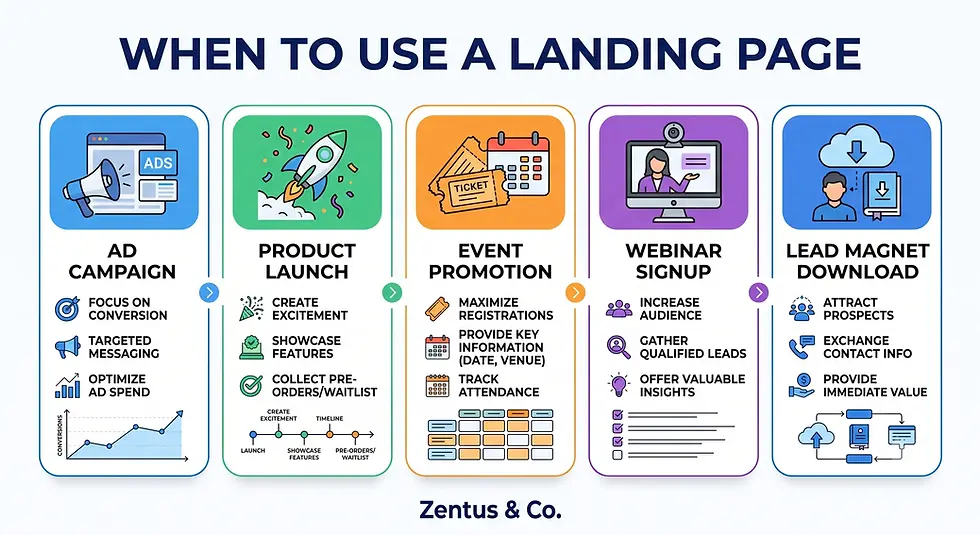
Use a landing page whenever you have one specific offer and traffic is arriving from one specific source — an ad, an email, a QR code, or a social post. The rule of thumb: if you're paying for the click, you need a page built to convert that exact click, not a general-purpose website homepage competing for attention with a nav bar full of other options.
When Should I Use a Landing Page Instead of a Website?
Use a landing page instead of a website when you're running a time-limited campaign: a seasonal sale, a webinar signup, a lead magnet download, a single product launch, or a local event promotion. In each case, the goal is one conversion from a known traffic source — exactly what a landing page is built for, and exactly what a general website homepage does poorly.
Are Landing Pages Good for Facebook Ads?
Yes — landing pages are the standard best practice for Facebook and Instagram ad campaigns. According to Meta's own advertiser guidance, ads pointing to a dedicated landing page (rather than a homepage) consistently produce lower cost-per-conversion, because the page matches the ad's specific message with zero navigation to distract the visitor from converting.
When You Need a Full Website
You need a full website the moment your business relies on people finding you organically — through Google search, business directories, or someone searching your business name after hearing about you. A landing page cannot fulfil this role: it has no capacity to rank for the dozens of search terms a real business needs to be found for over time.
How Do I Know If My Business Needs a Full Website?
Your business needs a full website if any of these apply: you offer more than one service, you want to rank on Google for local or industry search terms, you need customers to trust you before buying (higher-ticket services, B2B, healthcare, legal), or you plan to operate for years, not weeks. A landing page cannot serve any of these needs long-term.
Does a Service Business Need More Than One Page?
Most service businesses need at least 4-6 pages: a homepage, a page per major service (or one combined services page), an about/trust page, and a contact page. A single-page site for a service business typically under-explains the offer and gives Google far fewer opportunities to rank the business for relevant local search terms.

Landing Pages for Ad Campaigns
Landing pages exist to serve one traffic funnel cleanly: ad click → landing page → conversion. Every design decision on the page — headline, imagery, social proof, call-to-action — should mirror the exact promise made in the ad that brought the visitor there. Break that match, and conversion rates drop sharply, a phenomenon marketers call message mismatch.
Why Do Marketers Use Landing Pages for Ads?
Marketers use dedicated landing pages for ads because they can be tailored precisely to the ad's message, tracked in isolation (one URL, one set of analytics), and A/B tested without touching the main website. A homepage serving ten different audiences can't be optimised for any single one — a landing page can be optimised relentlessly for exactly one.
Do Landing Pages Convert Better Than Websites for Ads?
Yes, in almost every documented case. Removing the navigation menu alone has been shown in Unbounce's platform data to lift conversion rates because visitors have no alternative path except the intended action. Sending paid traffic to a full website homepage typically dilutes conversion rate because visitors browse instead of converting.

Websites for Long-Term Branding
Where landing pages win on short-term conversion, websites win on compounding value. Every blog post, every service page, and every piece of content published on a website is a permanent asset that keeps generating organic traffic long after it's published — something a landing page, by design, cannot do.
Why Do Websites Build More Trust Than Landing Pages?
Websites build more trust because they give visitors the ability to verify a business independently: browsing the about page, checking multiple services, reading testimonials, and confirming contact details before committing. A landing page, with its single-minded focus on one action, can feel high-pressure to visitors who are still in the research phase rather than ready to buy.
Can a Website Help With Long-Term SEO Growth?
Yes — a website is the only format that can compound in Google visibility over time. Each new page or blog post is an additional opportunity to rank for a new search term, and Google explicitly rewards sites with depth of relevant content on a topic. A landing page, capped at one URL, has no way to replicate this growth mechanism.
Cost Differences Explained
Here's the honest, exact breakdown of what each format costs to build professionally, based on typical UK/US agency pricing in August 2026. Zentus & Co. positions its build pricing roughly 5-7% below typical market rates for equivalent Wix Studio quality.
Build type | Typical agency price | Zentus & Co. price | Best for |
Single landing page | £650-£950 ($800-$1,200) | £595-£880 ($750-$1,100) | Ad campaigns, product launches, single offers |
Small business website (5-8 pages) | £1,800-£3,200 ($2,300-$4,000) | £1,670-£2,975 ($2,100-$3,750) | Service businesses, retailers, local brands |
Website + blog setup | £2,400-£4,200 ($3,000-$5,300) | £2,230-£3,900 ($2,800-$4,900) | Businesses investing in organic SEO growth |
Landing page + full website combo | £2,300-£3,900 ($2,900-$4,900) | £2,140-£3,625 ($2,700-$4,600) | Businesses running ads AND wanting long-term SEO |
A landing page costs less because it's one page, one design pass, and one round of copywriting. A full website costs more because it requires an information architecture (deciding what goes where), multiple page designs, and typically more content — but it's the only format that keeps paying off in organic traffic for years, not just for the length of an ad campaign.
Is a Landing Page Cheaper to Build Than a Website?
Yes — a landing page is almost always cheaper, typically £595-£880 versus £1,670-£2,975 for a small business website (August 2026 figures). The cost gap reflects scope: one page with one goal versus five-to-eight interconnected pages, each requiring its own structure, content, and design pass.
How Much Does a Small Business Website Cost?
A professionally built small business website (5-8 pages) typically costs £1,670-£2,975 / $2,100-$3,750 with Zentus & Co. in August 2026, against a market average of £1,800-£3,200 / $2,300-$4,000 at comparable agencies. Pricing depends on page count, custom design versus template-based build, and whether a blog is included.
How Much Does a Landing Page Cost to Build?
A single, professionally designed landing page typically costs £595-£880 / $750-$1,100 with Zentus & Co. in August 2026, compared with a market average of £650-£950 / $800-$1,200. Price scales with the number of sections, custom copywriting, and whether A/B test variants are included.

Hiring Local vs Remote Help for Your Landing Page or Website
Whether you're commissioning a landing page or a full website, you'll typically choose between a local agency or freelancer and a remote specialist agency. Here's the honest comparison for both build types, based on typical UK figures across a 3-year ownership period.
Route | Build cost | Annual running cost | 3-year total |
Local agency/freelancer | £2,000-£6,000 | £600-£1,500 | £3,800-£10,500 |
Remote specialist agency (Zentus & Co.) | £950-£4,200 | £420-£900 | £2,210-£6,900 |
When local wins: you specifically want face-to-face meetings, you're part of a local business network that refers work to nearby designers, or you need in-person training on managing the site after handover.
When remote wins: you want specialist Wix Studio expertise without paying for a local agency's office overhead, you're comparing landing page and website builds and want fixed, transparent pricing, or you're happy to collaborate over video calls, Loom walkthroughs and email — which covers the vast majority of landing page and small website projects.
Over a 3-year period, a remote specialist route can save a business roughly £1,600-£3,600 compared with a typical local agency retainer, according to the figures above — a gap that widens further if the business needs both a landing page and a website built in the same year.
SEO Differences Between the Two
This is the trade-off most business owners underestimate until months into their marketing. A single landing page has almost no capacity to rank organically on Google — it's one URL competing against multi-page websites with dozens of targeted pages.
Do Landing Pages Rank on Google Like Websites Do?
No — landing pages rank poorly on Google compared with websites, because they're built around one keyword or offer, carry minimal supporting content, and are usually excluded from Google's index deliberately (many ad-funded landing pages use noindex tags to avoid diluting the main site's SEO). Websites, by contrast, can rank for dozens or hundreds of search terms.
Can a Landing Page Rank for Multiple Keywords?
Rarely, and never well. A landing page is built around a single, narrow offer, which limits its content depth to one topic. Google's ranking algorithm rewards topical depth — multiple pages covering related subtopics — something a single landing page structurally cannot provide, regardless of how well it's optimised.
Does a Full Website Rank Better Than a Landing Page?
Yes, decisively. Verdict: for organic Google visibility, a full website always outperforms a landing page — a website's multiple pages, internal linking, and (if maintained) blog content give Google far more material to index and rank than a single standalone page ever can.
Can You Have Both?
Yes — and for most growing businesses, running both is the correct long-term setup. The website handles organic search, brand trust, and the full service range; dedicated landing pages handle each paid campaign, seasonal offer, or product launch without cluttering the main site's navigation or diluting its SEO focus.
Can a Landing Page Replace My Whole Website?
No, not for any business planning to operate beyond a single campaign. A landing page cannot list multiple services, cannot rank for more than a narrow set of terms, and gives returning customers nowhere to browse. It works brilliantly as a campaign tool but fails as a permanent business home. ways to increase online sales
Do I Need a Website If I Already Have a Landing Page?
Yes, in almost every case. A landing page converts the traffic you're already paying to send it — but it does nothing to generate new organic traffic or build the long-term trust a website provides. Businesses that rely solely on a landing page effectively rent their visibility through ongoing ad spend, rather than owning it.
Can I Use a Landing Page and a Website Together?
Yes — this is the most common professional setup: a full website as the permanent home (linked from Google, business cards, and social profiles), with individual landing pages built and retired as needed for specific campaigns, each one linking back to the main site's relevant service page once the visitor has converted or the campaign ends.
Decision shortcut: if you're running paid ads this month → build a landing page. If you want to be found on Google in 12 months → build a website. If both apply → build the website first, then add landing pages per campaign.
Not sure which one fits your business? Get a free teardown of your goals and we'll tell you honestly whether you need a landing page, a full website, or both.

Landing Page vs Homepage Differences
These two get confused constantly because both are often "the first page" a visitor sees — but they serve opposite purposes.
Navigation: Homepage has a full menu; landing page has none.
Traffic source: Homepage receives varied traffic (search, direct, social); landing page receives one specific source (an ad or campaign link).
Goal: Homepage introduces the whole business; landing page drives one action.
Lifespan: Homepage is permanent; landing page is often retired after a campaign ends.
SEO role: Homepage is usually indexed and optimised; landing pages are often deliberately excluded from search indexing.
Content depth: Homepage links deeper into the site; landing page contains everything needed to convert on that single page.
Is My Homepage Considered a Landing Page?
Technically, any page a visitor "lands on" from an ad could be called a landing page — but functionally, no: if your homepage has a full navigation menu, it's operating as a website page, not a true landing page. True landing pages are purpose-built with navigation stripped away entirely.
What's the Difference Between a Homepage and a Landing Page?
A homepage is the entry point to a multi-page website, with navigation to every other section of the business. A landing page is a standalone, navigation-free page built for one conversion goal, disconnected from the rest of the site's browsing structure.

Is a Landing Page Enough for a New Business Launch?
For a pure launch moment — announcing a new product, running a pre-order campaign, or testing demand before building out a full brand — a single landing page can be enough short-term. It's fast to build, cheap to test, and focused entirely on validating the offer.
Is One Landing Page Enough for a New Business Launch?
One landing page is enough for the first 2-6 weeks of a launch — long enough to validate demand and collect early leads or sales. Beyond that window, most new businesses need to move to a full website to support organic search visibility, list multiple offerings, and build the trust signals a single page can't carry indefinitely.
In Wix Studio builds, the setup detail that changes the outcome here is planning the landing page's structure so it can later be absorbed as a homepage section inside a full website — saving a full rebuild once the launch phase ends.
The Conversion Gap Most One-Page Sites Miss
Businesses that launch with a single landing page and never expand often hit an invisible ceiling: they can convert the traffic they pay for, but they have no mechanism to convert people who find them through search, referral, or word-of-mouth — because there's nowhere for that traffic to land except the same single, campaign-specific page.
Should My Landing Page Link Back to My Main Website?
Yes, once a main website exists. A landing page should include a subtle link back to the main site (often in the footer only, to avoid distracting from the primary call-to-action) so visitors who aren't ready to convert immediately can still explore the broader business rather than bouncing away entirely.
When configuring this workflow in Wix, the practical issue is that a landing page with zero exit paths converts well for the ready-to-buy visitor but loses everyone else completely — a soft footer link recovers a meaningful share of that otherwise-lost traffic without hurting the primary conversion rate.
The SEO Risk of Skipping a Full Website
Businesses that rely permanently on landing pages (rather than a website) run a specific, compounding risk: zero organic visibility growth. Every visitor has to arrive through a paid channel, meaning the business is permanently renting its traffic rather than building an owned, growing asset.
A clean Wix Studio setup usually separates businesses that thrive long-term from those stuck restarting every quarter, because the ones with a real website keep accumulating indexed pages, backlinks and search rankings — assets that keep working even when ad budgets pause. A landing page provides none of that residual value once the campaign ends.
According to Ahrefs' 2024 organic traffic study, websites with 20+ indexed pages received on average 7x more organic search traffic than single-page sites — a gap that only widens the longer a business relies solely on paid landing pages.
Hidden Costs Most Quotes Don't Include
Whether you build a landing page or a full website, watch for costs agencies often leave out of the headline quote:
Domain renewal — typically £10-£15 / $12-$18 per year, separate from the build.
Copywriting — many quotes assume you supply the words; professional copy can add £150-£500 per page.
Stock imagery or custom photography — £50-£300 depending on licensing and volume.
Email hosting — business email is rarely bundled; expect £4-£8/month per mailbox.
Ongoing maintenance/updates — plugin and app updates, content changes: £40-£120/month if outsourced.
A/B testing tools — for landing pages specifically, split-testing apps can add £20-£50/month.
SEO retainer — for websites aiming to rank, ongoing content and optimisation work typically runs £300-£800/month.
Always ask any quote — including from Zentus & Co. — to itemise these separately before comparing prices across agencies.
Who This Is Best For
Best for a landing page: businesses running one paid ad campaign, launching a single product, promoting a one-off event, or collecting leads for a webinar or download.
Best for a full website: service businesses with multiple offerings, businesses that want to rank on Google, anyone needing customers to trust them before buying, and any business planning to operate beyond a single campaign.
Best for both together: growing businesses running active ad campaigns while also investing in long-term organic SEO growth — the most common setup among established small businesses.
FAQ
How much does it cost to build a landing page vs a full website?
A single landing page typically costs £595-£880 / $750-$1,100 with Zentus & Co. (August 2026), while a full small business website (5-8 pages) runs £1,670-£2,975 / $2,100-$3,750. The gap reflects scope — one focused page versus a full multi-page structure with navigation, content, and SEO setup.
Is it cheaper to start with a landing page before building a website?
Yes — starting with a landing page is the cheaper way to validate an offer before committing to a full website build. It typically costs 60-70% less upfront, letting you test demand for as little as £595-£880 before investing in the larger website build once the offer is proven.
Can I build a landing page using Wix?
Yes — Wix and Wix Studio both support standalone landing pages with drag-and-drop sections, no navigation menu required, built-in analytics, and A/B testing tools on higher-tier plans. It's one of the most common platforms for building fast, professional landing pages without custom code.
Does Wix let me upgrade a landing page into a full website later?
Yes — a Wix landing page can be expanded into a full website by adding pages and a navigation menu without rebuilding from scratch, since the same site editor and design elements carry over. This is one reason many businesses start with a landing page on Wix and grow it into a full site later.
Should a new business start with a landing page or a website?
It depends on the launch goal: if you're testing demand for one specific offer, start with a landing page (£595-£880). If you're launching a business with multiple services and want to be found on Google from day one, start with a full website (£1,670-£2,975).
How do I decide between a landing page and a full website?
Ask two questions: where is my traffic coming from (paid ads = landing page; Google search = website), and how many things am I selling (one offer = landing page; multiple services = website). If both a paid campaign and organic discovery matter, you'll eventually need both.
Do restaurants need a full website or just a landing page?
Most restaurants need a full website with a menu page, location/hours, reservations link, and photos — because customers primarily find restaurants through Google search and Maps, not paid ads. A landing page might supplement a specific promotion (a new opening or a seasonal menu) but can't replace the core site.
Is a landing page enough for a local service business?
Rarely as a permanent solution. Local service businesses (plumbers, electricians, salons) rely heavily on local Google search visibility, which requires multiple indexed pages and a Google Business Profile connection — something a single landing page structurally cannot support long-term.
What is the difference between a landing page and a website?
A landing page is one standalone page built for a single conversion goal with no navigation menu; a website is a multi-page structure built for browsing, organic search visibility, and long-term trust. One serves a campaign; the other serves the whole business, ongoing.
Can a landing page replace a website completely?
No — a landing page cannot list multiple services, rank for a range of search terms, or give returning visitors somewhere to browse. It's an effective campaign tool but not a substitute for the ongoing visibility and trust-building a full website provides.
How long does it take to build a landing page compared to a website?
A landing page typically takes 1-2 weeks to design, write, and launch. A full small business website (5-8 pages) typically takes 3-5 weeks, depending on content readiness, revisions, and whether a blog setup is included. how long it takes to build a website
Which converts better for lead generation, a landing page or a website?
For paid traffic and lead generation specifically, a landing page converts better — average conversion rates of 5.89% (Unbounce, 2024) versus 2-3% for general website pages — because it removes navigation and focuses the visitor on one action. For organic, browsing traffic, a full website typically performs better overall.
Conclusion
The landing page vs website decision comes down to one question: are you paying for this traffic, or do you want people to find you for free, forever? Paid campaigns deserve a focused landing page. Long-term visibility and trust require a full website. Most growing businesses eventually need both — a website as the permanent home, and landing pages built and retired around each campaign.
Not sure which one your business actually needs? Get a free teardown from Zentus & Co. — we'll look at your goals honestly and tell you whether a landing page, a full website, or both is the right call, with exact pricing before you commit.

Comments