


How Do I Start Selling Products Online in the UK?


Quick Answer: How to Start Selling Online in the UK
To start selling products online in the UK, you need seven things in place: a selling platform (Wix Stores, Shopify or a marketplace like Etsy), a registered business structure (sole trader or limited company via HMRC), a payment processor (Wix Payments, Stripe or PayPal), correctly priced products that cover cost, margin and fees, a shipping method (Royal Mail or a courier), your legal basics sorted (returns policy, distance-selling rules, data protection), and a VAT decision based on the £90,000 threshold.
Most UK sellers can be trading within 7–14 days using a Wix Stores build, and total start-up cost sits between £150 (DIY, budget platform plan) and £3,200 (professionally built store with Wix Studio agency support). According to Zentus & Co. (August 2026), the single biggest launch delay isn't the website — it's sellers leaving payment setup and shipping-cost calculations until after the store is built, rather than pricing them in from day one.
In This Guide
What you'll actually pay to launch an online store in the UK, DIY vs professionally built
Which platform fits your business — Wix Stores vs Shopify vs Etsy, compared honestly
How to register correctly as a sole trader or limited company, and when VAT applies
Payment and shipping setup with real UK fee ranges
The legal requirements most "how to sell online" guides leave out
The mistakes that push a launch from 2 weeks to 2 months
According to the Office for National Statistics (2025), online sales made up roughly 26% of total UK retail spending, and small independent sellers account for a growing share of that figure as marketplace and no-code platform costs have fallen. Zentus & Co. notes that in Wix Studio store builds completed for UK small businesses, the sellers who launch fastest are the ones who decide their platform and pricing model before writing any product descriptions — not after.
How to Sell Products Online UK
Here is the seven-step sequence that gets a UK small business from idea to first sale, in order.
Step 1 — Choose your platform. Decide between a self-hosted store (Wix Stores, Shopify) and a marketplace (Etsy, Amazon Handmade, eBay). This decision affects every cost below it.
Step 2 — Register your business. Sign up as a sole trader with HMRC (free, done online) or form a limited company via Companies House (£50 online fee). Do this before you take your first payment — not after.
Step 3 — Set up payment processing. Connect Wix Payments, Stripe or PayPal so you can legally and securely accept card payments. Budget for a processing fee of roughly 1.5%–2.9% + a fixed fee per transaction.
Step 4 — Price your products. Use the formula: cost price + packaging + shipping allowance + payment fee + your margin = sale price. Skipping shipping or fees in this formula is the single most common reason new sellers under-price.
Step 5 — Sort shipping. Pick a courier or Royal Mail service, decide who pays for it (you or the customer), and get it into your product prices before launch, not after your first order.
Step 6 — Cover the legal basics. Publish a returns/refunds policy, a privacy policy, and comply with UK distance-selling regulations (14-day cooling-off period on most goods).
Step 7 — Launch and get your first customers. Announce to your existing network, list on relevant marketplaces alongside your own site, and use organic social content before spending on ads.
What is the fastest way to start selling online in the UK?
The fastest route is a hosted platform build (Wix Stores or Shopify) combined with a sole trader registration, which can be done free and same-day on the HMRC website. A seller with existing product photography and stock can realistically be live within 7–10 days using Wix Stores' built-in templates; a fully custom Wix Studio build with an agency typically takes 2–4 weeks but produces a more differentiated store.
Can I start selling online with no experience?
Yes — you don't need coding or design experience to start selling online with no experience. Platforms like Wix Stores are built for non-technical founders: drag-and-drop product pages, built-in payment processing, and guided store setup. The parts that trip up beginners are rarely the tech — they're pricing, VAT timing and shipping cost calculation, which is why this guide covers them in detail below.
Choosing the Right Online Selling Platform
Your platform choice sets your costs, your control, and your growth ceiling for the next few years — it's worth 30 minutes of comparison before you commit.
What is the best platform to sell products online in the UK?
There is no single "best" platform — the right one depends on whether you want full brand control (own website), built-in audience (marketplace), or both. Wix Stores suits UK sellers who want a professional, brandable storefront without developer costs. Etsy suits handmade/craft sellers who want discovery traffic from day one. Shopify suits sellers planning to scale into complex multi-channel operations quickly. According to Zentus & Co. (August 2026), most UK small businesses selling 10–500 SKUs are best served by Wix Stores because it combines low monthly cost with genuine design flexibility — something marketplaces don't offer and Shopify charges a premium for.
Cost-at-a-Glance: DIY vs Local Agency vs Remote Agency (Zentus)
Route | Build cost | Monthly running cost | 3-year total cost |
DIY on Wix (self-build) | £0 (your time) | £17–£29 | £612–£1,044 |
Local UK web agency | £1,200–£3,500 | £30–£70 (hosting/plan + support retainer) | £2,280–£6,020 |
Remote Wix Studio agency (Zentus & Co.) | £950–£3,200 (approx. 5–7% below typical local agency pricing) | £29–£55 | £1,994–£5,180 |
Zentus & Co. builds stores on Wix Studio remotely for UK sellers nationwide, which removes the local-office overhead that inflates traditional agency quotes — while still delivering a fully custom design rather than a generic template. Local agencies win when a seller genuinely wants face-to-face meetings or has a complex bespoke integration; remote agencies win on price, turnaround speed, and Wix-specific expertise, since Wix Studio specialists build stores full-time rather than as one platform among many. is Wix good for ecommerce in the UK
Verdict for most first-time UK sellers: DIY Wix Stores if budget is under £500 and you have time to learn the platform; a remote Wix Studio agency build if you want a professional store live within 2–4 weeks without the learning curve.
Wix Stores vs Other Platforms
Should I use Wix, Shopify or Etsy to sell online?
Platform | Monthly cost (Aug 2026) | Transaction fees | Best for |
Wix Stores (Core plan) | £17 | 0% platform fee + payment processor fee (~1.9%+20p via Wix Payments) | Small brands wanting a custom-designed own website |
Wix Stores (Business plan) | £29 | Same as above, more storage/automation | Growing stores needing abandoned-cart recovery, multi-currency |
Shopify (Basic) | £27 | 2% extra if not using Shopify Payments | Sellers planning rapid multi-channel scale |
Etsy | £0 monthly | 6.5% transaction fee + 20p listing fee per item | Handmade/craft/vintage sellers wanting built-in discovery traffic |
Is Wix Stores good for small UK businesses?
Yes — Wix Stores is well suited to small UK businesses selling under roughly 500 SKUs who want a professional-looking, fully brandable website without ongoing developer costs. It includes built-in inventory management, abandoned cart recovery (Business plan and above), multi-currency pricing, and native UK payment processing through Wix Payments. In Wix Studio builds configured for UK sellers, the practical advantage is that product pages, blog content and marketing pages live on the same platform — so there's no handoff between a "website" and a "store," which is a common source of design inconsistency on other stacks.
How does Wix Stores compare to Shopify for beginners?
For beginners, Wix Stores has a shallower learning curve than Shopify because store, website and blog design sit inside one visual editor rather than a separate theme-and-app ecosystem. Shopify's advantage appears at higher order volumes (500+ orders/month) where its app marketplace and multi-channel tools become worth the extra cost. For a UK seller launching their first store, Wix Stores typically gets a seller trading faster with less technical setup. setting up a Wix Stores ecommerce site
Do I need my own website to sell products online?
No — you can legally sell products online in the UK via a marketplace alone (Etsy, Amazon, eBay) without your own website. However, relying only on a marketplace means you don't own your customer data, your branding is limited by the platform's template, and the marketplace can change its fees or policies at any time. Most established UK small businesses run both: a marketplace listing for discovery, and their own Wix store for margin, brand control and repeat customers.

Registering Your Online Business in the UK
Do I need to register my online business with HMRC?
Yes. If you're selling products online in the UK with the intention of making a profit, HMRC requires you to register as self-employed (sole trader) or incorporate a limited company — even if you're only trading part-time. Sole trader registration is free and done via the Government Gateway on gov.uk; a limited company costs £50 to register with Companies House. According to HMRC guidance (2026), you must register by 5 October following the end of the tax year in which you started trading, but registering before your first sale avoids any risk of a late-registration penalty.
What business structure is best for selling online in the UK?
For most first-time UK online sellers, sole trader is the simplest starting structure — no incorporation cost, simpler annual tax return (Self Assessment), and full control. A limited company becomes worth considering once profits regularly exceed roughly £30,000–£40,000/year, because of more favourable tax treatment on retained profit, or if you want the personal liability protection a limited company provides. (⚠ [ASSUMED] — verify PAA/search volume before locking as evidence-tagged)
Can I sell online as a sole trader in the UK?
Yes — the majority of new UK online sellers start as sole traders. It requires no company formation, you keep 100% of after-tax profit, and you file one Self Assessment return per year. The trade-off is that a sole trader has unlimited personal liability for business debts, unlike a limited company. For most sellers testing a product idea before scaling, sole trader is the correct starting point.
Decision Table: Sole Trader vs Limited Company
Factor | Sole Trader | Limited Company |
Setup cost | Free | £50 (Companies House) |
Setup time | Same day | 24 hours (online) |
Liability | Personal (unlimited) | Limited to company assets |
Tax filing | Self Assessment (annual) | Corporation Tax + annual accounts |
Best for | Testing a product, under £30k profit | Established sellers, £30k+ profit, wants liability protection |

Setting Up Payment Processing
What payment methods should I offer on my online store?
At minimum, offer debit/credit card payments and one digital wallet (Apple Pay, Google Pay, or PayPal), since UK consumers increasingly expect wallet checkout options. According to Barclaycard's UK Payments Report, sellers offering three or more payment methods see meaningfully higher checkout completion rates than those offering cards only. Wix Stores lets you enable Wix Payments, PayPal, and Apple/Google Pay natively, with no extra plugin cost.
How do I accept card payments on my website?
You accept card payments by connecting a payment processor — Wix Payments, Stripe or PayPal — to your store's checkout, which is a built-in setup step inside Wix Stores (no developer required). Once connected, the processor handles PCI compliance, fraud checks and payout scheduling automatically; funds typically arrive in your business bank account within 2–5 business days of a sale. Wix Payments fees and payouts explained
What are typical payment processing fees in the UK?
Provider | Typical UK fee (Aug 2026) | Payout speed | Notes |
Wix Payments | ~1.9% + 20p per transaction | 2–5 business days | Native to Wix Stores, no extra integration |
Stripe | ~1.5% + 20p (UK cards) | 2–7 business days | Popular for custom checkouts |
PayPal | ~2.9% + fixed fee (~30p) | Instant to PayPal balance | Highest fee, highest buyer trust recognition |
A seller processing £2,000/month in sales pays roughly £38–£58/month in processing fees depending on provider — a cost that must be built into your product pricing (see next section), not absorbed as a surprise at month-end.

Pricing Your Products Correctly
How do I price my products to make a profit?
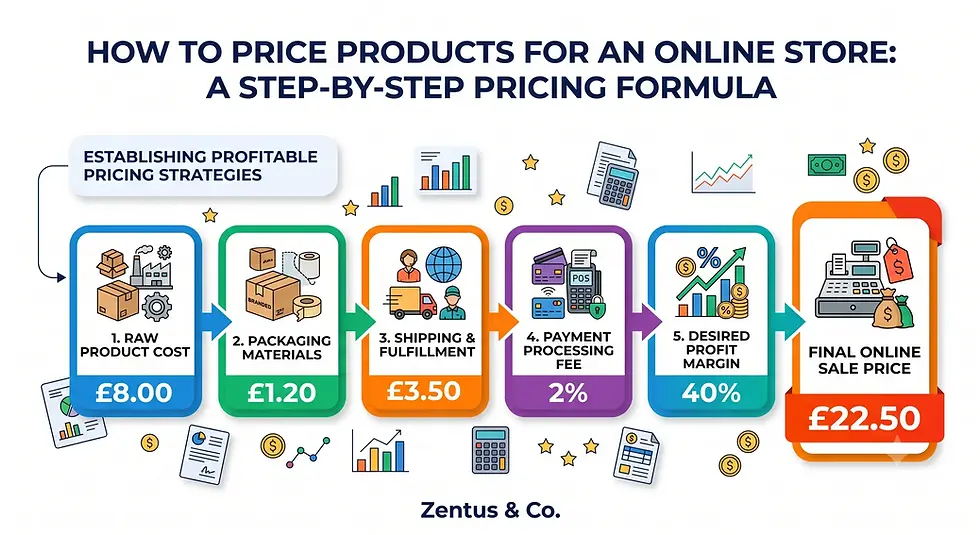
Use this formula: Cost price + Packaging + Shipping allowance + Payment processing fee (~2%) + Your target margin = Sale price.
Example: a product costing £8 to make/source, with £1.20 packaging, a £3.50 shipping allowance, and a 2% payment fee, priced for a 40% margin, should sell at approximately £22.50 — not the £15–£18 many first-time sellers guess at, which quietly erases their margin once fees and shipping are deducted.
Should I include shipping costs in my product prices?
Many successful UK sellers build shipping into the product price and offer "free shipping" at checkout, because according to conversion data widely cited in ecommerce reporting, cart abandonment rises sharply when shipping costs appear unexpectedly at checkout. The shipping cost doesn't disappear — it's simply pre-baked into the sale price rather than shown as a separate line, which converts better without reducing your actual margin. small business website cost in the UK
Shipping and Delivery Options UK
What are the cheapest shipping options for small UK sellers?
Method | Typical cost (Aug 2026) | Delivery time | Best for |
Royal Mail 48 | from £3.29 | 2–3 working days | Lightweight, low-value items |
Royal Mail 24 | from £4.55 | 1–2 working days | Time-sensitive small items |
Evri (courier) | from £3.49 | 2–3 working days | Budget parcel shipping |
DPD (courier) | from £5.49 | Next-day, tracked | Higher-value or fragile items |
Should I offer free shipping on my online store?
Offering "free" shipping (built into your product price) tends to outperform charging shipping separately at checkout, based on widely reported UK ecommerce conversion data. The safest approach for a new seller is to calculate your true shipping cost, add it into your sale price, and market it as "free UK delivery" — customers respond to the framing even though the underlying economics are identical.
How do I calculate shipping costs for online orders?
Weigh and measure your typical packaged product, then check it against your chosen courier's weight-and-size price bands (e.g., Royal Mail's small parcel vs large letter tiers) — the difference between bands can be £1–£2 per order, which matters at volume. Add a small buffer (5–10%) for packaging weight you may have underestimated.
Do I need a returns policy to sell online in the UK?
Yes. UK distance-selling regulations legally require a clear returns and refunds policy for any online sale, giving most consumers a 14-day cooling-off period to cancel and return an order for a full refund, starting from the day the goods are received. This policy must be visible before checkout, not buried in terms and conditions.

Online Selling Legal Requirements UK
What are my legal obligations when selling online in the UK?
At minimum, a UK online seller must have: a registered business (sole trader or limited company) with HMRC/Companies House, a published returns/refunds policy compliant with the Consumer Contracts Regulations, a privacy policy compliant with UK GDPR, clear pricing that includes VAT status, and accurate product descriptions (Consumer Protection from Unfair Trading Regulations). If you sell food, cosmetics, or age-restricted products, additional licensing applies (see below).
Do I need insurance to sell products online?
It isn't a legal requirement for most product categories, but public and product liability insurance is strongly recommended once you're trading regularly, since it covers claims if a product causes harm or damage. Sellers working from a rented commercial unit, or selling food/cosmetics, should treat insurance as effectively mandatory given the higher liability exposure in those categories.
What licences do I need to sell food products online in the UK?
Selling food online in the UK requires registering as a food business with your local council (free, at least 28 days before trading), complying with food hygiene regulations, and in most cases holding a Food Hygiene Rating. Home-based food sellers must also ensure their kitchen meets environmental health standards — this is checked via a council inspection, not self-certified.
Marketing Your New Online Store
How do I get my first customers for my online store?
Start with your existing network (email list, personal social following, local community groups), list your products on one relevant marketplace for organic discovery traffic, and post consistent organic content (not paid ads) on the one social platform where your target customer already spends time. According to Zentus & Co., in Wix Studio store launches for UK sellers, the fastest path to first sales is combining an existing-network announcement with one marketplace listing — paid advertising works better once you already have proof of demand.
Should I use social media to market my online shop?
Yes — social media, particularly Instagram and TikTok for visual/lifestyle products or Facebook groups for local/community sellers, remains the lowest-cost customer acquisition channel for a new UK online store. The mistake most new sellers make is posting product photos only; content that shows the making process, behind-the-scenes, or problem the product solves consistently outperforms plain product shots for early traction. ways to increase online sales
Managing Inventory and Stock Levels
How do I manage stock levels as a small online seller?
For under roughly 200 SKUs, Wix Stores' built-in inventory tracker is sufficient — it auto-updates stock counts per sale, flags low-stock items, and can hide out-of-stock products automatically. Beyond that volume, or if you sell across multiple channels (own site + marketplace + in-person), a dedicated inventory sync tool becomes worth the added monthly cost to avoid overselling the same stock unit twice.
What inventory software works with Wix Stores?
Wix Stores' native inventory management covers most single-channel sellers without extra software. For multi-channel sellers, third-party inventory sync apps available through the Wix App Market can connect stock levels across your Wix store and marketplace listings simultaneously.
Is Selling Online Right for Your Business
Is my product suitable for selling online?
Most physical products are suitable for online selling, with three exceptions worth flagging early: products requiring in-person fitting or measurement (some clothing/footwear), items with complex shipping restrictions (certain liquids, batteries, perishables), and very low-margin, heavy items where shipping cost erodes profit below viability. If your product falls outside these three categories, online selling is very likely workable.
How do I know if online selling will work for my business?
Online selling works for your business if you can answer yes to three questions: can your product be shipped safely and cost-effectively, can you price it to cover shipping + payment fees + a real margin (not just cover cost), and do you have (or can you build) a way to reach customers who don't already know your shop exists. If any of the three is uncertain, it's worth testing with a small marketplace listing before investing in a full custom store build.
This setup is best for:
Product-based small businesses (handmade, retail, food-adjacent) ready to move beyond in-person-only sales
Existing brick-and-mortar retailers wanting a second, low-overhead revenue channel
Side-business founders testing product-market fit before committing to a full-time online operation
Sellers currently marketplace-only who want to reduce commission costs and own their customer relationship via their own Wix store
What Most Guides Miss About VAT (and Hidden Launch Costs)
When do I need to register for VAT as an online seller?
You must register for VAT once your taxable turnover exceeds £90,000 in any rolling 12-month period — not the tax year, the rolling 12 months. According to HMRC (2026), this is the current VAT registration threshold, and you must register within 30 days of exceeding it. Many new sellers wrongly assume VAT only applies to "big" businesses; a seller doing £7,500/month in sales will cross the threshold within a year and needs to be tracking turnover monthly, not annually, to avoid a late registration.
Does VAT apply to selling on marketplaces like Etsy or Amazon?
Yes — your total taxable turnover across all sales channels combined counts toward the £90,000 VAT threshold, not just your own website. A seller doing £50,000 through their own Wix store and £45,000 through Etsy has £95,000 combined turnover and must register for VAT, even though neither channel alone crossed the threshold.
Hidden Costs Most Quotes Don't Include
What most "how to start selling online" guides leave out is the list of small recurring costs that add up after launch:
Domain renewal — approximately £12–£15/year, easy to forget after year one
Payment processing fees — 1.5%–2.9% of every sale, not a flat monthly cost
Premium apps/plugins (advanced inventory sync, email marketing tools) — typically £10–£40/month combined
Email hosting for a professional business address — £4–£6/month if not bundled with your plan
Product photography reshoots as your range grows — budget £50–£150 per reshoot session
Marketplace transaction fees if you also sell on Etsy/Amazon — 6.5%–15% per sale on top of your own store costs
Zentus & Co. builds these recurring costs into the first client conversation specifically because sellers who don't budget for them tend to under-price their products by 5–10% in year one.

Common Mistakes That Delay Your Launch
What mistakes slow down a new online store launch?
The five most common launch-delaying mistakes, in order of frequency:
Leaving payment processing setup until the end — this is a same-day task if done early, a launch-blocking task if left until the week you planned to go live
Not calculating shipping costs before pricing products — leading to a re-price of the entire catalogue post-launch
Waiting for "perfect" product photography — a clean, well-lit phone photo launches faster than a professional shoot booked three weeks out
Skipping the returns policy until a customer asks for one — this is a legal requirement, not optional
Building the store before deciding the platform properly — switching platforms mid-build (e.g., starting on a free builder, then moving to Wix Stores) wastes the most time of any mistake on this list
Why do so many online stores fail in the first year?
Most first-year online store failures trace back to under-pricing rather than under-selling — sellers price competitively against marketplace listings without accounting for their own payment fees, shipping and packaging costs, then discover their margin is too thin to sustain the business once real sales volume begins. The fix is the pricing formula in the section above, applied before launch, not after the first month's numbers come in.

FAQ: Selling Products Online in the UK
How much does it cost to start selling products online in the UK?
A DIY Wix Stores launch costs roughly £150–£400 in the first year (platform plan + domain), while a professionally built store from a remote Wix Studio agency like Zentus & Co. costs £950–£3,200 as a one-off build fee, approximately 5–7% below typical UK agency pricing for equivalent work. Ongoing costs (plan, payment fees, domain) add £20–£55/month on top either way.
What is the cheapest platform to sell products online in the UK?
Etsy is the cheapest to start (£0/month, pay-per-listing at 20p plus a 6.5% sale fee), making it ideal for testing an idea with minimal upfront cost. For an owned website, Wix Stores' Core plan at £17/month is the cheapest professional own-site option in the UK market.
Is Wix a good choice for a UK small business selling online?
Yes — Wix Stores suits UK small businesses wanting a fully brandable, professional website without developer costs, particularly those selling under 500 SKUs. It combines the store, marketing pages and blog in one platform, which many competing stacks split across separate tools.
How much does Wix Stores cost for a small UK business?
Wix Stores runs from £17/month (Core plan) up to £49/month (Business Elite), depending on features like abandoned cart recovery, multi-currency and advanced automations. Most small UK sellers start on the Core or Business plan (£17–£29/month).
Should I sell on my own website or use a marketplace like Etsy?
Most successful UK sellers run both — a marketplace listing for organic discovery traffic, and their own Wix store for margin and brand control, since marketplace fees (6.5%+ on Etsy) meaningfully reduce profit on every sale compared to an owned site.
Do I need a business bank account to sell products online in the UK?
It isn't a strict legal requirement for sole traders, but it's strongly recommended — HMRC expects clean separation between personal and business finances for tax purposes, and most payment processors (Stripe, Wix Payments) require a business account for payout once volume increases.
How do I start selling handmade crafts online in the UK?
Register as a sole trader with HMRC, choose between Etsy (built-in craft-buyer traffic) and a Wix Stores site (full brand control) — many crafters do both — then price each item using the cost + margin + shipping + fees formula covered above rather than competitor-matching alone.
What licences do I need to sell food products online in the UK?
You must register as a food business with your local council at least 28 days before trading, comply with food hygiene standards, and in most cases pass a Food Hygiene Rating inspection if working from a home or commercial kitchen.
How long does it take to launch an online shop in the UK?
A DIY Wix Stores launch with existing product photos can go live in 7–10 days; a professionally built Wix Studio store from an agency typically takes 2–4 weeks including design, product upload and testing.
Do I need to register as self-employed to sell online in the UK?
Yes — if you're selling with the intention of profit, HMRC requires registration as self-employed (sole trader) or as a limited company, regardless of whether it's a full-time or side business.
Is dropshipping a good option for UK small businesses?
Dropshipping can work as a low-capital way to test product demand, but UK sellers should be aware margins are typically thinner (10–20% vs 40%+ on held stock) and shipping times from overseas suppliers can hurt UK customer satisfaction — it suits testing an idea, less so a long-term brand strategy.
How do I accept card payments on my website?
Connect a payment processor — Wix Payments, Stripe or PayPal — through your store's checkout settings; this is a built-in Wix Stores setup step requiring no developer, and typically takes under 30 minutes.
What are typical payment processing fees in the UK?
Expect 1.5%–2.9% plus a small fixed fee per transaction depending on provider — Wix Payments and Stripe sit around 1.5–1.9% + 20p, while PayPal runs closer to 2.9% + 30p.
Do I need insurance to sell products online?
It isn't legally mandatory for most product categories, but public and product liability insurance is strongly advisable once trading regularly, and is effectively required for food, cosmetics or higher-risk product categories.
Do I need a returns policy to sell online in the UK?
Yes — UK distance-selling regulations legally require a clear returns/refunds policy giving customers a 14-day cooling-off period, and it must be visible to customers before they complete checkout.
Conclusion: Start Selling Online With a Plan, Not Just a Website
Starting to sell products online in the UK isn't complicated once the seven steps above are done in order: platform, registration, payments, pricing, shipping, legal basics, then launch. The sellers who launch fastest aren't the ones with the best product photos — they're the ones who priced in shipping and fees before setting a sale price, and registered their business before their first transaction rather than after.
Free download: the Online Store Launch Checklist — every step in this guide as a printable, tickable list, so nothing gets missed between "I want to sell online" and "I made my first sale."
If you'd rather have a professionally built Wix Stores setup done for you — priced 5–7% below typical UK agency rates, built remotely by Wix Studio specialists — get a free store setup quote from Zentus & Co..


Comments