


Should a Small Business Start With SEO or Google Ads?


Quick Answer: Should You Start With SEO or Google Ads?
If you need customers within days, start with Google Ads — campaigns can go live in 24-48 hours and put you at the top of Google immediately, for a typical starting budget of £500-£1,500/month in ad spend. If you have 3-6 months of runway and want traffic that keeps arriving without an ongoing bill, start with SEO — most small businesses see measurable ranking movement in 3-4 months and meaningful traffic by month 6-9, for a typical agency retainer of £400-£1,000/month.
The honest verdict: most small businesses shouldn't pick one forever — they pick one to start, based on cash-flow urgency, and add the second once the first is working. Businesses with tight, short-term budgets and an urgent need for leads (a new business, a seasonal push, a product launch) should lead with Google Ads. Businesses that can absorb 3-6 months without paid traffic, and want an asset that compounds, should lead with SEO. Zentus & Co. recommends starting with whichever channel matches your cash-flow reality first — then layering the second channel once the first is generating a predictable return.
In this guide: what SEO and Google Ads actually cost month-to-month · how long each one realistically takes to pay off · which one fits a brand-new business vs an established one · the hidden costs neither channel advertises · and how to tell, from your own numbers, which one to fund first.
According to BrightEdge research, organic search drives roughly 53% of all trackable website traffic — more than any paid channel, including Google Ads. But according to WordStream's Google Ads benchmark data, the average cost-per-click across industries sits around $2.69 (approx £2.15), rising to £6-£10+ for competitive service categories like law, home services, and finance. Both numbers matter — and neither tells the whole story on its own. This guide breaks down exactly where each one wins.
SEO vs Google Ads: The Core Difference
SEO (Search Engine Optimisation) earns your website a free position in Google's organic results by improving relevance, content, and technical performance. Google Ads buys a position at the top of the same results page, priced per click, for as long as you keep paying.
The core difference isn't cost — it's ownership vs rental. SEO builds an asset: rankings you keep even in months you don't spend a penny on marketing. Google Ads rents attention: the moment the budget stops, the traffic stops, usually within 24-48 hours.
Factor | SEO | Google Ads |
Speed to traffic | 3-6 months | 24-48 hours |
Cost model | Monthly retainer or in-house time | Per-click, pay-as-you-go |
Traffic after you stop paying | Continues (assets remain indexed) | Stops almost immediately |
Best for | Long-term, compounding growth | Immediate, controllable lead flow |
Control over messaging | Indirect (content, structure) | Direct (ad copy, targeting, budget) |
Typical monthly cost (small business) | £400-£1,000 (agency) or £0-£100 (DIY tools) | £500-£2,000 ad spend + £300-£750 management |
A clean website foundation benefits both channels equally — Google's Quality Score algorithm for Ads and its ranking algorithm for organic results both reward fast load times, mobile usability, and clear page structure. This is the one investment that pays off no matter which channel you fund first.

How Google Ads Works for a Small Business
Google Ads runs on an auction: you bid on keywords a customer might type, Google ranks ads by bid amount combined with a Quality Score (relevance, landing page experience, expected click-through rate), and you pay only when someone clicks — a model called pay-per-click (PPC).
For a small business, this means three moving costs: the daily ad budget (what you pay Google), the management cost (your time, or an agency fee), and the landing page cost (the page the ad sends traffic to, which must convert or the spend is wasted).
What budget do I need to start with Google Ads?
Most small businesses can test Google Ads meaningfully from £500-£1,000/month in ad spend. Below roughly £300/month, Google's algorithm often can't gather enough click data to optimise the campaign, so results stay noisy. A realistic starting range for a local service business is £15-£35/day (£450-£1,050/month), plus either your own time or a management fee of £300-£750/month if you hire help.
Do I need a website before running Google Ads?
Yes — technically you can point ads at a Google Business Profile or a simple landing page, but a proper, fast-loading website page dramatically outperforms both. Google's Quality Score directly rewards landing page relevance and speed, which lowers your cost-per-click; a slow or generic page can double what you pay for the same click position.
Can Google Ads work without a strong website?
It can technically run, but it rarely performs well. A weak landing page hurts Quality Score, raises cost-per-click, and — even if the click is cheap — converts poorly once the visitor arrives. In Wix Studio builds we configure for ad campaigns, the practical issue is almost always the landing page, not the ad copy — businesses that pair Ads with a dedicated, fast, conversion-focused page consistently pay less per click and convert more of the traffic they buy.
How do I measure success with Google Ads campaigns?
Track cost-per-click (CPC), conversion rate (visitors who become leads or sales), and cost-per-acquisition (CPA) — what one paying customer actually costs you. A campaign with a high CPC but low CPA can still be profitable; the CPA number, not the CPC number, is the one that decides whether Ads is working.
What happens to traffic if I stop paying for Google Ads?
Traffic stops almost immediately — typically within 24-48 hours of pausing or exhausting the budget, since your ad simply disappears from the auction. This is the defining trade-off of paid search: total control, but zero residual value once spending ends.
How SEO Works for a Small Business
SEO improves three layers of a website: technical health (speed, crawlability, mobile usability), content relevance (pages that genuinely answer what people search for), and authority (other reputable sites and directories linking back to you). Google's algorithm scores all three together to decide ranking position — there is no single "SEO switch."
How much time does SEO take to manage each week?
A small business doing basic SEO itself typically needs 3-5 hours a week: publishing or updating content, checking Google Search Console for errors, building a handful of local citations, and monitoring rankings. Agencies typically compress this into 8-15 hours/month of specialist work behind the retainer fee.
Can a small business do SEO without an agency?
Yes, for the fundamentals — optimising page titles, writing genuinely useful content, claiming a Google Business Profile, and fixing obvious technical issues (broken links, slow pages, missing headings) can all be done in-house with free tools like Google Search Console and Google Analytics. Competitive keywords and technical SEO (schema markup, site architecture, backlink outreach) usually need specialist time.
Do I need a website before starting SEO?
Yes — SEO optimises an existing website; there's nothing to rank without one. A clean Wix Studio setup usually separates businesses that rank quickly from those that don't, because sites built with proper heading structure, fast hosting, and mobile-first layouts pass Google's technical checks from day one, instead of needing a rebuild six months into an SEO campaign. SEO for small business
What budget do I need to start with SEO?
DIY SEO can start near £0-£100/month (tools like Ahrefs' free tier, Google Search Console, and your own time). Agency-managed SEO for a small business typically runs £400-£1,000/month, according to commonly cited UK agency pricing benchmarks, scaling toward £1,500+/month for competitive national keywords.
What happens to rankings if I stop doing SEO?
Rankings don't vanish overnight — they decay gradually over weeks to months as competitors keep publishing and your content ages, and as technical issues (broken links, outdated info) accumulate unaddressed. This is SEO's core advantage over Ads: even a pause doesn't erase the traffic instantly.
How do I measure success with SEO efforts?
Track organic sessions (Google Analytics), keyword rankings (Search Console or a rank tracker), and organic conversion rate. According to Search Engine Journal, SEO-sourced leads close at roughly 14.6%, compared to around 1.7% for outbound channels like print or cold outreach — a stat worth watching if your close-rate data starts trending that way too.
Cost Comparison: SEO vs Google Ads
This is the number every small business owner actually wants: what will this cost me, per month, in real money?
Cost-at-a-glance:
Approach | Typical Monthly Cost | Time to First Results | Best For |
SEO — DIY | £0-£100 (tools only) | 4-6 months | Owners with spare time, tight cash |
SEO — Agency-managed | £400-£1,000/month | 3-6 months | Businesses wanting expert-led, compounding growth |
Google Ads — Self-managed | £500-£1,500 ad spend | 24-48 hours | Fast-moving owners comfortable learning the platform |
Google Ads — Agency-managed | £500-£2,000 ad spend + £300-£750 fee | 24-48 hours | Businesses wanting expert campaign management from day one |
How much does SEO cost for a small business each month?
Commonly cited UK agency benchmarks place small-business SEO retainers at £400-£1,000 per month, with entry-level local packages sometimes starting near £300/month and competitive national campaigns exceeding £1,500/month. DIY SEO can run near £0-£100/month in tool costs alone.
How much does Google Ads cost per click for a small business?
According to WordStream's benchmark data, the average cost-per-click across all industries is roughly $2.69 (approx £2.15), but small-business-relevant categories vary widely: home services and legal often see £4-£10+ per click, while retail and hospitality often sit closer to £0.50-£2.
Is SEO cheaper than Google Ads in the long run?
For most small businesses, yes — once SEO rankings are established, the marginal cost of each additional visitor drops close to zero, whereas every Google Ads click is paid for individually, forever. Over a 3-year horizon, a business spending £700/month on SEO (£25,200 over 3 years) that reaches strong organic rankings by year two often ends up with a lower blended cost-per-lead than a business spending an equivalent £700/month on Ads the entire time, because the SEO traffic keeps compounding while the paid traffic never does. small business website cost
What is the average return on investment for Google Ads?
Commonly cited industry data (Google Economic Impact Report methodology) suggests businesses average roughly $2 in revenue for every $1 spent on Google Ads, though this varies enormously by industry, margin, and landing page quality — treat this as a directional benchmark, not a guarantee.
What is the average return on investment for SEO?
SEO ROI is harder to benchmark universally because payback is delayed, but commonly cited figures suggest a well-executed SEO campaign can return 5-10x the monthly spend in organic traffic value within 12-18 months, once rankings mature — again, directional, not a guarantee, and highly dependent on competition in your niche.
DIY vs Professional-Managed: the real 3-year cost picture
Since this decision usually isn't about local vs remote agencies but about doing it yourself vs paying for expert management, here's the honest 3-year comparison:
Route | Build/setup cost | Annual running cost | 3-year total |
DIY SEO (owner's time) | £0 | £0-£1,200 (tools) | £0-£3,600 |
Agency-managed SEO | £0-£300 (onboarding) | £4,800-£12,000 | £14,400-£36,000 |
Self-managed Google Ads | £0 | £6,000-£18,000 (ad spend) | £18,000-£54,000 |
Agency-managed Google Ads | £0-£200 (setup) | £9,600-£33,000 (spend + fees) | £28,800-£99,000 |
DIY wins on cash outlay; agency-managed wins on speed to competence and avoids the wasted ad spend that comes from a learning curve. Zentus & Co. typically sees new Google Ads accounts waste 15-25% of spend in the first month on broad-match keywords and untested landing pages — a cost that a properly configured account largely avoids.

Free Website Speed & SEO-Readiness Audit: before you commit a budget to either channel, make sure the website itself can convert the traffic you're about to earn or buy. Get your free audit →
How Long Each Channel Takes to Work
How long does SEO take to show results?
Most small businesses see initial ranking movement within 3-4 months, with meaningful organic traffic growth by month 6-9, and full maturity of a competitive keyword campaign often taking 12 months or longer. Google itself has stated it can take 4-12 months to see the impact of SEO changes.
How fast can Google Ads bring in customers?
Google Ads campaigns can go live within 24-48 hours of setup approval, with clicks and leads arriving the same day the budget activates. This is the single biggest structural advantage Ads holds over SEO.
Quotable comparison: A September 2026 market snapshot: SEO campaigns typically take 90-180 days to show meaningful ranking movement, while Google Ads campaigns typically deliver measurable leads within 1-2 days of launch — a gap of roughly 6 months, which is the real reason cash-strapped new businesses often start with Ads.

Which Option Suits a Brand-New Business
Does SEO work for very new businesses?
Yes, but slower — a brand-new domain has no backlink history and no trust signals, so it typically takes longer to rank than an established site making the same content improvements. New businesses doing SEO should expect closer to 6-9 months before seeing solid organic traffic, versus 3-6 months for an established domain.
Should startups focus on SEO or paid ads first?
Most startups with limited runway should lead with Google Ads to generate early revenue and customer data quickly, while building SEO in parallel at a lower monthly spend — so organic traffic is ready to take over once the startup budget for paid ads tightens. Running both from day one, even at modest budgets, avoids the "cliff" that happens when a business relies solely on Ads and then has to cut spend.

Which Option Suits an Established Business
An established business with existing traffic, reviews, and domain history already has a head start on SEO — content and technical fixes tend to show results faster than for a brand-new site, often within 8-10 weeks rather than 3-6 months, because Google already trusts the domain.
Which channel is better for seasonal small businesses?
Seasonal businesses (Christmas retail, summer tourism, tax-season accountants) generally get more value from Google Ads timed tightly around the peak season, since SEO's 3-6 month runway doesn't align well with a 6-8 week sales window. SEO still helps seasonal businesses build year-round brand visibility, but it shouldn't carry the peak-season revenue load alone.
Best Channel for Local Service Businesses
Which is better for local businesses, SEO or Ads?
Local SEO (Google Business Profile optimisation, local citations, location-specific content) tends to deliver the best long-term value for local service businesses — plumbers, salons, dentists, solicitors — because local searches carry strong buyer intent and Google's "map pack" results sit above standard organic results for free. Google Ads' local service ads format is a strong complement for urgent-need categories (emergency plumbing, locksmiths) where searchers want to call immediately.
How do I know if my industry favours SEO?
Industries with long research cycles and high-value purchases — B2B services, home renovation, legal, financial advice — tend to favour SEO, because buyers research extensively before contacting anyone, and a well-ranked, content-rich site captures that research phase for free, repeatedly.
How do I know if my industry favours Google Ads?
Industries with urgent, immediate-need searches — emergency repairs, same-day services, time-sensitive offers — tend to favour Google Ads, because the searcher wants to act now and paid placement guarantees visibility at that exact moment, regardless of how new or unranked the business is.
Do Google Ads work better than SEO for service businesses?
It depends on urgency, not category: emergency and same-day services (locksmiths, emergency plumbers) generally see faster ROI from Ads, while appointment-based, research-driven services (dentists, solicitors, accountants) generally see stronger long-term ROI from SEO. Google Business Profile website button
Is Google Ads a good fit for a limited marketing budget?
It can work, but only in short, tightly targeted bursts — a limited budget spread across broad keywords underperforms badly, whereas the same budget focused on 3-5 highly specific, high-intent keywords can generate a genuine return even at £300-£500/month.
Is SEO a good fit for a limited marketing budget?
Yes, arguably more so than Ads — a limited budget invested consistently in SEO (even just £200-£400/month for content and basic technical fixes) compounds over time, whereas the same limited budget in Ads simply buys fewer clicks with no lasting value once spending stops.
Can You Run Both Channels at Once
Can small businesses run SEO and Ads together?
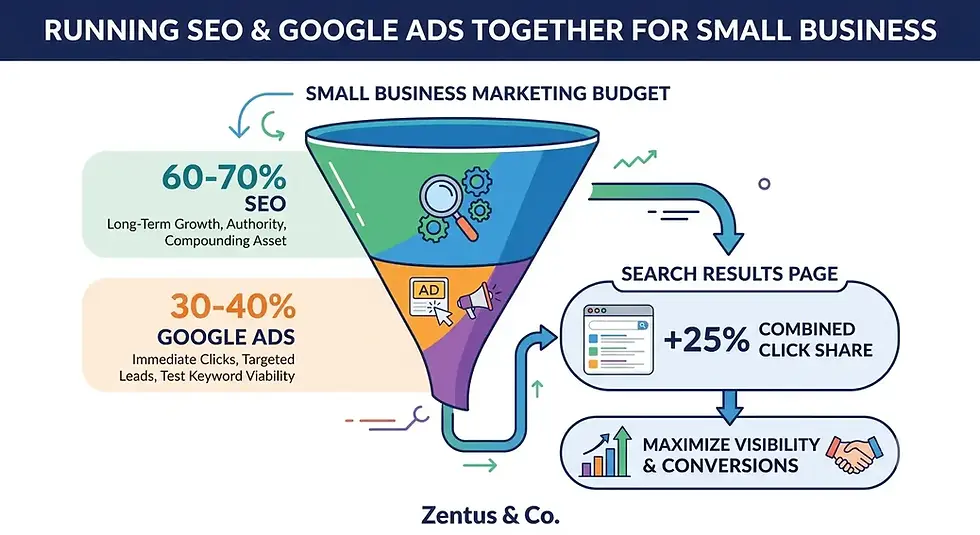
Yes, and according to commonly cited Google-published data, running both channels together for the same keywords can lift total click share by up to 25% compared to running either channel alone, because a business appearing in both the ad slot and the organic listing signals stronger credibility to searchers scanning the results page.
A practical split for a modest budget: 60-70% toward SEO (the long-term asset) and 30-40% toward a tightly targeted Ads campaign (immediate leads on your highest-intent keywords), adjusting the ratio as SEO traffic grows and the Ads budget can shrink.
Common Mistakes When Choosing a Channel
The most common mistake Zentus & Co. sees small businesses make is picking a channel based on what a competitor is doing, rather than their own cash-flow timeline. Other recurring mistakes:
Starting Ads with no landing page strategy — sending traffic to a generic homepage instead of a page built to convert that specific search.
Abandoning SEO after 6-8 weeks because "it isn't working yet" — well before the 3-6 month window where results typically appear.
Running Ads on broad-match keywords with no negative keyword list, which wastes 15-25% of early spend on irrelevant clicks.
Treating SEO as a one-time project rather than an ongoing process — rankings decay without maintenance.
Ignoring conversion tracking on both channels, making it impossible to know which one is actually generating revenue.
Signs You Should Start With Google Ads
You should lead with Google Ads if: you need customers within the next 2-4 weeks, you have a clear, provable margin per sale (so you can calculate a target cost-per-acquisition), you're launching a new product or seasonal offer, or you're testing which messaging/offer converts before investing in long-term content.

Signs You Should Start With SEO
You should lead with SEO if: you can operate 3-6 months without new-channel traffic, your business model depends on repeat, ongoing search demand (not a one-off launch), you want to build an asset that reduces marketing cost over time, or your competitors already dominate the paid results and the organic listings are comparatively weak — an easier opening to win.
Fit: Best Fit for Tight Marketing Budgets
For a genuinely tight budget — under £500/month total — the strongest fit is usually DIY SEO fundamentals (Google Business Profile, on-page optimisation, basic content) paired with a small, hyper-targeted Google Ads test of £150-£250/month on your single highest-intent keyword. This combination avoids the trap of spreading a small budget too thin across either channel alone.
Gap: Why Most Small Businesses Get This Wrong
The gap Zentus & Co. consistently sees: small businesses treat SEO and Google Ads as competing choices rather than sequential investments. They pick one, judge it against the other's strengths (judging SEO by Ads' speed, or Ads by SEO's low ongoing cost), get disappointed, and abandon it — instead of recognising that each channel is solving a different problem on a different timeline. In Wix Studio builds we configure for both channels simultaneously, the businesses that succeed are the ones that fund SEO for the long game and Ads for the short game, from day one, at whatever ratio their budget allows.
Risk: What Happens if You Pick the Wrong Channel First
What are the risks of relying only on Google Ads?
The core risk is total dependency: if the budget stops — due to cash flow, a platform policy change, or rising CPCs from new competitors — lead flow can drop to near zero within 48 hours, with no organic safety net underneath it.
What are the risks of relying only on SEO?
The core risk is timeline mismatch: a business that needs revenue in 30 days but waits on SEO alone often runs out of runway before the campaign matures, abandoning the strategy just before it would have started working — the single most common reason SEO campaigns get judged as "failed" when they were simply stopped too early.

Hidden Costs Most Small Businesses Don't Budget For
Neither SEO quotes nor Google Ads budgets usually show the full picture up front. Before committing, budget for:
Landing page design/updates — a page built specifically for ad traffic or a target keyword, separate from your homepage: typically £150-£500 per page if outsourced.
Conversion tracking setup — Google Analytics 4 and Google Ads conversion tags configured correctly; skipping this makes both channels impossible to measure honestly.
Content production for SEO — ongoing blog posts, service pages, and local pages beyond the initial audit; agencies often quote the audit but not the monthly writing cost.
Ad creative refreshes — ad copy and extensions need periodic updates to avoid "ad fatigue," typically every 60-90 days.
Local citation/directory listings — consistent business information across 20-50+ directories, sometimes billed separately from a core SEO retainer.
Technical fixes uncovered mid-campaign — broken schema, slow hosting, or a site rebuild that an SEO audit reveals is needed before rankings can move.
Who This Is Best For
This decision framework is best for:
New businesses with under 6 months of cash runway → start with Google Ads, layer SEO in parallel at a lower spend.
Established local service businesses with steady cash flow → start with SEO, use Ads for seasonal peaks or new service launches.
Seasonal businesses with a tight sales window → lean Ads-heavy during the season, SEO-light year-round for brand visibility.
Businesses with under £500/month total marketing budget → DIY SEO fundamentals plus a small, hyper-targeted Ads test.
B2B and high-consideration service businesses (legal, financial, consulting) → prioritise SEO; Ads plays a supporting role for specific service pages.
FAQ
How much should a small business budget for SEO in the first year?
A realistic first-year SEO budget for a small business is £4,800-£12,000 (based on a £400-£1,000/month agency retainer), or near £0-£1,200 for a DIY approach using free and low-cost tools. Expect the first 3-6 months to show limited traffic while the technical and content foundation is built.
What is a realistic monthly Google Ads budget for a business just starting out?
A realistic starting budget is £500-£1,000/month in ad spend, which is usually the minimum needed for Google's algorithm to gather enough click data to optimise the campaign properly. Below roughly £300/month, results tend to stay noisy and hard to evaluate.
Does a Wix website help with SEO automatically?
A Wix Studio website provides strong SEO foundations out of the box — clean code, fast hosting, mobile responsiveness, and built-in meta tag controls — but it does not rank a site automatically. Content, keyword targeting, and ongoing optimisation still have to be done on top of the platform.
Can I run Google Ads campaigns pointing to a Wix website?
Yes — Wix websites work fully with Google Ads, including conversion tracking via Google Tag Manager and Google Analytics 4 integration. Zentus & Co. configures dedicated, fast-loading landing pages within Wix Studio specifically to maximise Quality Score and lower cost-per-click for ad campaigns.
Should I choose SEO or Google Ads if I only have $500 a month to spend?
At roughly $500/month, the strongest approach is usually a hybrid: DIY SEO fundamentals (free) combined with a small, tightly targeted Google Ads test (£300-£400) on your single most valuable keyword, rather than spreading the full budget thin across a broad SEO retainer or a broad ad campaign.
Is it better to start with SEO or Google Ads if I need customers fast?
Google Ads — campaigns can go live within 24-48 hours, while SEO typically needs 3-6 months before delivering meaningful traffic. If the need is genuinely urgent, Ads is the only channel that can meet that timeline.
Is SEO or Google Ads better for a local restaurant?
A local restaurant typically gets the strongest return from local SEO (Google Business Profile, reviews, local citations) paired with a small Google Ads budget targeted at high-intent searches like "[cuisine] near me" during known peak booking periods (weekends, holidays).
Which channel works better for a small home service business, SEO or Google Ads?
Home service businesses (plumbers, electricians, cleaners) generally benefit from both, but urgency-driven searches (emergency callouts) convert best on Google Ads and Local Service Ads, while non-urgent, research-driven searches (renovation planning) convert best through local SEO content.
What is the difference between SEO and Google Ads?
SEO earns a free organic ranking position through website relevance and authority over time; Google Ads buys a paid position at the top of the results page, priced per click, for as long as the budget runs. SEO builds a lasting asset; Ads delivers immediate, rented visibility.
Which marketing channel gives a better long-term return, SEO or Google Ads?
SEO generally delivers a better long-term return because the marginal cost of additional organic traffic approaches zero once rankings are established, while every Google Ads click carries an ongoing cost indefinitely — but this advantage only materialises after the 3-6 month runway SEO requires.
Can a small business switch from Google Ads to SEO later without losing traffic?
Yes, but the switch should be gradual, not abrupt — reduce Ads spend as organic rankings and traffic climb, rather than stopping paid traffic before SEO has matured enough to fill the gap, to avoid a visible dip in total leads during the transition.
Conclusion
There's no universal winner between SEO and Google Ads — there's only the right sequence for your cash-flow timeline. If you need customers in the next 2-4 weeks, fund Google Ads first. If you can absorb 3-6 months of runway, fund SEO first and let it compound. Most small businesses that succeed at both eventually run them together — Ads for immediate, controllable leads; SEO for the traffic that keeps arriving long after the invoice is paid.
Whichever channel you fund first, it only performs as well as the website behind it. A slow, poorly structured site raises your Google Ads cost-per-click and slows your SEO rankings at the same time — it's the one weak point that damages both channels simultaneously.
Get a free Website Speed & SEO-Readiness Audit from Zentus & Co. before you commit a marketing budget to either channel. Contact us →

Comments