


Should Small Businesses Invest in Email Marketing?

Updated: 1 day ago

Quick Answer: Is Email Marketing Worth It?
Yes — for most small businesses, email marketing is worth it, and the numbers back it up hard. According to Litmus (2023), email marketing delivers an average $36 return for every $1 spent — a 3,600% ROI that outperforms paid social and paid search by a wide margin. It costs as little as $0-$13/month to start, takes under an hour to set up on a tool like Wix Ascend or Mailchimp, and works even with a list of a few hundred contacts.
It is not worth it if you have zero customer contact list, no time to send even one email a month, or a business model where repeat contact doesn't drive revenue (e.g., single-transaction referral work). For everyone else — service businesses, local shops, ecommerce, solo owners — email marketing pays for itself within the first campaign if you send consistently and segment your list.
Zentus & Co. verdict: email marketing is worth it for 90%+ of small businesses, and the ones it isn't worth it for usually have a bigger problem — no email list at all.
In This Guide
In this guide: exact monthly costs for email marketing tools · real ROI data with sources · email vs social media vs paid ads compared side by side · how to build your first list and campaign step by step · the mistakes that quietly kill open rates · hidden costs most "free" tools don't mention · and who this actually suits vs who should fix something else first.
Cost-at-a-Glance
Route | Monthly cost | Best for |
DIY (free ESP tier) | $0 | Brand-new businesses under 500 contacts |
DIY (paid ESP tier) | $13-$50 | Growing lists, 1,000-5,000 contacts |
Local marketing freelancer | $250-$400/mo | Owners who want hands-off local support |
Zentus & Co. (remote Wix agency) | $230-$375/mo | Wix-based businesses wanting professional setup without local-agency overhead |
Most small business owners don't reject email marketing because it doesn't work — they reject it because nobody's shown them the real numbers. 75% of consumers say website and brand design shape whether they trust a business (Stanford Web Credibility research), and the same trust logic applies to inbox presence: a business that shows up consistently in someone's inbox with useful, well-designed emails reads as more established than one that doesn't. In Wix Studio builds where Zentus & Co. configures Ascend email automations for service businesses, the single biggest lever for revenue isn't the email tool — it's whether the business actually has somewhere to send people to convert. That's the gap this guide gets into later.
Email Marketing For Small Business Basics
Email marketing is the practice of sending targeted, permission-based messages to a list of contacts who've opted in — newsletters, promotions, automated sequences — with the goal of driving repeat visits, bookings, or sales. For a small business, it's the one owned marketing channel where you don't pay a platform every time you want to reach your own customers.
Is email marketing still effective in 2026?
Yes — email marketing is more effective in 2026 than most owners assume, because inbox competition has actually made well-targeted email stand out more, not less. With organic social reach dropping year over year, email remains one of the few channels where a message lands directly in front of the person who chose to hear from you, with no algorithm deciding whether they see it.
Do small businesses really need an email list?
Yes — if you have any repeat-customer potential, you need an email list, because it's the only customer data you actually own. Social media followers, ad audiences and directory listings can all disappear or change terms overnight; a list of real email addresses you've collected directly stays yours regardless of what any platform does.
How is email marketing different from newsletters?
A newsletter is one format of email marketing, not the whole discipline. Email marketing includes newsletters, but also automated welcome sequences, abandoned-cart or abandoned-inquiry follow-ups, promotional blasts, re-engagement campaigns and transactional touchpoints — a much wider toolkit than a single recurring update.
Benefits Of Email Marketing For Owners
The core benefits for a small business owner are direct reach, low cost, high ROI, and full ownership of the customer relationship — no algorithm, no rising ad costs, no rented audience.
Direct access — messages land in an inbox, not a feed the platform decides to show or hide
Low cost, high return — $36 return per $1 spent on average (Litmus, 2023)
Automation-friendly — welcome sequences and follow-ups run without daily owner input
Measurable — open rates, click rates and conversions are trackable in real time
Owned asset — your list stays yours even if a platform shuts down or changes its rules
Do customers still read marketing emails in 2026?
Yes — well-targeted marketing emails are still opened at healthy rates in 2026, particularly from small, local, or niche businesses where the sender feels personal rather than corporate. Generic average open rates sit around 20-25% across small business sending, but relevant, segmented sends regularly beat that.
Is email marketing worth it for a brand-new business?
Yes, but with lower expectations in month one — a brand-new business won't have list volume yet, so early ROI looks smaller in absolute dollars even though the percentage return can be strong. The real value for a new business is starting the list from day one, since a list built for a year outperforms one started six months late.
Email Marketing Cost Breakdown
Email marketing costs fall into two buckets: the software (ESP) subscription, and who runs it — you, a local freelancer, or an agency.
Email Marketing Tool Costs (Platform/Plan Table)
Plan | Monthly cost | What it unlocks | Best for |
Free | $0 | Up to 500 contacts, basic templates, 1 automation | Brand-new businesses testing the water |
Starter | $13 | Up to 1,000 contacts, A/B testing, no platform branding | Small but active lists |
Growth | $50 | Up to 5,000 contacts, advanced segmentation, multi-step automations | Established businesses scaling outreach |
Premium | $300 | 10,000+ contacts, dedicated support, advanced analytics | Multi-location or high-volume retailers |
Prices based on August 2026 — verify current provider pricing before you buy.
How much does email marketing cost per month?
Most small businesses spend between $0 and $50 per month on email marketing software, with the free tier covering anyone under roughly 500 contacts and the $50 "Growth" tier covering most established local businesses with active lists up to 5,000 contacts.
What's a realistic budget for a first-year campaign?
A realistic first-year budget is $150-$650 if you're running email marketing yourself on a paid ESP tier, covering the monthly subscription plus basic design tools — no agency fees included.
DIY vs Local Freelancer vs Zentus & Co. (Remote Wix Agency)
Route | Setup cost | Monthly management | Year 1 total |
DIY (business owner) | $0-$50 | $0-$50 | $0-$650 |
Local marketing freelancer | $500-$900 | $250-$400 | $3,500-$5,700 |
Zentus & Co. (remote Wix agency) | $465-$840 (~5-7% below local) | $230-$375 (~5-7% below local) | $3,225-$5,340 |
3-year total cost of ownership: DIY $0-$1,950 · Local freelancer $10,500-$17,100 · Zentus & Co. $9,675-$16,020. Wix Ascend marketing suite
When DIY wins: you have time weekly and a list under 1,000. When a local freelancer wins: you want face-to-face strategy sessions and don't mind paying full local rates. When Zentus & Co. wins: you're already on Wix, want Ascend automations properly configured, and don't want to pay local-agency overhead for the same output.

Average Email Marketing ROI Stats
According to Litmus (2023), email marketing returns $36 for every $1 spent — the highest average ROI of any digital marketing channel tracked in that research.
Channel ROI Comparison
Channel | Average ROI | Source |
Email marketing | $36 per $1 (~3,600%) | Litmus (2023) |
Organic social media | ~$2.80 per $1 (estimated) | Industry benchmark |
Paid search/social ads | $2-$4 per $1 | Industry benchmark |
What is the average ROI of email marketing?
The average ROI of email marketing is $36 per $1 spent, according to Litmus (2023), though results vary by industry — retail and ecommerce tend to sit at the higher end, while service businesses with smaller lists see more modest but still strong returns.
How long before email marketing shows results?
Most small businesses see measurable opens and clicks within the first 1-2 sends, but meaningful revenue results usually take 60-90 days — enough time to build list size, test subject lines, and let an automated welcome sequence run against new signups.
What metrics actually matter for small business owners?
The metrics that matter most are open rate, click-through rate, and conversion rate — in that order of diagnostic value. Open rate tells you if your subject lines and sender reputation work; click rate tells you if your content is relevant; conversion rate tells you if the offer itself is working. increase online sales

Email Marketing Vs Social Media
Email Marketing vs Social Media
Factor | Email marketing | Social media |
Cost | Included in ESP fee ($0-$50/mo) | Free organic, or $6-$10 CPC for ads |
Reach | 100% of your list, no algorithm | Algorithm-limited, 2-5% organic reach typical |
Ownership | You own the list | Platform owns the audience |
Best for | Repeat customers, nurture, direct offers | Discovery, brand awareness, new audiences |
Can email marketing replace social media entirely?
No — email marketing should not replace social media, it should complement it. Social media is best for discovery and reaching new audiences; email is best for converting and retaining the people who already know you. Businesses that use both consistently outperform businesses that rely on either alone.

Email Marketing Vs Paid Ads
Email Marketing vs Paid Ads
Factor | Email marketing | Paid ads (search/social) |
Average ROI | $36 per $1 (Litmus, 2023) | $2-$4 per $1 |
Cost to reach 1,000 people | ~$1-3 (ESP fee share) | $20-$60 (CPC dependent) |
Longevity | List is owned and reusable | Stops the moment budget stops |
Best for | Repeat customers, nurture sequences | New audience discovery, fast volume |
Is email marketing cheaper than paid social ads?
Yes — email marketing is significantly cheaper per contact than paid ads. Reaching 1,000 existing subscribers via email costs a fraction of what it costs to reach 1,000 new people through paid social or search, because you're not paying per impression or per click for an audience you already have permission to contact.
Best Email Marketing Tools Compared
Tool | Free tier | Entry paid tier | Best for |
Wix Ascend (email) | Yes, limited contacts | ~$13-$25/mo | Wix website owners wanting native integration |
Mailchimp | Yes, up to 500 contacts | ~$13/mo | General small business, wide template library |
Klaviyo | Limited free tier | ~$20-$45/mo | Ecommerce, deeper segmentation |
ConvertKit | Limited free tier | ~$15-$29/mo | Solo creators, service providers |
What tools are best for beginners on a budget?
For a beginner on a tight budget, a free-tier ESP with a built-in website integration is the best starting point — it removes the need to connect a separate tool, and most free tiers cover the first 500 contacts, which is more than enough for the first 6-12 months for most small businesses. Wix email marketing vs Mailchimp
Is Mailchimp better than Wix for small business?
Neither is universally "better" — it depends on where your website lives. If your site is already built on Wix, Wix Ascend integrates natively with your site's forms, orders and customer data without a third-party connection. If your site is on another platform, Mailchimp's broader integration library often makes more sense.
How To Start An Email List
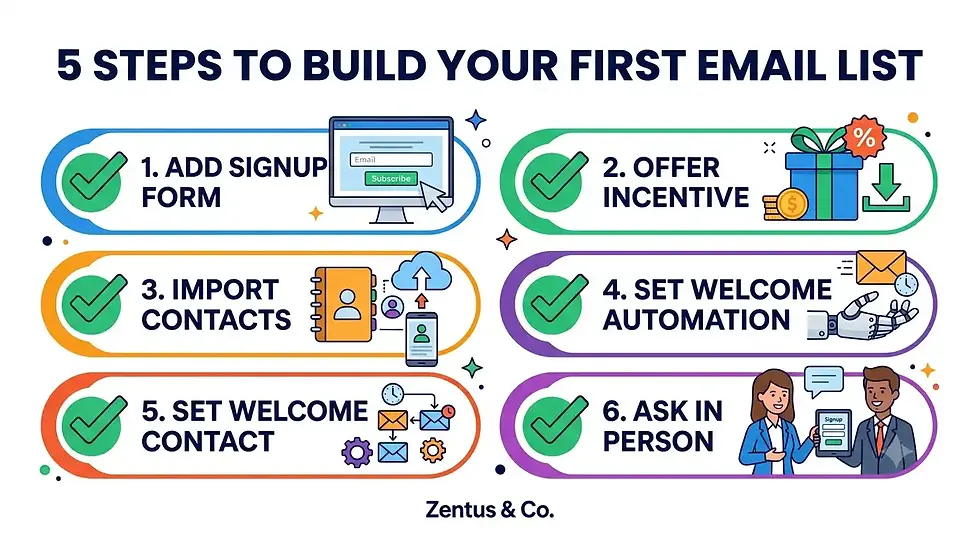
5 Steps to Build Your First Email List:
Add a signup form to your homepage, checkout page and blog
Offer a real incentive — a discount code, free guide, or early access
Import existing customer contacts you already have permission to email
Set up a welcome automation that fires within 24 hours of signup
Ask in person — a QR code at the till or desk converts surprisingly well
How do I build an email list from scratch?
You build an email list from scratch by combining a visible signup form, a real incentive, and a first-touch welcome email — most small businesses can reach their first 100 subscribers within 30 days using existing foot traffic, receipts, and social bios alone.
How many subscribers do I need to see results?
You can see meaningful results from as few as 100-200 engaged subscribers, particularly for service businesses where a single booking or repeat client covers the entire monthly software cost — list size matters less than list engagement.
What's the fastest way to grow an email list organically?
The fastest organic method is a gated incentive at the point of highest intent — a discount code offered at checkout, or a free resource offered at the exact moment someone is already reading about your service, converts far faster than a generic "sign up for updates" form.
Building Your First Campaign
Campaign Funnel: Signup → Welcome email → Value/offer email → Repeat send
What content should my first email campaign include?
Your first campaign should include a clear subject line, one core offer or piece of value, and a single obvious next step — one call-to-action per email converts better than five competing links, because it removes decision friction for the reader.
How often should a small business send emails?
Once a week to twice a month is the sweet spot for most small businesses — frequent enough to stay visible, infrequent enough to avoid unsubscribes. Weekly works well for active promotions; monthly suits businesses with less frequent news.
What is a good email open rate for small business?
A good open rate for a small business sits between 20% and 35%, depending on industry — local service businesses with warm, familiar lists often beat this benchmark, while broader retail lists sit closer to the lower end.

Common Email Marketing Mistakes
4 Email Marketing Mistakes That Kill Open Rates:
Inconsistent sending — long gaps make subscribers forget why they signed up
No segmentation — sending the same offer to every contact regardless of interest
Weak subject lines — vague or overly salesy lines get ignored or marked as spam
Buying email lists — cold, unpermissioned contacts tank deliverability fast
What's the biggest mistake small businesses make?
The biggest mistake is inconsistency — starting strong for two weeks, then going silent for three months. Inconsistent sending resets subscriber familiarity and quietly kills open rates over time, even when the content itself is good.
Is buying an email list ever worth it?
No — buying an email list is never worth it. Purchased lists haven't opted in, trigger high spam complaints, and can get your sending domain blacklisted, which then damages deliverability for your legitimate, permission-based contacts too.
How do I avoid the spam folder with cold emails?
You avoid the spam folder by only emailing people who've opted in, using a verified sending domain, and avoiding spam-trigger words in subject lines — deliverability is protected far more by list quality and permission than by any clever subject-line trick.

Signs Email Marketing Isn't Working
If open rates sit under 15%, click rates under 1%, or unsubscribes spike after every send, something structural — not just content quality — usually needs fixing.
Why do some email campaigns get no opens?
Campaigns get zero opens most often due to poor sender reputation, an unverified domain, or a subject line that trips spam filters — before blaming the content, check deliverability basics: domain authentication (SPF/DKIM/DMARC), sending consistency, and list hygiene.
Email Marketing For Local Businesses
Local businesses benefit from email marketing differently than ecommerce — the goal is usually repeat bookings and foot traffic, not one-off online purchases.
Does email marketing work for service businesses?
Yes — email marketing works especially well for service businesses, because the customer relationship is already personal and repeat-visit driven. A salon, clinic, or trades business can use automated reminders and seasonal offers to fill quiet booking periods without any extra ad spend.
Original observation: In Wix Studio builds where Zentus & Co. configures Ascend automations for local service businesses, adding a two-touch follow-up sequence to unbooked inquiry leads recovers noticeably more bookings than a single reminder email — most missed conversions come from a lead going cold after just one contact attempt.
Fit: When Email Marketing Suits A Tight Budget
Email marketing suits a tight budget better than almost any other channel because the entry cost is $0-$13/month, and it works with a list you likely already have (past customers, enquiry forms, receipts).
Should I hire someone to run my email marketing?
You should consider hiring help once your list passes roughly 1,000-2,000 contacts, or once you don't have 2-3 hours a month to dedicate to it — below that threshold, most owners can run it themselves on a free or low-cost tier without losing meaningful results.
This setup is best for:
Solo owners and small teams with an existing customer base but no ad budget
Local service businesses (salons, clinics, trades) wanting repeat bookings
New Wix website owners who already have Ascend included and unused
Retail and ecommerce businesses with an existing checkout email capture

Gap: What Email Marketing Alone Won't Fix
Email marketing amplifies what's already working — it doesn't fix a broken offer, a slow website, or a business with no repeat-customer potential.
How does email marketing compare to SEO long term?
Email marketing and SEO solve different problems and work best together, not as alternatives — SEO brings new people to your website organically over months and years; email converts and retains the people who are already on your list. Neither replaces the other.
Can I automate email marketing without a big team?
Yes — a one-person business can fully automate email marketing using a welcome sequence, an abandoned-inquiry follow-up, and a monthly scheduled send, all set up once and left running with minimal ongoing input beyond monitoring performance.
Hidden Costs Most Quotes Don't Mention: email marketing budgets often miss list-cleaning tools (removing bounced/inactive contacts), stock imagery or design time for campaign graphics, copywriting time if outsourced, deliverability/domain authentication setup, and compliance requirements (CAN-SPAM in the US, GDPR/PECR in the UK/EU) — none of which show up in a bare "$13/month" software quote but all of which affect real performance. SEO for small business
FAQ: Email Marketing For Small Business
How much should a small business budget for email marketing monthly?
Most small businesses should budget $0-$50/month for software alone, rising to $230-$400/month if paying a freelancer or agency to manage campaigns. Start on a free tier and upgrade only once your list exceeds the free threshold.
What does email marketing software typically cost per year?
Annual software costs typically run $0-$600/year for DIY setups on a paid tier, not including any agency management fees. Free tiers cost nothing but cap contact volume, usually around 500 subscribers.
Can I run email marketing directly from my Wix website?
Yes — Wix Ascend includes native email marketing tools that connect directly to your site's forms, store data and contact list, without needing a separate third-party integration.
Does Wix integrate with Mailchimp or other email tools?
Yes — Wix supports integrations with Mailchimp and other major ESPs through its app market, though many Wix-based businesses find Ascend's native tools simpler since customer data doesn't need syncing between two separate systems.
Is email marketing or a website upgrade the better first investment?
It depends on whether you have anywhere to send traffic yet — if your website already converts visitors reasonably well, email marketing is the faster, cheaper first investment; if your site itself is the weak link, fixing that first makes any email campaign perform better.
Should a one-person business bother with email marketing at all?
Yes — a one-person business benefits especially, because email marketing runs on automation and doesn't require daily attention once a welcome sequence and a monthly send schedule are set up.
Do UK small businesses see different email marketing results than the US?
Broadly similar results, with one key difference: UK and EU businesses must comply with GDPR/PECR consent rules, which are stricter than US CAN-SPAM requirements, so UK list-building needs clearer opt-in language from the start.
Is email marketing worth it for local shops with no online sales?
Yes — even without online sales, email marketing drives repeat foot traffic through promotions, event announcements, and loyalty offers, functioning as a free, direct line to past customers.
What is email marketing in simple terms?
Email marketing is sending planned, permission-based messages to people who've agreed to hear from your business, with the goal of building relationships and driving sales — no more complicated than a well-timed, well-written email sent to the right list.
Is email marketing dead in 2026?
No — email marketing is not dead; it remains one of the highest-ROI channels available, returning $36 per $1 spent according to Litmus (2023), and inbox usage across age groups remains high.
What's the difference between email marketing and email automation?
Email marketing is the overall discipline; automation is one method within it. Automation refers specifically to triggered sends (welcome emails, follow-ups) that fire without manual sending, while email marketing also includes manually scheduled newsletters and one-off campaigns.
Conclusion
Email marketing for small business is worth it in almost every case where a repeat-customer relationship exists — the cost floor is near zero, the ROI ceiling is the highest of any channel tracked ($36 per $1, Litmus 2023), and the setup effort is measured in hours, not weeks. The businesses it doesn't suit are usually missing something more fundamental: a website that converts, or a list to send to in the first place.
If your Wix website already has traffic but no working email capture or automation behind it, that's the fastest fix available before spending another dollar on ads.
Get your free Email Marketing ROI Snapshot — a quick, no-obligation look at what email marketing could realistically return for your business. Contact Zentus & Co. →


Comments