


AI Overviews for Wix Websites: Get Cited


AI Overviews for Wix Sites: Quick "Get Cited" Verdict
If you only read one section, read this: ranking and getting cited are no longer the same goal. A page can sit at position 4 and never be quoted by an AI Overview, while a page at position 9 gets pulled into the answer box because it's easier for the model to extract and trust.
For AI overviews for Wix websites, the quick verdict is:
Entity clarity beats keyword density — the AI needs to know exactly who you are, what you do, and where, before it will quote you.
Structured data (schema) is the citation layer — it's how an AI confirms facts about your business without guessing.
Answer-first paragraphs get lifted, buried paragraphs don't — write the direct answer in sentence one of every section.
E-E-A-T signals still matter — AI systems favour sources that look demonstrably knowledgeable, not just optimised.
You optimise for both — AI Overviews sit on top of traditional rankings, they don't replace the need to rank first.
Introduction
AI overviews for Wix websites are changing what "ranking" even means. Google's AI Overviews, and the wider shift toward generative and AI search, now answer many queries directly at the top of the results page — often before a single blue link appears. For a small business running a Wix site, this means the old goal of "get to position 1" is being joined by a new goal: get quoted inside the answer itself. Most SEO advice hasn't caught up. It still talks about keywords and backlinks while ignoring the entity signals, schema markup and answer-formatted content that actually get a page cited by an AI system. This post breaks down exactly what changed, how AI Overviews choose sources, and what a Wix site specifically needs to become "answer-engine ready" in 2026.

The Ranking-to-Citation Shift: What Actually Changed in Search
Search results used to be a list of links you had to earn a click from. AI Overviews changed that by inserting a synthesised answer above the links, built from a handful of sources the AI chose to trust and quote. Your job is no longer just to rank — it's to be one of the sources the AI decides is safe to summarise.
This matters because a citation inside an AI Overview can drive visibility (and sometimes a click) even from a lower organic position, while a page that ranks well but is vague, unstructured, or hard to extract facts from may never appear in the answer at all.
What Is the Difference Between Ranking and Getting Cited?
Ranking means your page appears in the list of organic results for a query. Getting cited means an AI system reads your page, trusts a specific fact or sentence on it, and repeats or links to it inside a generated answer. A page can rank on page 1 and never be cited, and a page ranking lower can still be pulled into the AI Overview if its content is clearer and easier to extract.
How Are AI Overviews Reshaping the SERP?
AI Overviews are pushing the traditional "10 blue links" further down the page, sometimes below the fold entirely. For informational and comparison queries, users increasingly read the AI-generated summary and only click through if they want more detail. This means your click-through rate from a given ranking position is dropping, but a citation inside the summary — with a linked source — can partially offset that loss.
How AI Overviews Choose Which Sites to Cite
AI Overviews select sources using a mix of relevance, extractability, and trust signals — not a single ranking score. Understanding this selection process is the core of getting cited instead of just ranked.
How Do AIs Select Sources to Cite?
AI systems scan top-ranking, well-structured pages and prefer ones where a fact or answer can be lifted as a self-contained sentence. If your key point is buried in the third paragraph inside a long, unstructured block of text, the AI has to work harder to extract it — and it will often choose an easier source instead, even if that source ranks lower than you.
What Signals Make a Site Quotable?
A quotable page has a clear direct answer near the top of each section, consistent entity information (business name, service, location matching across the site and structured data), and schema markup that confirms those facts programmatically. Pages that pair a plain-English answer with matching schema are the easiest for an AI to trust and quote without needing to cross-check elsewhere.
Why Do Some Ranked Sites Never Get Cited?
Many ranked pages are written for humans skimming a page, not for a model trying to extract a fact. If your content mixes opinion with fact, avoids stating anything directly, or contradicts your own schema data, the AI treats you as low-confidence and looks elsewhere — even if your page outranks the source it ultimately quotes.

Entity Clarity: Making Your Business Unmistakable to an AI
Entity clarity is the single biggest lever most Wix site owners are ignoring. It's the difference between an AI knowing exactly who you are and an AI guessing.
What Is Entity Clarity in AI Search?
Entity clarity means an AI system can confidently identify your business as a distinct, real-world entity — with a consistent name, category, location, and set of services — rather than a vague blob of text. Search engines and AI models build a "knowledge graph" understanding of entities, and a business with clear, consistent entity signals is far easier to cite confidently than one whose name or details shift across pages.
How Do You Make Your Business Unmistakable to an AI?
Use the exact same business name, address, and category everywhere: your Wix homepage, About page, footer, Google Business Profile, and schema markup. Add an About page that states plainly what you do, who you serve, and where — in direct sentences, not marketing fluff. Consistency across these touchpoints is what lets an AI merge them into one confident entity record instead of several conflicting fragments.
What Entity Information Does an AI Need?
At minimum, an AI needs your business name, category/industry, service area, contact details, and a clear statement of what problem you solve. This information should exist in visible text (not just an image) and be mirrored in your Organization schema, so the AI can confirm the same facts twice — once from your writing, once from your structured data.

Structured Data and Schema: The Citation Signals AIs Read
Schema markup is the machine-readable layer that lets an AI confirm facts about your business instantly, without needing to interpret your prose.
Which Schema Helps AI Search Cite Your Site?
Organization, WebSite, WebPage, BreadcrumbList, and FAQPage schema are the most useful starting set for most Wix sites. Organization schema confirms who you are; FAQPage schema gives the AI pre-packaged question-and-answer pairs that are extremely easy to lift directly into an AI Overview or a voice search answer.
How Does Structured Data Feed AI Overviews?
Structured data acts as a confirmation layer behind your visible content. When your page states a fact ("we serve clients across the UK and USA") and your schema states the same fact in a structured field, the AI treats that fact as verified rather than merely claimed. Mismatches between visible text and schema reduce trust and reduce the chance of citation.
What Wix Schema Matters Most for Citation?
For most Wix Studio sites, FAQPage schema and Organization schema deliver the most citation value per hour invested. Wix's built-in SEO settings panel allows custom meta tags and structured data snippets to be added per page — this is where these schema types should live, applied consistently across your key service and blog pages, not just the homepage.

Answer-Targeted Content: Writing So an AI Can Quote You
Content written to be quoted looks different from content written to be skimmed — shorter, more direct, and structured around a real question.
What Is Answer-Targeted Content?
Answer-targeted content is writing that states a direct, self-contained answer to a specific question in the first sentence of a section, before any explanation or context follows. It's built to be lifted whole — a single sentence or short paragraph that makes sense with no surrounding text needed.
How Do You Write So an AI Can Quote You?
Put your most important sentence first, under a heading phrased as the actual question a user would type. Avoid burying the answer under a story, a stat, or a caveat — those can follow, but the direct answer must lead. Keep each answer to two or three sentences before expanding, so the AI has a clean, quotable unit to extract.
What Content Formats Get Cited Most?
FAQ sections, numbered steps, comparison tables, and definition-style paragraphs get cited far more often than long narrative prose, because each one is already a self-contained, extractable unit. A well-structured FAQ block is often the single highest-yield section on a page for AI Overview citation.
E-E-A-T for AI: Why Demonstrable Expertise Drives Citations
AI systems are tuned to avoid amplifying low-trust sources, which means the same E-E-A-T signals Google has rewarded for years now double as citation signals.
How Does E-E-A-T Affect AI Citations?
Experience, Expertise, Authoritativeness, and Trustworthiness (E-E-A-T) signal to an AI that a source is safe to repeat publicly. A page that demonstrates first-hand, practical knowledge of a topic — rather than generic, recycled advice — is treated as a stronger candidate for citation because the model is effectively vouching for it when it quotes you.
How Do You Signal Authority an AI Trusts?
Show specific, practical detail that only someone who actually works with the subject would know — a setting's exact location, a real trade-off, a common mistake. Pair this with a visible author or organisation identity, consistent entity data, and an About/Contact page that confirms you're a real, operating business. Vague, generic advice signals low expertise and is easy for an AI to skip in favour of a more specific competitor.
What a Wix Site Specifically Needs to Be Answer-Engine Ready
Wix Studio gives you the tools for AI-citation readiness natively — the gap is usually in how those tools are configured, not in the platform itself.
What Does a Wix Site Need to Be Answer-Engine Ready?
A Wix site needs consistent entity information across every page, custom schema added through the SEO settings panel, and content structured with direct-answer headings — particularly on service pages, the About page, and blog content. Without these three elements, even a fast, well-designed Wix site is unlikely to be pulled into an AI Overview.
Which Wix Settings Affect AI Citability?
The SEO settings panel (per-page title, meta description, and structured data), the URL structure, and heading hierarchy (H1/H2/H3) all affect how easily an AI can parse your page. Wix's built-in SEO tools (see our Wix SEO Wiz setup guide) also affect crawlability, which is the first gate a page must pass before it can ever be considered for citation. Site speed matters too — see our notes on Wix website speed and the Wix Core Web Vitals checklist, since slow-loading pages are crawled and refreshed less often.
How Does Wix Schema and Structure Help or Hurt?
Wix generates some schema automatically, but custom Organization, FAQPage, and BreadcrumbList schema still need to be added manually through the SEO settings or a structured-data app. Sites that rely only on Wix's default markup miss the FAQPage and Organization detail that drives most AI citation value, leaving an obvious, fixable gap.
AI-Citation Readiness Checklist:
✅ Business name, category, and location match across every page
✅ Organization and FAQPage schema added via SEO settings
✅ Each H2/H3 section leads with a direct one-sentence answer
✅ About page states plainly what you do and who you serve
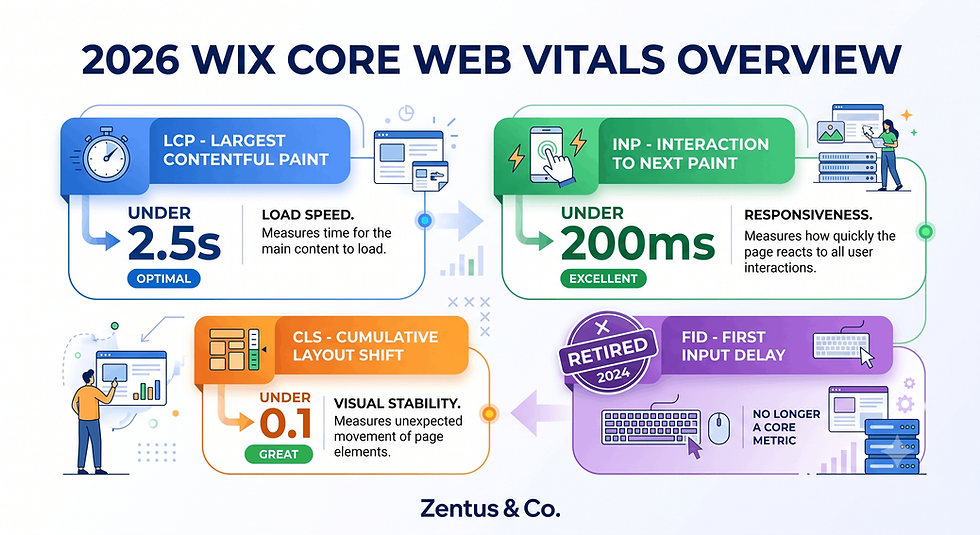
✅ Core Web Vitals pass (affects crawl frequency)
✅ FAQ section present on key service and blog pages
AI Search vs Traditional SEO: What Stays and What Changes
AI search doesn't replace traditional SEO — it adds a citation layer on top of it, which means most of your existing SEO foundation still matters.
What Stays the Same Between AI Search and Traditional SEO?
Crawlability, page speed, mobile-friendliness, and relevant keyword targeting still matter exactly as much as before, because an AI system still needs your page indexed and ranking reasonably well before it can even consider citing it. There is no shortcut that skips traditional SEO fundamentals — see our broader SEO for small business guide for the baseline.
Should You Optimise for Both?
Yes — you cannot optimise for AI citation instead of ranking; you optimise for citation on top of ranking. Treat traditional SEO as the entry ticket and entity clarity, schema, and answer-formatted content as the layer that determines whether you're quoted once you're in the room.
Ranking Signals vs Citation Signals
Factor | Drives Ranking | Drives AI Citation |
Page speed / Core Web Vitals | Yes | Indirect (affects crawl frequency) |
Keyword in title/H1 | Yes | Minor |
Backlinks | Yes | Indirect (trust signal) |
Organization/FAQPage schema | Minor | Strong |
Entity consistency (name, category, location) | Minor | Strong |
Direct-answer paragraph structure | Minor | Strong |
E-E-A-T signals | Yes | Strong |
FAQ content | Minor | Very strong |
The Time, Tools and Effort Cost of Becoming AI-Citable
Becoming AI-citation ready is mostly a content and configuration project, not a rebuild — which keeps the cost and time investment realistic for most small businesses.
How Much Time Does Becoming AI-Citable Take?
For a typical 8–12 page Wix site, expect 6–10 hours to audit entity consistency, add Organization and FAQPage schema, and rewrite key sections into direct-answer format. Larger sites with more service pages or blog content will take proportionally longer, since each page needs its own schema and answer-first rewrite.
What Tools and Costs Are Involved in AI-Citation Readiness?
Most of the work uses tools you already have inside Wix — the SEO settings panel handles schema and meta data at no extra cost. The main optional spend is on an AI-visibility tracking tool if you want to formally measure citations over time.
Cost/Time Comparison Table
Item | Price (checked July 2026) | What It Unlocks | Best For |
Wix Core plan | approx. $29–36/mo (range — verify current pricing) | Custom SEO tags, structured data fields, connected domain | Most small business AI-readiness setups |
Wix Business Unlimited | approx. $59–66/mo (range — verify current pricing) | Full app/API flexibility for advanced schema and booking data | Sites needing custom structured data feeds |
Manual schema setup (DIY via SEO panel) | $0 | Organization, FAQPage, BreadcrumbList schema | Owners with 6–10 hours to spare |
AI-visibility tracking tool (third-party) | approx. $0–99/mo (range — verify current pricing) | Tracks whether your brand appears in AI-generated answers | Businesses wanting to measure citation ROI |
Prices checked for July 2026. Always verify current Wix and tool pricing before you buy — platform pricing can change.
For a professionally handled setup, see our Wix Studio services and current website design pricing.

How to Measure Whether You're Getting Cited
Unlike traditional rankings, citation tracking is still an emerging discipline — but there are practical ways to check your visibility today.
How Do You Track AI Overview Citations?
Manually search your target queries in Google and note whether an AI Overview appears and whether your domain is listed as a source. This is slow but free, and it's the most reliable way to confirm citation for your specific priority queries right now.
What Tools Show If You're Being Cited?
Several third-party SEO platforms have begun adding AI Overview and AI-visibility tracking features that flag when your domain appears inside a generated answer. These tools are evolving quickly, so treat any single tool's citation count as directional rather than definitive.
How Do You Measure Citation ROI?
Track branded search increases, direct traffic changes, and referral clicks from AI-generated summaries where your analytics can detect them, alongside manual citation checks for your top 10–15 target queries. A rising trend across these signals over 8–12 weeks indicates your entity and schema work is paying off.
When Being Citable Matters More Than Being Rankable
Not every business needs to chase AI citation with equal urgency — for some, it's already where a meaningful share of attention is moving.
Which Businesses Benefit Most From Being Citable?
Businesses answering informational, comparison, or "how does X work" queries benefit most, because these are exactly the query types AI Overviews dominate. A local service business fielding mostly navigational searches ("[business name] near me") will see less immediate impact than an educational or advice-driven brand.
When Does Citation Beat Ranking?
Citation beats ranking when your audience searches for answers rather than storefronts — think comparison questions, "how to" queries, or definitional searches. In these cases, being the quoted source can outperform a page-1 ranking that never gets clicked because the AI Overview already satisfied the searcher.
How Does Citation Compound Over Time?
Once an AI system trusts your entity and schema data, it tends to keep pulling from the same reliable source for related future queries, compounding your visibility without additional link-building. This is different from traditional rankings, which can fluctuate independently for each keyword.
The Ranking-to-Citation Shift Most SEO Guides Haven't Noticed
Most published SEO advice is still written for a search results page that no longer looks the way it used to.
Why Are SEO Guides Still Blue-Link Focused?
Most SEO content was written and refined over a decade of Google results that were purely link-based, so the advice hasn't caught up to a results page where an AI summary sits above the links. Updating that advice requires rethinking content structure, not just keyword targeting — which most guides haven't done yet.
What Is the Risk of Ignoring AI Search?
The risk isn't losing your ranking — it's losing visibility even while ranking well, because your competitor's better-structured page gets quoted in the AI Overview above you. Over time, this can quietly erode click-through rate even on queries where your position hasn't moved.
How Does the Shift Change Content Strategy?
Content strategy now needs a dual objective: rank well enough to be considered, and be structured clearly enough to be extracted and trusted. That means writing direct answers first, adding schema consistently, and treating your FAQ sections as a citation asset rather than an afterthought.
Entity, Schema and Answer-Format Checks Before You Target AI Overviews
Before investing more time chasing AI Overview visibility, run these checks — most citation failures trace back to one of these three problems.
What Structured Data Errors Block AI Citation?
The most common error is schema that contradicts your visible content — for example, an old business name in your Organization schema while your homepage displays a new one. Validate your schema with a structured-data testing tool and confirm every field matches what's actually written on the page.
Which Content Formats Confuse AI Answer Extraction?
Long paragraphs that bury the answer after several sentences of context are the biggest culprit, along with headings phrased vaguely instead of as real questions. If an AI has to infer your point rather than read it directly, it will typically choose a clearer competing source.
How Do You Audit a Wix Site Before Targeting AI Overviews?
Check that your entity details match across every page, your FAQ and Organization schema are live, and your top 10 pages each lead with a one-sentence direct answer under their headings. This 15-minute audit catches the majority of issues before you invest further time in content rewrites.

Frequently Asked Questions About AI Overviews for Wix Websites
How do I get my Wix site cited in AI Overviews?
Start by fixing entity consistency (same business name, category, and location everywhere), adding Organization and FAQPage schema through Wix's SEO settings, and rewriting key sections so the direct answer appears in the first sentence. These three changes address the majority of what stops a well-ranking Wix page from ever being quoted.
Does structured data help get cited in AI search?
Yes — structured data confirms facts an AI would otherwise have to infer from your prose alone, which reduces the model's uncertainty about your business. Pages with accurate, matching schema are meaningfully more likely to be treated as trustworthy citation candidates than pages relying on text alone.
Can a Wix site appear in Google AI Overviews?
Yes, a Wix site can be cited in AI Overviews the same as any other platform, since citation depends on content structure, entity clarity, and schema — not the underlying website builder. Wix's built-in SEO settings panel supports the custom schema and meta data needed to compete for citation.
How is AI search different from regular SEO?
AI search adds a citation layer on top of traditional ranking — it summarises and quotes selected sources rather than only listing links. Traditional SEO factors like speed and relevance still apply, but entity clarity and answer-formatted content become additional requirements specific to being quoted.
Does AI search replace traditional rankings?
No — AI Overviews sit above traditional rankings, they don't replace them. Your page still needs to rank well enough to be considered as a source in the first place; AI citation is an additional layer of visibility, not a substitute for organic ranking.
What is LLM SEO and how is it different from traditional SEO?
LLM SEO refers to optimising content so large language models can accurately extract, understand, and cite it — focusing on entity clarity, schema, and answer-first writing rather than keyword density and backlinks alone. It shares the same technical foundation as traditional SEO but adds a layer focused on machine readability and trust.
How long does it take to get cited in an AI Overview?
Most sites see initial movement within 4–8 weeks of fixing entity consistency and adding schema, though full citation stability can take longer as AI systems re-crawl and re-evaluate sources. Consistent monitoring of your top target queries over 8–12 weeks gives a realistic read on progress.
How much does it cost to make a Wix site AI-citation ready?
For most small Wix sites, the core work is time, not money — schema and content rewrites can be done using Wix's built-in SEO settings at no extra plan cost. Optional AI-visibility tracking tools add a monthly cost if you want formal citation measurement rather than manual checks.
Do I need an FAQ page to get cited in AI Overviews?
An FAQ section significantly increases your citation odds because FAQPage schema packages your content into ready-made question-and-answer pairs that are easy for an AI to lift directly. It isn't strictly mandatory, but it's one of the highest-yield sections you can add for AI search visibility.
Will AI Overviews reduce website traffic to my Wix site?
For some informational queries, yes — users may get their answer directly from the AI Overview and not click through. However, being cited as a source can offset this by building brand visibility and driving referral clicks for users who want more detail than the summary provides.

Conclusion & Action Checklist
AI Overviews haven't replaced ranking — they've added a citation layer that rewards clarity over cleverness. A Wix site that fixes its entity consistency, adds Organization and FAQPage schema, and writes direct answers first has a real, achievable shot at being quoted, not just listed.
This week:
✅ Audit your business name, category, and location for consistency across every page
✅ Add Organization and FAQPage schema via Wix's SEO settings panel
✅ Rewrite your top 5 pages so each section leads with a one-sentence direct answer
✅ Run a structured-data validator to catch schema mismatches
✅ Manually check your top 10 target queries for AI Overview citations
If you'd rather have this audited and built by a Wix Studio team, explore our Wix Studio services or book a free consultation to get started.

Comments