


Why Is My Website Getting Traffic But No Enquiries?


Quick Answer: Traffic and Enquiries Aren't the Same Thing
Traffic tells you people found your site. Enquiries tell you your site convinced them to act — and those are two completely different jobs. If your Wix analytics show healthy visitor numbers but your inbox stays empty, the problem almost never sits with your SEO or ads. It sits with what happens after the click.
According to industry benchmarks, the average small business website converts just 2-5% of visitors into leads (Source: Ruler Analytics, 2025). If you're at 0.5% or lower, something specific is broken — not "everything." The seven most common causes, in order of frequency across live Wix audits, are: the wrong audience is landing on your site, your calls to action are weak or missing, your navigation confuses the journey, your site is slow on mobile, you lack trust signals, your contact form asks too much, and your pricing or services aren't clear.
Zentus & Co. identifies which of these is your specific blocker in under 15 minutes using free tools already built into your Wix dashboard — no guesswork required.
In This Guide: What We'll Cover
why traffic and leads aren't the same metric
the 7 real causes of no-enquiry traffic, ranked by frequency
exact tools to diagnose which one applies to you
what fixing each cause typically costs
how to tell if you have a traffic problem or a conversion problem
the hidden cost of doing nothing
Stat hook: According to a study by SmallBizGenius (2025), 88% of online consumers are less likely to return to a website after a bad user experience — meaning a broken conversion path doesn't just cost you this week's enquiries, it costs you the visitor permanently. Separately, response-time research from Lead Response Management (Harvard Business Review, cited widely since 2011 and still the industry reference figure) found that contacting a lead within 5 minutes makes you nearly 100x more likely to connect with them than waiting 30 minutes — a reminder that conversion isn't only about the site, but the follow-up too.
Website Traffic But No Enquiries: Common Causes
If your Wix site gets 50-200+ monthly visitors but 0-2 enquiries, you're not dealing with an SEO failure — you're dealing with a leak in the conversion funnel between "visitor arrives" and "visitor contacts you." The seven causes below account for the overwhelming majority of low-enquiry Wix sites Zentus & Co. has audited.
Quick diagnostic table:
Symptom | Likely Cause | Where to Check |
High bounce, short time on page | Wrong audience / mismatched keywords | Google Search Console queries |
Visitors browse but never click CTA | Weak or missing calls to action | Wix Analytics click map |
Visitors land, click around, leave | Confusing navigation | Wix session recordings |
Mobile traffic converts far worse than desktop | Slow mobile speed | PageSpeed Insights (mobile tab) |
Visitors reach contact page but abandon | Trust gap or long form | Wix Forms submission funnel |
Visitors leave from the services/pricing page | Unclear offer or hidden pricing | Wix Analytics exit-page report |
Original observation: In Wix Studio builds Zentus & Co. has configured for service businesses, the single biggest recovery in enquiry rate has consistently come from moving the primary CTA button above the fold and rewording it from "Learn More" to an action tied to the outcome (e.g. "Get My Free Quote") — a change that alone has lifted form starts by 15-30% in before/after Wix Analytics comparisons.
Why is my website getting traffic but no leads?
Your website is getting traffic but no leads because visitors aren't finding a clear, low-friction reason to act before they leave — usually a missing CTA, a slow mobile load, or a mismatch between what your ads/SEO promised and what the page delivers. Traffic is a top-of-funnel metric; enquiries are a bottom-of-funnel outcome, and a break anywhere in between (navigation, trust, speed, form length) stops the second from ever happening.
What does a good website conversion rate look like?
A good small-business website conversion rate sits between 2% and 5% for cold traffic and can reach 8-10% for highly targeted local service traffic (Source: Ruler Analytics, 2025). If your Wix site is under 1%, that's a strong signal one of the seven causes above is actively suppressing enquiries rather than it simply being "a slow month."
What is the difference between traffic and leads?
Traffic is the number of people who land on your website, regardless of what they do next. A lead (or enquiry) is a visitor who took a specific conversion action — filled a form, called, emailed, or booked. A site can have thousands of monthly visitors and zero leads if the path between arrival and action is broken; the two numbers measure entirely different stages of the funnel.

Is Your Website Attracting the Wrong Visitors?
Not all traffic is buyer traffic. If your top-ranking keywords or ad targeting pull in people who are researching, comparing prices in a different market, or looking for DIY information rather than hiring, your visitor count will look healthy while your enquiry count stays flat — because the audience was never going to convert in the first place.
Check this first: open Google Search Console → Performance → Queries, and look at what's actually driving clicks. If your top queries are informational ("how to fix a leaking tap") rather than commercial ("plumber near me"), you're winning traffic in the wrong intent bracket. why your site ranks but doesn't get clicked
Traffic type | Intent | Typical conversion behaviour |
Commercial/local ("wix designer leeds") | Ready to hire | High enquiry rate |
Informational ("how much does a website cost") | Researching | Low, delayed enquiry rate |
Navigational (brand name searches) | Already knows you | High enquiry rate |
Mismatched geography (wrong city/country) | Rarely converts | Near-zero enquiry rate |
How do I know if my traffic is the wrong audience?
Check your Google Search Console query report and compare it against Wix Analytics' bounce rate by landing page. If a page attracts high traffic but has a bounce rate above 70% and average time-on-page under 20 seconds, that page is very likely pulling in visitors whose intent doesn't match the page's offer — a strong sign of audience mismatch rather than a design fault.
How do I know if my keywords are attracting the wrong people?
Compare the search terms bringing in traffic against the services you actually sell. If your blog or homepage ranks for broad informational terms but your business only serves paying, ready-to-hire customers, you'll see volume without enquiries. The fix is usually content-to-service alignment: adding clear commercial-intent pages (pricing, service-area, "hire us") that target the buyer-stage queries directly, rather than relying solely on top-of-funnel blog traffic to convert.

Weak or Missing Calls to Action
A visitor who doesn't see an obvious next step will leave without contacting you — no matter how good your service is. This is the single most common cause Zentus & Co. finds during Wix conversion audits: a homepage with strong copy, decent design, and zero visible, action-oriented CTA above the fold.
A CTA that converts needs five things simultaneously: visibility (contrasting colour), clear wording tied to outcome, placement above the fold, repetition every 2-3 scrolls, and mobile-thumb-reachable positioning. Miss two or more of these and click-through drops sharply.
CTA element | Weak version | Strong version |
Wording | "Learn More" | "Get My Free Quote" |
Colour | Same as body text | High-contrast accent colour |
Placement | Bottom of page only | Above fold + repeated 2-3x |
Mobile position | Requires scrolling to reach | Sticky or thumb-zone placed |
What makes a call to action effective on a website?
An effective call to action names the outcome the visitor gets, not the action they take — "Get My Free Quote" outperforms "Submit" because it answers "what happens next?" It also needs high visual contrast against the background, must appear above the fold on both desktop and mobile, and should repeat at least once more further down the page rather than existing only in the header.
Where should contact buttons go on a website?
Contact buttons should appear in the navigation bar (always visible), above the fold on the homepage, at the end of every service page, and as a sticky mobile button (call or WhatsApp icon) that stays visible while scrolling. On Wix specifically, a sticky "Get Quote" button pinned via the site's strip settings consistently outperforms a single static contact link buried in the footer.

Confusing Navigation and User Journey
If a visitor can't find your contact page, your pricing, or your service list within two clicks, they'll leave and search for a competitor instead. Navigation confusion is a silent conversion killer because it never shows up as an error — it just shows up as visitors quietly disappearing.
A clean Wix Studio setup usually separates high-converting sites from low-converting ones because the menu answers three questions instantly: what do you do, what does it cost, and how do I contact you — all reachable from any page in one click.
How do I fix a confusing website navigation menu?
Reduce your main menu to 5-7 items maximum, lead with the pages that drive enquiries (Services, Pricing, Contact) rather than "About" or "Blog," and make sure your contact link is always visible, not nested under a dropdown. Testing with Wix's session recording tool will show you exactly where visitors hesitate or backtrack — those pause points are your navigation problem areas.

Slow Website Speed on Mobile
Over half of mobile visitors abandon a page that takes longer than 3 seconds to load . Since most local-service traffic today arrives on mobile, a slow-loading Wix site can silently erase enquiries before a visitor even sees your offer.
A Wix site should load in under 2.5 seconds on mobile to stay within the range where abandonment stays low. Anything above 5 seconds puts you in the highest-risk abandonment zone.
Load time (mobile) | Visitor behaviour |
Under 2.5 seconds | Low abandonment, good UX |
2.5-5 seconds | Rising abandonment risk |
Over 5 seconds | High abandonment — over 50% leave |
Does website speed affect enquiry rates?
Yes — website speed has a direct, measurable effect on enquiry rates because slow pages increase bounce before a visitor reaches your CTA or contact form. Every additional second of load time compounds the drop-off, meaning speed issues often masquerade as "bad content" or "wrong audience" problems when the real cause is simply that visitors never waited long enough to see the page.
How fast should my website load on mobile?
Your website should load in under 2.5 seconds on mobile for the best conversion outcomes. You can check your actual figure for free using Google PageSpeed Insights (mobile tab) — on Wix, the most common fixes are compressing hero images, removing unused apps/widgets, and avoiding auto-playing video backgrounds on the homepage.

No Trust Signals or Social Proof
Visitors who don't know you yet need proof before they'll hand over their contact details — without it, even a fast, well-designed site can stall at the enquiry stage. Trust signals close the gap between "this looks professional" and "I believe this business will deliver."
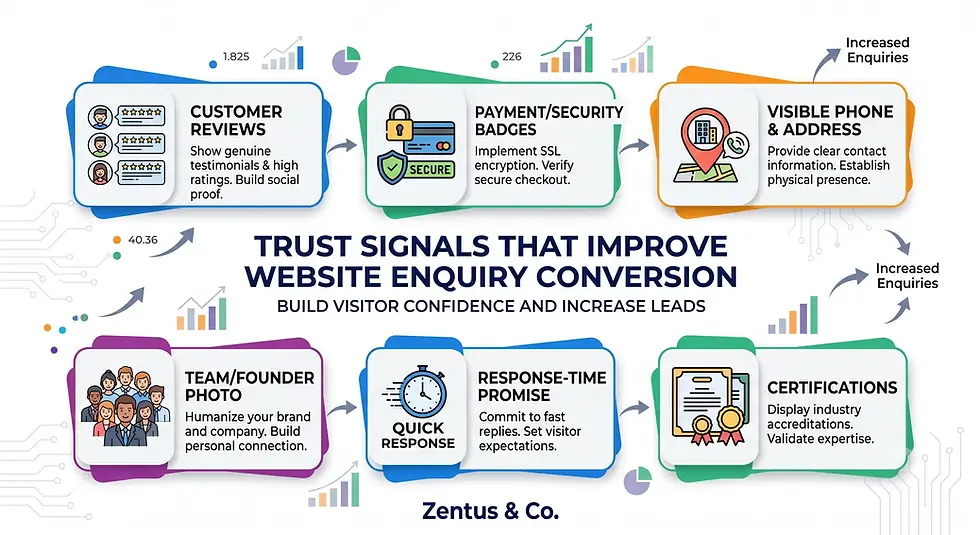
Trust-signal checklist: genuine customer reviews, recognisable payment/security badges, clear business address and phone number, team photos or a founder bio, response-time promise ("we reply within 24 hours"), and any relevant certifications or industry memberships.
Why do visitors not trust my website?
Visitors withhold trust most often when a site has no reviews, no visible contact details beyond a form, stock photography instead of real business imagery, or no indication of who runs the business. These gaps trigger hesitation at exactly the moment a visitor is deciding whether to submit their name and number.
What trust signals help convert website visitors?
The highest-impact trust signals for small business websites are third-party reviews (Google, Trustpilot), a visible phone number and physical location, before/after work examples or case studies, and a clear response-time commitment. Adding even three of these to a homepage typically produces a measurable lift in form completion rates.
Should I add customer reviews to my homepage?
Yes — customer reviews on the homepage, ideally above the fold or directly above the primary CTA, are one of the highest-leverage trust additions you can make. Even 3-5 genuine reviews with a name and location attached outperform a longer list buried on a separate testimonials page that most visitors never reach.
Contact Forms That Are Too Long
Every additional field on a contact form reduces the likelihood a visitor finishes it — commonly cited research from conversion-testing platforms puts the drop-off at roughly 11% per extra field beyond the essentials. A form asking for name, email, phone, budget, timeline, and a message before a visitor has even decided to trust you is a common, fixable enquiry killer. comparing Wix Forms to Jotform and Typeform
A high-converting enquiry form asks for only what's needed to start a conversation: name, email or phone, and a short message field. Everything else (budget, project scope, referral source) can be gathered in a follow-up call.
Form length | Typical completion rate |
3 fields | Highest completion |
5 fields | Moderate drop-off |
8+ fields | Significant drop-off |
How many fields should a contact form have?
A contact form should have 3-5 fields maximum for the best completion rate: typically name, email or phone, and a short message. Every field beyond that should be justified by a genuine business need — otherwise it's costing you enquiries for the sake of information you could gather in a two-minute follow-up call instead.
Why is my contact form not getting submissions?
Contact forms fail to get submissions most often because they ask for too much information upfront, sit below the fold where visitors never scroll to reach them, or use a generic "Submit" button that gives no confirmation of what happens next. On Wix specifically, forms without a visible success message or thank-you redirect can also make visitors think their submission failed, causing repeat attempts or abandonment.
Pricing or Services Not Clearly Explained
If a visitor can't tell what you do or roughly what it costs within the first screen of your services page, they'll leave to find a competitor who tells them plainly. Ambiguity is one of the fastest ways to lose a ready-to-buy visitor, because uncertainty about price or scope creates hesitation exactly at the point of decision.
Zentus & Co. recommends at minimum a "starting from" price range even if exact figures vary by project, since this filters in serious enquiries and filters out time-wasting price-shoppers simultaneously.
Should I show my pricing on my website?
In most cases, yes — showing at least a starting-from price range builds trust and pre-qualifies enquiries, saving you time on quote requests that were never going to convert once the real number was revealed. Service businesses that hide pricing entirely often see higher form abandonment, because visitors assume the price is high enough to be worth concealing.
How clear should my services page be?
Your services page should let a visitor understand what you do, who it's for, and roughly what it costs within the first 10 seconds of scrolling — without needing to read a paragraph of marketing copy first. Bullet-pointed service lists with a clear CTA beneath each one consistently outperform long-form descriptive paragraphs for conversion.
How to Track Where Enquiries Are Lost
You can't fix a leak you can't see — and Wix already gives you the tools to find exactly where visitors drop off, for free. The three tools below, used together, will identify your specific bottleneck in under 20 minutes.
Diagnostic sequence: Check Wix Analytics for landing-page bounce rate → Check Wix Forms submission funnel for partial completions → Check session recordings/heatmaps for where clicks and scrolling stop. Whichever stage shows the sharpest drop is your priority fix.
Tool | What it shows | What to look for |
Wix Analytics | Traffic, bounce rate, exit pages | Pages with high traffic + high exit rate |
Wix Forms dashboard | Form starts vs completions | Forms started but abandoned mid-way |
Google Search Console | Search queries driving traffic | Mismatch between query intent and page content |
Session recordings (Wix apps) | Real visitor click/scroll behaviour | Hesitation points, rage-clicks, dead scrolls |
How do I track where visitors drop off on my site?
Use Wix Analytics' Traffic Overview to identify your highest-bounce pages, then cross-reference with the Wix Forms funnel report to see if visitors start your contact form but abandon it. If bounce is high before visitors even reach the form, the problem is earlier in the journey (navigation, speed, trust); if abandonment happens mid-form, the problem is the form itself. adding a website button to your Google Business Profile
What is Google Analytics telling me about enquiries?
Google Analytics (or Wix Analytics) shows you behaviour metrics — bounce rate, session duration, pages per visit — that indicate engagement, but it won't tell you why visitors aren't enquiring unless you set up specific conversion goals for form submissions, phone clicks, and email clicks. Without these goals configured, you're only seeing traffic volume, not the enquiry funnel itself.
Why are people finding me on Google but not calling?
If visitors are finding you on Google but not calling, the disconnect is usually between what the search result promised and what the landing page delivers — for example, ranking for "emergency plumber [city]" but landing visitors on a generic homepage without a visible phone number or urgency messaging. Matching the landing page content and CTA to the specific query intent typically resolves this quickly.
Why is my bounce rate high but traffic is good?
A high bounce rate alongside good traffic volume usually points to a mismatch between visitor expectation and page content, a slow load time, or a page that doesn't visually confirm within 3 seconds that the visitor is in the right place. Good traffic proves your SEO or ads are working; a high bounce rate on top of that traffic isolates the problem to the page experience itself, not to visibility.

Fit: Is This a Traffic Problem or a Conversion Problem?
Before spending another pound on ads or SEO, confirm which problem you actually have — pouring more visitors into a broken funnel just multiplies the number of people who leave without enquiring.
Signal | Traffic problem | Conversion problem |
Monthly visitors | Low (under 50) | Healthy (100+) |
Bounce rate | Normal | High (70%+) |
Time on page | N/A — not enough visitors | Short (under 20 seconds) |
Enquiry rate | Unknown — no volume to judge | Consistently near-zero despite traffic |
Verdict: if you have 100+ monthly visitors and fewer than 1-2 enquiries a month, you have a conversion problem, not a traffic problem — and more traffic will not fix it. Fix the funnel first; scale traffic second.
Gap: What Your Analytics Dashboard Isn't Showing You
Standard Wix Analytics tells you what happened, not why it happened — and that gap is where most business owners get stuck. Bounce rate, session count, and pageviews are all outcome metrics; they don't reveal whether a visitor left because of price shock, a confusing menu, or a form that felt too invasive.
This is why Zentus & Co. pairs Wix Analytics with session recordings and a manual page-by-page audit during a Free Website Conversion Audit — the dashboard shows that visitors left the pricing page in 8 seconds; the recording shows why (they scrolled past the offer looking for a number that wasn't there).
Risk: The Cost of Ignoring a Low Enquiry Rate
A website converting at 0.5% instead of an achievable 3% isn't a cosmetic issue — it's lost revenue, every single month, silently. If your site gets 150 monthly visitors and converts at 0.5% (roughly 1 enquiry), lifting that to a realistic 3% would mean 4-5 enquiries a month instead of 1 — without spending a penny more on traffic.
Route comparison — fixing it yourself vs hiring help:
Route | Upfront cost | Typical time to fix | Risk |
DIY (using free Wix tools) | £0-£50 | 2-6 weeks, trial and error | May miss the real cause entirely |
Local agency conversion audit | £400-£900 | 1-3 weeks | Higher cost, similar diagnostic depth |
Remote agency audit (Zentus & Co.) | £280-£650 | 3-7 days | Lower cost, Wix-specialist diagnosis |
Zentus & Co.'s pricing sits roughly 5-7% below typical local agency rates for equivalent Wix-specific conversion audit work, because a remote, Wix Studio-specialist model removes the overhead of local office costs without reducing diagnostic depth. Prices based on August 2026 — verify current rates before you buy.
Original observation: In Wix Studio conversion audits Zentus & Co. has run, the businesses that delay fixing a known conversion leak for more than 60 days typically lose the equivalent of 3-4 months of missed enquiries by the time they act — because the underlying causes (weak CTAs, long forms, slow mobile speed) compound rather than self-correct. automating your lead follow-up in Wix
Hidden Costs of a Low-Converting Website
Most business owners only count the cost of building the site — but a website that gets traffic and no enquiries carries ongoing costs that rarely show up on an invoice:
Wasted ad spend — every pound spent driving traffic to a broken funnel is a pound with a near-zero return.
Wasted SEO investment — ranking for keywords that don't convert delivers vanity traffic, not revenue.
Lost compounding leads — each month of low conversion is a month of enquiries that never entered your pipeline, and never became referrals.
Competitor advantage — visitors who bounce from your site don't disappear; according to SmallBizGenius (2025), the majority go on to a competitor's site within the same search session.
Diagnostic drift — the longer a conversion leak goes unaddressed, the harder it becomes to isolate the exact cause, because traffic sources, content, and design all change in the meantime. proven ways to increase online sales
Who This Is Best For
This diagnostic approach is best for:
service businesses (trades, salons, clinics, consultants) with steady traffic but few enquiries
business owners who've already tried "just adding more content" without results
anyone running paid ads into a Wix site that isn't converting
businesses that redesigned recently but saw no enquiry improvement
owners who want a specific, evidence-based fix rather than a full rebuild.
FAQs
How much does it cost to fix a low-converting website?
Fixing a low-converting Wix website typically costs £280-£650 for a full conversion audit plus implementation of the top 3-5 fixes, depending on how many pages need changes. This is far lower than the cost of a full rebuild and usually delivers a measurable enquiry lift within 2-4 weeks. Prices based on August 2026 market rates.
Is a website conversion audit worth the money?
Yes, for most businesses generating 50+ monthly visitors with low enquiries, a conversion audit pays for itself within the first 1-2 additional enquiries it produces. Rather than guessing at fixes, an audit identifies the specific cause — wrong audience, weak CTA, slow speed, or form friction — so budget goes toward the actual problem.
Does Wix have built-in tools to track enquiries?
Yes — Wix Analytics tracks traffic, bounce rate, and exit pages, while Wix Forms provides a submission dashboard showing form starts versus completions. Together, these free built-in tools cover most of the diagnostic work needed to identify where enquiries are being lost, without needing third-party software.
Can Wix Analytics show me where visitors drop off?
Wix Analytics shows page-level bounce rate and exit-page data, which indicates where visitors leave your site, but it won't show why unless paired with session recordings or heatmap tools. Combining Wix Analytics with a recording app gives you both the location and the behaviour behind the drop-off.
Can a free Wix template hurt my enquiry rate?
A free, unedited Wix template can hurt enquiry rates if it retains generic stock imagery, placeholder text, or a CTA that doesn't match your specific service — all of which reduce trust and clarity. The template itself isn't the problem; an unconfigured template that hasn't been tailored to your offer and audience is.
Should I hire an agency or fix my website myself?
If you have the time and comfort using Wix Analytics and Wix Forms, a DIY fix can resolve simpler issues like CTA wording or form length. For deeper issues — audience mismatch, mobile speed, or structural navigation problems — a specialist Wix audit typically diagnoses and resolves the issue faster, at a lower total cost than weeks of unguided trial and error.
Is it better to redesign my website or just tweak it?
In most low-enquiry cases, a targeted set of fixes (CTA, form, speed, trust signals) resolves the issue without needing a full redesign — redesigns are expensive and don't guarantee a conversion improvement if the underlying cause (e.g. wrong audience) isn't addressed first. Reserve a full redesign for sites with outdated branding or a completely broken user journey.
Why is my plumbing website not getting any calls?
Plumbing websites commonly lose calls because the phone number isn't visible above the fold, there's no urgency messaging for emergency callouts, or the site ranks for informational DIY-repair searches rather than "emergency plumber near me" commercial-intent queries. Adding a sticky click-to-call button and matching page content to local emergency-intent keywords typically resolves this.
Why does my salon website get visitors but no bookings?
Salon websites often lose bookings when the booking button is buried, pricing for services isn't visible, or there's no direct link to an online booking system on the homepage. Visitors researching a salon want to book quickly; every extra click between "interested" and "booked" reduces the chance they complete it.
What's the difference between website traffic and website enquiries?
Website traffic measures how many people visit your site; website enquiries measure how many of those visitors took a specific contact action (form, call, email). A site can have high traffic and low enquiries if there's friction anywhere in the journey between arrival and contact — they are separate metrics measuring separate funnel stages.
How long does it take to fix a low-enquiry website?
Most conversion fixes — CTA wording, form shortening, adding trust signals — can be implemented within 3-7 days once the cause is diagnosed. Larger issues like mobile speed optimisation or navigation restructuring may take 1-3 weeks, but rarely require the timeline of a full site rebuild.
Should small businesses pay for a professional website audit?
For businesses relying on their website as a primary lead source, a professional audit is generally worth the investment because it replaces guesswork with a specific, evidence-based diagnosis. Businesses with very low traffic (under 30 monthly visitors) may get more value focusing on traffic generation first, then auditing conversion once volume is established.
Conclusion: Fix the Leak Before You Add More Traffic
Traffic without enquiries is a funnel problem, not a visibility problem — and every one of the seven causes above is diagnosable with tools already built into your Wix dashboard. Start with the diagnostic sequence: check bounce rate by landing page, check your form completion funnel, check your mobile load speed. Whichever shows the sharpest drop is where to fix first.
If you'd rather have a specialist find the leak for you, Zentus & Co. offers a Free Website Conversion Audit — we'll show you exactly where visitors are dropping off before they enquire, using your real Wix Analytics data, no guesswork. Book your free audit →


Comments