


What's the Best Way to Get Customer Testimonials?


Quick Answer
The fastest way to get customer testimonials is to ask at the right moment — right after a purchase, a completed project, or a "win" moment — using a short, specific request (email or text) that asks 3-5 guided questions instead of "can you write us a review?" Most businesses see a 15-25% response rate when they ask within 48 hours of a positive interaction, versus under 5% when they ask weeks later or leave it to chance.
The three fastest collection methods, ranked by speed:
Direct email/SMS request with a template — same-day setup, free
Testimonial collection software (Testimonial.to, Shapo, Endorsal) — $0-$99/month, automates the ask
Google Review funnel — free, reuses reviews you already have as website testimonials
In this guide:
how to ask without sounding awkward
the exact email scripts that get replies
where to place testimonials for maximum conversion
video vs written testimonials
legal rules around incentives and fake reviews
and how to set up a testimonials widget in Wix in under 10 minutes.
According to BrightLocal's Local Consumer Review Survey (2024), 98% of consumers read online reviews for local businesses, and 72% say positive testimonials increase their trust in a business before they buy. Separately, testimonials placed near a call-to-action button have been shown to lift conversion rates by as much as 34% in controlled landing-page tests (VWO Testing Data, 2023). Zentus & Co. treats testimonial collection as a conversion feature, not a decoration — it belongs in the build plan from day one, not bolted on after launch.
How to Ask Customers for Testimonials
The single biggest reason businesses don't have testimonials isn't that customers refuse — it's that nobody asked. Studies on referral and review behaviour consistently show that most satisfied customers are happy to help if the ask is easy, specific, and timed well. The goal is to remove friction: don't ask someone to "write something nice," ask them to answer 3-4 short questions you can turn into a testimonial yourself.
What questions should I ask for a testimonial?
Ask four guided questions instead of one open-ended request: (1) What problem were you trying to solve before you found us? (2) What almost stopped you from choosing us? (3) What result or change have you noticed since? (4) What would you tell someone considering us? This structure produces a usable, specific quote even from customers who claim they're "not good at writing," because you're doing the writing — they're just answering questions.
How do I ask a client for a testimonial without being awkward?
Frame it as a favour that helps other people, not a favour for you: "Would you be willing to share a couple of sentences about your experience so other [salon owners/homeowners/clients] know what to expect?" This reframing works because it shifts the ask from self-promotion to helping a peer decide — most people say yes to that framing far more readily than to "please review us."
What should I do if a customer refuses to give a testimonial?
Thank them and move on without pressure — a declined ask costs nothing, but a pushy follow-up can damage the relationship. Some customers are private, some are simply busy; neither reflects on your service. Rotate to your next satisfied customer instead of re-asking the same person twice, and note privately (not publicly) that a second, lighter-touch ask in a few months is fine.

Best Testimonial Request Email Templates
Below are two ready-to-use templates: one for service businesses and one for product/e-commerce. Both follow the same structure: thank you → specific ask → guided questions → low-friction close.
Service business template:
Subject: Quick favour, [Name]?Hi [Name], thanks again for choosing us for [service]. If you have two minutes, would you share a short testimonial? Just answer whichever of these feel relevant: What made you choose us? What result have you seen? Would you recommend us, and why? Reply to this email or record a 30-second voice note — either works.
Product/e-commerce template:
Subject: How's [product] working out?Hi [Name], it's been [X] weeks since your [product] arrived. We'd love a short review — even two sentences helps other shoppers decide. Click here to leave one in under a minute: [link].
What's the best length for a written testimonial?
The sweet spot is 2-4 sentences (roughly 40-80 words) — long enough to include a specific detail (a number, a result, a before/after) but short enough that visitors actually read it. Testimonials longer than 100 words see lower read-through on mobile, where most traffic now lands; if a customer sends a long response, edit it down to the strongest sentence or two and offer to link the full version elsewhere.

Where to Display Testimonials on Website
Placement matters almost as much as the testimonial itself. Testimonials work best positioned near a decision point — right before or after a pricing table, a booking button, or a checkout step — rather than isolated on a standalone "Testimonials" page nobody visits. proven ways to increase online sales
Placement | Conversion Impact | Best For |
Homepage, above the fold | High — first trust signal | Service businesses, agencies |
Directly above pricing table | Highest — removes last-minute doubt | SaaS, courses, memberships |
Product page, near "Add to Cart" | High | E-commerce |
Dedicated testimonials page | Low on its own — pair with homepage snippets | Backup/reference, not primary |
Footer | Low | Supplementary trust badge only |
How many testimonials should a website have?
3-6 strong testimonials per key page performs better than a long, unfiltered list — quality and specificity beat volume. A dedicated testimonials or "reviews" page can hold 10-20+ for visitors who want deeper proof, but the homepage and product pages should feature only the sharpest, most relevant examples.
How many testimonials are too many on one page?
More than 6-8 testimonials stacked on a single page starts to reduce impact — visitors skim rather than read, and the page feels padded rather than credible. If you have more good testimonials than that, rotate them in a carousel or split them across relevant pages (service-specific testimonials on service pages, general trust ones on the homepage).
Should testimonials appear on every page or just one?
Testimonials should appear on every page with a decision point — homepage, pricing, service/product pages, and checkout — but not necessarily the same testimonials each time. Match the testimonial to the page's intent: a pricing-page testimonial should mention value or ROI; a service-page testimonial should mention that specific service.
Where should testimonials go on a homepage?
The strongest position is directly below the hero section, before visitors scroll into features or pricing — this is where trust needs to be established before you ask for anything. A second testimonial (often video) works well just above the final call-to-action near the bottom of the page, reinforcing the decision right before the click.
How do I display testimonials on a mobile website?
On mobile, use a single-card carousel (one testimonial visible at a time, swipeable) rather than a grid — grids force pinch-zooming and get skipped. Keep photos/avatars small (40-60px), keep text under 3 lines before a "read more" toggle, and make sure star ratings and names remain legible without zooming.

Video Testimonials vs Written Reviews
Factor | Video Testimonials | Written Testimonials |
Perceived authenticity | Higher — harder to fake | Moderate — easy to fabricate, needs proof |
Setup effort | Higher — filming, editing, hosting | Low — email or form response |
Conversion impact | Often 20-30% higher engagement (Wyzowl, 2024) | Solid baseline, especially in text-heavy niches |
Best for | High-ticket services, coaching, home services | E-commerce, SaaS, fast-scan pages |
Response rate from customers | Lower — video feels like more effort | Higher — quicker to give |
Do video testimonials convert better than text?
Video testimonials tend to convert better for high-consideration purchases — home renovations, coaching, high-ticket services — where seeing a real person builds trust faster than reading text. According to Wyzowl's State of Video Marketing (2024), 79% of people say they've been convinced to buy a product or service after watching a brand's video, though written testimonials still perform strongly for quick-scan, lower-cost purchases where speed matters more than depth.
Can I use star ratings without written reviews?
Yes, star ratings alone still lift conversion — a visible 4.8/5 average builds quick trust — but pairing stars with even one or two written lines performs meaningfully better than stars alone, because the written detail answers the "why" a bare number can't.

How to Get Customer Testimonials Fast
If you need testimonials quickly (new site launch, new service line), combine three tactics at once: (1) email your last 10-20 happy customers with the guided-question template above, (2) screenshot and repurpose existing 5-star Google or Facebook reviews with permission, and (3) use a free testimonial collection tool to remove friction from the ask.
Testimonial collection tools — cost at a glance (August 2026):
Tool | Monthly Cost | What It Unlocks | Best For |
Manual email/form (DIY) | Free | Basic collection, no automation | Startups, first 10 testimonials |
Shapo | Free–$19/mo | Widgets, video + text collection | Small businesses |
$29–$99/mo | Video testimonials, auto-embed | Service businesses, coaches | |
Endorsal | $29–$79/mo | Automated request sequences | Agencies managing many clients |
Boast | $150+/mo | Video + survey + CRM integration | Larger teams, enterprise |
Prices based on August 2026 — verify current vendor pricing before you buy.
What is the best software for collecting testimonials?
For most small businesses, Shapo or Testimonial.to offer the best balance of cost and features — both let customers submit a written or short video testimonial via a simple link, with a widget you can embed directly into a Wix page. Agencies managing testimonials for multiple clients tend to prefer Endorsal, since it automates the follow-up sequence across many customers at once.

Testimonial Request Timing Best Practices
Timing determines response rate more than almost any other variable. The goal is to ask while the positive experience is still fresh, but after the customer has had enough time to actually experience the result.
Business Type | Best Time to Ask |
Service completed in one visit (salon, cleaning) | Same day or next day |
Product delivery (e-commerce) | 7-14 days after delivery |
Multi-week project (renovation, web design) | Within 3-5 days of project sign-off |
Subscription/SaaS | After first "success moment" (e.g., 30 days in) |
B2B/consulting | At contract renewal or project milestone |
How soon after a purchase should I ask for a testimonial?
For most service businesses, the best window is 24-72 hours after the service is delivered — the experience is fresh, but the customer has had time to notice the result. For physical products, wait 7-14 days so the customer has actually used the item rather than just unboxed it, which produces a more specific, credible testimonial.
How do I follow up if a customer forgets to send a testimonial?
Send one polite follow-up after 5-7 days, then stop — a second reminder rarely changes the outcome and risks feeling like pressure. Frame the follow-up as a simple bump: "Just floating this back to the top of your inbox in case it got buried — no worries if you're not able to." One follow-up is standard practice; more than that reduces goodwill.
Using Google Reviews as Testimonials
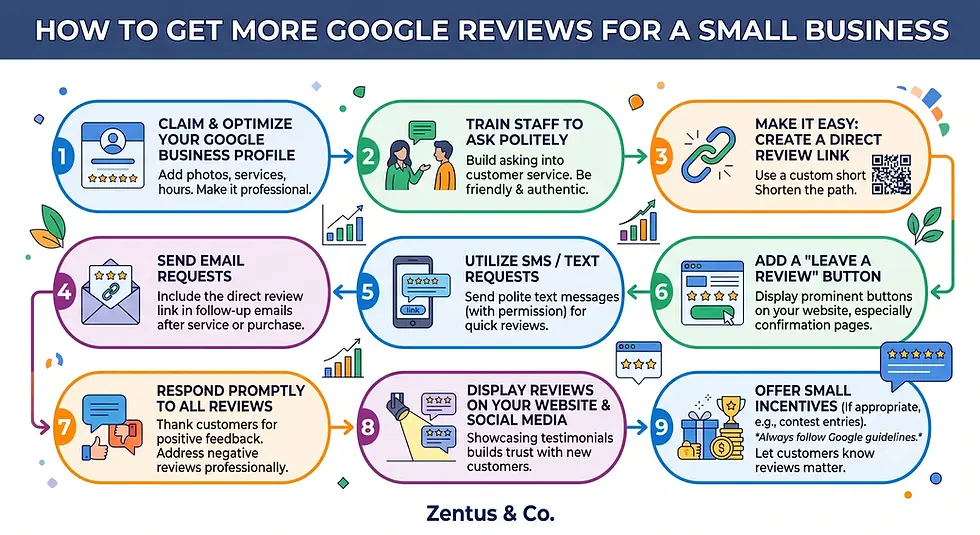
Google reviews are often the fastest source of testimonials you already have — no new outreach required. With the reviewer's permission (or where your business terms allow republishing public reviews), you can convert them directly into on-site testimonials.
Can I use social media comments as testimonials?
Yes — a genuine, positive comment from Facebook, Instagram, or LinkedIn can be used as a testimonial, provided you credit the platform and the person's name (or initials, with permission) rather than presenting it as if it were submitted directly to you. Always screenshot the original comment for your records in case of a dispute.
How do I turn a Google review into a website testimonial?
Screenshot the review (showing the star rating and reviewer name), or copy the text and pair it with a small "as seen on Google" badge and a link to your Google Business Profile. This dual-sourcing — visible on-site plus verifiable off-site — is one of the most trusted formats because visitors can click through and confirm it's real.
Can I use LinkedIn recommendations as testimonials?
Yes, particularly for B2B and professional services — LinkedIn recommendations are already public, attributed to a real, searchable profile, and carry strong credibility because a reader can click through to verify the person's job title and employer.
Wix Testimonials Widget Setup Guide
In a Wix Studio build, the fastest route to a working testimonials section is the native Testimonials app (available in the Wix App Market) combined with the built-in Wix Reviews element, which can also pull in Google reviews via a connected app.
Setup steps:
Open the Wix Editor and go to Add Elements → Apps.
Search "Testimonials" and add the native Wix Testimonials widget to your page.
Choose a layout (slider, grid, or single-card) that matches your page's design.
Connect it to a CMS collection if you want to manage testimonials as structured data (name, quote, photo, rating) rather than static text.
For Google Reviews specifically, install a third-party review-sync app from the Wix App Market and map it to the same collection.
Publish and test on both desktop and mobile views — carousel widgets often need spacing adjustments on smaller screens.
How do I add a testimonial widget to my Wix site?
From the Wix Editor, click Add Elements, search "Testimonials," and drag the widget onto your page — Wix's native app includes pre-built layouts you can populate manually or connect to a CMS collection for easier bulk editing. Most businesses have a working widget live within 10-15 minutes.
What tools integrate testimonials with Wix automatically?
Shapo, Trustmary, and EmbedSocial all offer Wix-compatible embed codes that sync testimonials collected off-platform (via email or their own forms) directly into a Wix page, updating automatically as new testimonials come in — avoiding manual copy-paste each time.

Incentivizing Customers for Reviews Legally
Offering something in exchange for a testimonial is legal in most markets only if the incentive is disclosed and isn't conditional on a positive review specifically — paying for positive reviews only, or hiding the incentive, breaches FTC rules in the US and equivalent consumer-protection rules in the UK/EU.
Is it legal to pay customers for testimonials?
Yes, but only within limits: you can offer a small incentive (discount code, entry into a prize draw) for leaving a review, but you cannot make the incentive conditional on the review being positive, and you must disclose the incentive clearly wherever the testimonial appears. The FTC's updated Endorsement Guides (2023) carry penalties of up to $50,120 per violation for undisclosed paid endorsements.
Should I offer a discount in exchange for a testimonial?
A discount for honest feedback, regardless of rating, is generally acceptable and common practice, but a discount explicitly for a 5-star review crosses into incentivized-bias territory and risks violating advertising standards. The safer approach: "Thanks for your feedback — here's 10% off your next order" applied to anyone who leaves a review, positive or not.
Testimonial Consent and Legal Requirements
Before publishing any testimonial, get explicit written permission — an email reply saying "yes, you can use that" is sufficient in most jurisdictions, but a signed release form is safer for video testimonials or ones featuring a full name and photo.
Should testimonials include full names and photos?
Full names and photos increase perceived credibility significantly compared to "Anonymous" or first-name-only quotes, but always get explicit consent before publishing either — a quick reply confirming "yes, feel free to use my name and photo" is enough documentation for most small businesses.
How do I get permission to use a customer's testimonial?
A simple reply-confirmation is usually sufficient: "Would it be okay to feature this on our website with your first name?" — save that email as your consent record. For video testimonials or B2B case studies, use a short written release covering how and where the content will be used.
Can I edit a customer's testimonial for grammar?
Yes — light editing for grammar, spelling, and length is standard practice and doesn't require re-consent, but you should never alter the meaning, sentiment, or specific claims in a testimonial without the customer's approval, since that crosses from editing into fabrication.
Which Businesses Need Testimonials Most
Testimonials matter most wherever a purchase involves trust, risk, or a high price point — the customer needs proof that someone like them had a good outcome before they'll commit.
Should testimonials be industry-specific or general?
Industry-specific testimonials convert better than generic ones because visitors relate to someone in their own situation — a salon owner reads a testimonial from another salon owner more attentively than a generic "great service!" quote. Where possible, tag testimonials by industry or use case so you can match them to the relevant page.
What's the best way to ask B2B clients for testimonials?
For B2B clients, frame the ask around results and ROI rather than general satisfaction — ask specifically "what measurable outcome did this project deliver?" B2B testimonials carry more weight when they include a job title, company name, and a specific metric (time saved, revenue increase, efficiency gain), since these are the details a buying committee actually checks.
What's the difference between a testimonial and a case study?
A testimonial is a short, quoted endorsement (2-4 sentences) focused on sentiment and trust, while a case study is a longer narrative (300-1,000+ words) documenting the specific problem, process, and measurable result. Testimonials work as quick trust signals throughout a site; case studies work as deeper proof for high-value or B2B decisions.
What Most Testimonial Pages Get Wrong
The most common mistake is treating testimonials as decoration rather than a conversion tool — vague quotes ("Great service, highly recommend!"), no photos or names, and testimonials buried on a page nobody visits. The second most common mistake is overloading a single page with dozens of unfiltered testimonials, which dilutes impact rather than building it. the essential pages every small business website needs
Fake Testimonials and FTC Compliance Risks
Fabricated or exaggerated testimonials carry real legal exposure. In the US, the FTC's 2023 update to its Endorsement Guides explicitly bans fake reviews, undisclosed material connections, and testimonials that don't reflect a real customer's genuine experience — with penalties reaching over $50,000 per violation. The UK's CMA and Advertising Standards Authority enforce similar rules against misleading endorsements.
How do I verify a testimonial is genuine?
Only publish testimonials you can trace to a real transaction — cross-check the name against your customer or booking records, and keep the original email, form submission, or screenshot on file. If a testimonial arrives via a third-party review platform (Google, Trustpilot), the platform itself provides the verification trail.
Decision check — is this testimonial FTC-compliant?
Did a real customer say this, unedited in meaning? → Required
Is any incentive for leaving it disclosed on the page? → Required if incentivized
Can you produce the original source if challenged? → Required
Does it avoid implying a typical result if it's an outlier? → Required
If any answer is "no," don't publish it — the fix is usually quick (add a disclosure line, get written consent), but publishing first and fixing later invites regulatory and reputational risk. SEO fundamentals for small business websites

DIY vs Testimonial Software vs Full Website Setup
Businesses collecting testimonials generally choose between three routes — doing it manually, using dedicated software, or having testimonials built into a professionally designed website from the start. Each has a different cost and time profile.
Route | Setup Cost | Annual Cost | 3-Year Total | Best For |
DIY (manual email + copy-paste) | $0 | $0 | $0 | Startups, first 10-20 testimonials |
Testimonial software (Shapo/Testimonial.to) | $0-$50 setup | $348-$1,188 | $1,044-$3,564 | Growing businesses needing automation |
Built into a professional Wix Studio site (Zentus & Co.) | One-time build cost | $0-$228 (widget only) | Lower long-term — no recurring software fee | Businesses wanting testimonials integrated with design and SEO from day one |
Zentus & Co. builds testimonial collection directly into the Wix Studio site structure — CMS-driven widgets, Google Review sync, and placement strategy — during the initial build, which typically removes the need for a separate paid testimonial tool entirely, saving the $350-$1,200/year a standalone subscription would cost.
Hidden Costs of Testimonial Collection
Most guides don't mention what testimonial collection actually costs beyond the software price tag:
Time cost — writing personalised requests, following up, and formatting quotes takes 2-4 hours/month for an active collection process
Design/dev time — a testimonial widget that matches your site's design (not a generic plugin look) often needs custom styling
Legal review — consent forms and disclosure language for incentivized reviews may need a one-time legal check
Video editing — raw video testimonials usually need trimming, captions, and branding before publishing (2-4 additional apps or a freelance editor)
Ongoing moderation — as testimonials age, outdated ones (old pricing, discontinued products) need periodic review and refresh
Who This Is Best For
This testimonial-collection approach is best for: service businesses (salons, clinics, contractors) needing quick social proof for local search decisions · e-commerce brands wanting to lift product-page conversion without redesigning the whole site · B2B and consulting firms that need fewer but higher-authority testimonials tied to measurable results · and agencies or freelancers building trust with a small but growing client base before case studies exist.
FAQ
How much does it cost to collect customer testimonials?
Collecting testimonials manually via email costs $0 beyond your time. Dedicated software ranges from $0-$19/month (Shapo's free/entry tier) up to $150+/month (Boast, for enterprise teams). Most small businesses can run an effective testimonial program for under $30/month or entirely free using manual requests and Google review republishing.
Is testimonial collection software free or paid?
Both options exist — Shapo offers a free tier, and manual collection via email/forms costs nothing, but paid tools ($29-$99/month) add automation, video collection, and auto-embedding widgets that save significant admin time as your customer base grows.
Does Wix have a built-in testimonial feature?
Yes — Wix includes a native Testimonials app in its App Market, with slider, grid, and card layouts you can add directly through the editor, plus CMS collection support for managing testimonials as structured, reusable data.
How do I add customer reviews to a Wix website for free?
Use Wix's native Testimonials widget (free, built into the platform) combined with a free-tier third-party app like Shapo to sync existing Google reviews — this combination requires no paid subscription for most small business needs.
Should I use written testimonials or video testimonials?
Use both where possible — written testimonials are faster to collect and scan, while video testimonials convert better for high-ticket, trust-sensitive services. If you can only manage one, prioritise video for services over $500 and written testimonials for lower-cost or e-commerce purchases.
Are customer testimonials worth the effort for a small business?
Yes — with 72% of consumers saying testimonials increase trust before purchase (BrightLocal, 2024), even 3-5 well-placed testimonials can measurably lift conversion on a homepage or pricing page, making the modest time investment one of the highest-return additions to a small business website.
How do salons collect customer testimonials effectively?
Salons see the highest response rates asking same-day, in person or via SMS, right after a service — a quick text with a review link while the client is still happy with their result outperforms email requests sent days later.
Do law firms need client testimonials on their website?
Yes, though most jurisdictions' bar association advertising rules require careful wording — avoid guaranteeing outcomes and stick to describing the client's experience with the process, not promised results, to stay compliant while still building trust.
What is a customer testimonial?
A customer testimonial is a short, first-person statement from a real customer describing their experience with a product or service, typically used on a website to build trust with prospective buyers before they purchase.
Why are testimonials important for a website?
Testimonials reduce perceived purchase risk by showing prospective customers that someone like them already had a good outcome — they function as social proof at exactly the moment a visitor is deciding whether to trust a business enough to buy.
How genuine do testimonials need to be to stay FTC-compliant?
Every testimonial published must reflect a real customer's actual, unedited-in-meaning experience — the FTC's 2023 Endorsement Guide update treats fabricated or heavily embellished testimonials as deceptive advertising, carrying penalties of up to $50,120 per violation.
Can a testimonial be used without the customer's name at all?
Yes, but anonymous or "Verified Customer" testimonials carry less persuasive weight than named ones — use them only when a customer explicitly declines to be named, and pair them with a rating or verifiable badge (like a Google Reviews link) to preserve some credibility.
Conclusion
Getting real customer testimonials isn't about luck or a naturally chatty customer base — it's a repeatable process: ask at the right moment, use guided questions instead of open-ended requests, place the results where buyers are deciding, and stay disclosure-compliant with any incentive. Businesses that build this into a structured, ongoing habit — rather than a one-off scramble before launch — end up with a steady stream of specific, credible proof that does real conversion work on the page.
If your current testimonial section is thin, generic, or buried where nobody scrolls, Zentus & Co. offers a free teardown of your existing setup — where your testimonials are placed, whether they're pulling their weight, and what a Wix Studio rebuild could add. Get your free testimonial teardown →
Comments